

Why Do Ships Measure Speed In Knots?
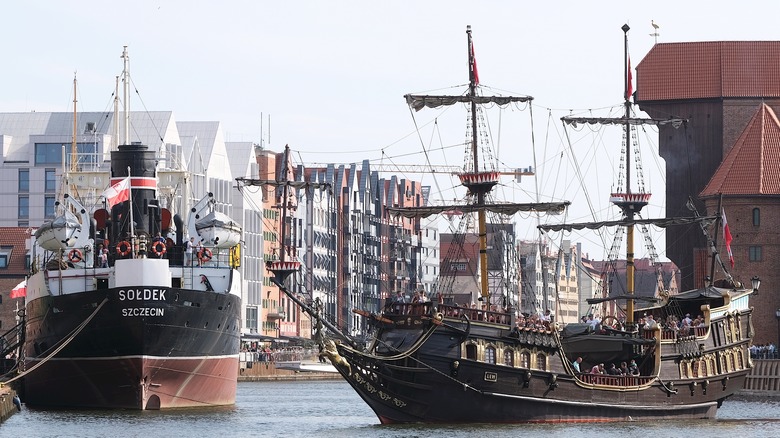
Imagine living sometime around the early 1600s. You're standing on the deck of a wooden ship. The wind's biting, the sky's endless. And your captain's yelling, "Drop the log!" Back then, before sonar and satellites (which can even provide internet to the rural U.S.), sailors figured out how fast they were moving using a rope, a plank, and some knots. Seriously.
Around 1500, a Portuguese navigator Bartolomeu Crescêncio was the first to think this out. He tested floating objects to measure his pace. The English then tried the "log-and-line" around 1574, as documented by William Bourne in his publication, "A Regiment for the Sea." Decades later, Dutch sailors used what they called a chip log: a piece of wood attached to a spool of rope knotted at regular intervals. The method is also known as the Dutchman's log. The crew would toss the log overboard and let it trail behind the ship.
Then came the fun part: counting how many knots slid through their hands in a set time using an hourglass (sorry, no Casios back then). More knots slipping through? Faster ship. Fewer knots? You're slow (or becalmed). The term stuck, turning into "knots" as the universal measurement of nautical speed, not distance.
It wasn't elegant, but it worked. A knot, defined as one nautical mile per hour (1 nautical mile is equals to 1.1508 land miles, so it's a little longer), came to represent the union between distance and time across open water. What started as a plank of wood dragging behind a ship became the metric that guided empires, wars, and trade routes across centuries.
From knotted ropes to satellites that know everything

Fast-forward a few hundred years, and we're still obsessed with knowing exactly how fast we're moving. Sailors no longer need to toss wooden boards off the stern to figure out how fast they're going. They once trusted sand and string; today's skippers get their speed down in precision, thanks to global positioning systems (GPS), ultrasonic sensors, and Doppler radar.
But oddly enough, nautical navigation still depends heavily on knots to monitor vessel and ship speed, adjust course path, and comply with the rules and regulations of the sea. Even modern enormous yachts and the biggest cruise ships or cargo ships stick with knots — a reminder that no matter how digital we get, seafaring still respects its ancient roots. Aviation also relies greatly on knots for flight planning and implementation.
Knots are woven into maritime DNA. The beauty of the old system is how surprisingly clever it was. Today, we've replaced intuition with software and advanced apparatus, but there's something undeniably charming about a measurement that relied on skill instead of signal strength. Nautical miles per hours is quiet a mouthful, too, so "knots" is much a better choice of word.
So the next time your GPS drops out, don't panic. Remember this: the old sailors (maybe even some pirates) managed just fine with a few knots of rope, and a lot more patience and counting.