

Yes, You Can Jump Start A Car Without Cables, But Here Are The Risks

It's entirely possible to jump-start a car without using jumper cables, and it's what car enthusiasts commonly refer to as push-starting or bump-starting. However, not all cars are suitable candidates for push-starting. You cannot push-start vehicles with automatic or semi-automatic transmissions (with the exception of a small handful of antique vehicles), and the same generally applies to cars with automatic stop-start technology and electronic parking brakes.
In addition, some vehicles that require stepping on the clutch and/or brake pedals when starting the engine should not be push-started when the battery goes flat. The same applies to some vehicles with timing chains. Forcibly jump-starting a car that wasn't suited for the job could cause serious engine or component damage. As mentioned, push-starting is for manual cars only, and we're mostly talking about older manual cars without fuel-saving start-stop technology or electric parking brakes.
That leads us to the main issue at hand: Why would you have to push-start the vehicle? Is it due to a dead battery after accidentally leaving the headlights on, or has the starter motor given up the ghost? Apparently, those are the only reasons why your car may be suitable for push-starting. If your engine turns over but refuses to keep going, push-starting it is unlikely to solve the problem, and it could lead to bigger (and costlier) issues later on. Moreover, think twice about push-starting a manual car with alternator issues, since your vehicle won't get very far before the engine dies again, leaving you back at square one. Finally, if you drive a newer vehicle with electronic fuel injection, push-starting may not work if the battery doesn't have enough juice to send fuel to the engine.
The bigger risks of push-starting
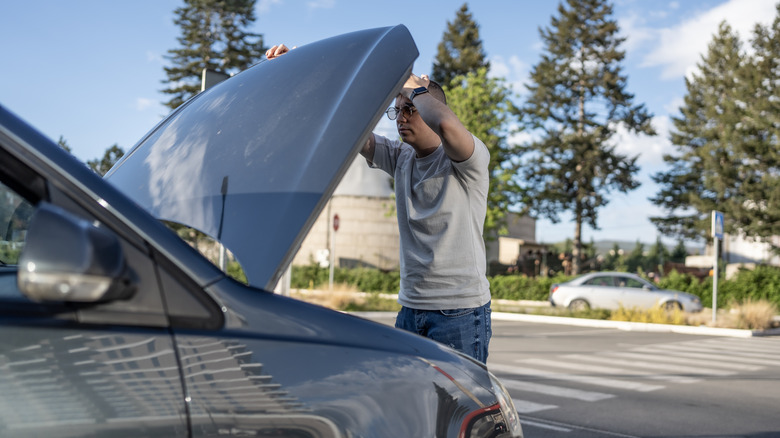
Push-starting a car sounds easy enough, but driver competence and the need for a friend or two to actually push the vehicle from behind are the basics of bump-starting. If you're a new manual driver (congratulations!), if you're alone when the battery dies, if your car is on an unpaved or dirt road, if you're on the shoulder of a busy highway, or if the weather is dicey, it's probably safer to call for help or use a portable jump starter (which we'll get to later). Why? Because we said so.
Kidding aside, a lot could go wrong if you insist on push-starting. You're putting other people and drivers at risk if you push-start on a busy road, and you could lose control of the vehicle when on a slope, which may lead to a collision with other cars, pedestrians, street signs, you name it. If the engine doesn't turn, the power brake booster won't have the vacuum to help you stop on a dime, and the loss of power steering assistance can make the wheel as stiff as a drill sergeant. Good Samaritans are few and far between (we know you exist), which could be an issue if you don't have an able body to push a rather heavy car.
Above all else, it takes experience to master awakening the engine with a push-start, because the skillset of timing the clutch release, pumping the gas, and regaining control of the vehicle after the motor starts requires practice, steady hands, and some mileage under your belt.
How to push-start a manual car
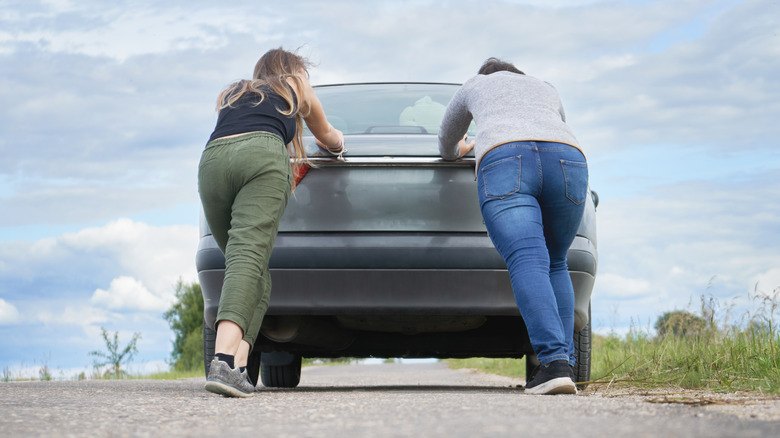
Despite the risks, push-starting a car is not that difficult. Get in the driver's seat, turn the ignition on, step on the brake pedal, press and hold the clutch, engage second gear, release the parking brake, and tell your friend to start pushing. Once the vehicle reaches 4 to 5 mph, release the clutch. If the engine starts, put the gear in neutral and step on the brake to stop the car with the engine idling. If it doesn't, try again at a faster speed. If the engine still refuses to turn, call for help since the problem is unlikely to be a dead or discharged battery – although, as mentioned, a dead battery could still be the culprit, especially if you drive a newer vehicle with electronic fuel injection.
That's why having a portable jump starter locked and loaded in the trunk is worth the extra investment. You can use it even when you're alone, and there's a lesser risk to life, limbs, and private property, too. Most of all, battery booster packs can be used by anyone, and they're generally easier to use than a set of tangled jumper cables.