

Subaru's Symmetrical AWD Is More Than Just Branding – Here's How It Works
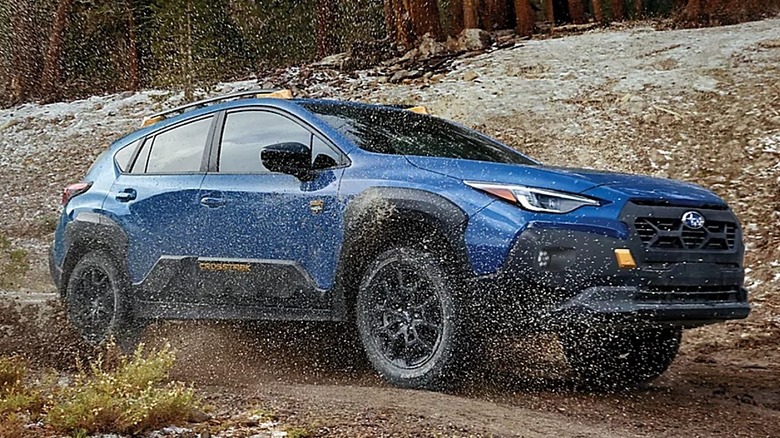
It's challenging to picture an Outback, Forester, or Crosstrek without immediately conjuring images of these vehicles handling rugged terrain or plowing through snow with ease. The reason is that Japanese automaker Subaru has made an effort to market its models with all-wheel drive (AWD). In fact, we got a hold of a 2025 Subaru Crosstrek with Symmetrical AWD and X-Mode, finding it a great budget option for those who appreciate functionality over flashy extras.
While it can be difficult to sift through all the marketing jargon thrown around by various companies eager to scoop up your money, Subaru's AWD system is worthy of attention. The automaker actually has several AWD configurations, but the most common will be the Active Torque Split (ATS) system offered with its models that have a CVT (continuously variable transmission). This particular configuration doesn't use a center differential, but instead leans on a multi-plate center clutch pack to distribute torque in a 60/40 ratio front to back.
Subaru's AWD ATS version is continually adjusting torque via braking force to select wheels, offering a full-time AWD setup. By monitoring data from various sensors measuring each wheel's traction level, Subaru's Symmetrical AWD works to maintain optimal grip, no matter what type of surface you're navigating.
The advantages Subaru's Symmetrical AWD offers
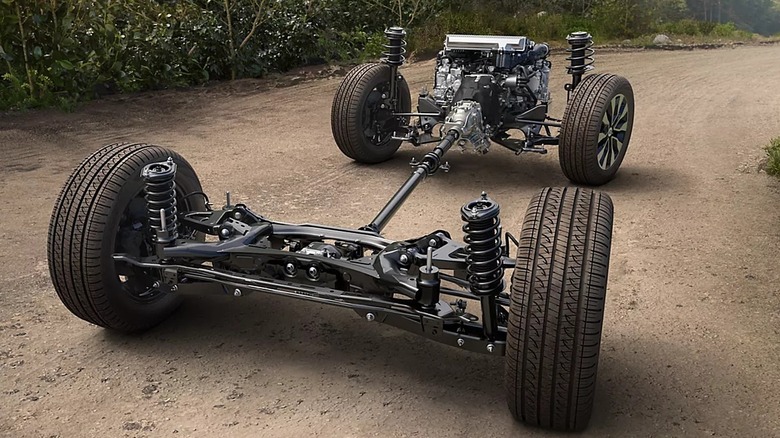
The "symmetrical" label refers to Subaru's design, which eliminates the need for redirecting power repeatedly due to the careful positioning of the vehicle's components. This symmetrical, low-mounted layout also helps distribute weight evenly and keeps the center of gravity lower, improving handling. However, the problem with having to redirect power to the axle is that it results in energy loss and reduced response. This is an issue with some other AWD systems, as the location of the engine and transmission don't line up for optimal power delivery.
In addition, many AWD systems are advertised as "part-time," meaning they are only selectively engaged. This results in a vehicle operating as a two-wheel drive, unless the system senses more traction is needed. The issue with part-time AWD is that there can be a delay before it enables power to the rear wheels, for example. So, essentially, your vehicle is already losing grip on the road before the system automatically kicks in.
Conversely, Subaru's AWD is always active and making adjustments. This is particularly handy when traveling during inclement weather, but can also be highly useful in other scenarios, as evidenced by the best Subaru models for off-roading. Basically, the full-time AWD takes a more preventive approach to traction loss versus a part-time system that only responds after the fact.
Subaru's AWD still has some downsides
The method Subaru uses to control power to the wheels of its vehicles is called brake-based torque vectoring. Instead of sending more power to a particular wheel, the system utilizes the brakes on the opposite side to adjust power delivery. For instance, while cornering, a measured amount of braking force on the inside wheel focuses torque to the outside wheel, improving stability. While this is a cost-effective system, it isn't as sophisticated as some other options that use mechanical torque vectoring, which typically offers enhanced performance and consistency over the brake-based variety.
In addition, Subaru's approach may also induce greater wear on the braking system, since it's continually used when adjusting torque delivery for traction, particularly in challenging scenarios. This is further complicated by the fact you could see brake pads wear down unevenly across the four wheels, making maintenance a bit more of a guessing game.
Lastly, while there are disadvantages to part-time AWD, a big plus comes in the form of better fuel economy. If you're driving mostly in two-wheel mode, the engine doesn't have to burn more fuel running all four wheels. While Subaru claims the difference in efficiency will be minimal for daily driving, it does admit its full-time AWD can use more gas, especially in more demanding instances. Despite this, the automaker has managed to offer new Subaru models that have the best MPG in its lineup, with good figures considering the full-time AWD systems.