

The F-22 Raptor's Gold-Tinted Canopy Is A Stealthy Secret Weapon
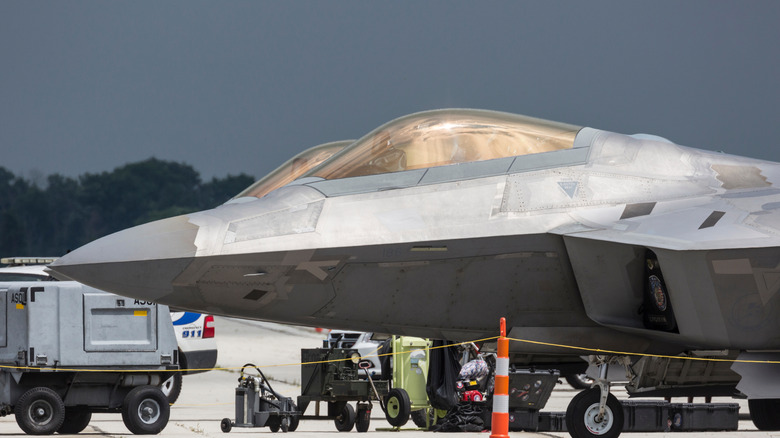
For years, nothing in the sky matched the Lockheed Martin F-22. Introduced in 2005, the Raptor was the first fifth-generation fighter to enter service, and its advanced capabilities quickly made it the deadliest plane in the air. Practically invisible to radar, the Raptor can sneak up on its prey undetected at speeds north of Mach 2. Up close, it's just as deadly, with its pair of thrust-vectoring engines giving it the ability to turn on a dime. The Raptor's production was canceled in 2009, but it was so ahead of its time that it took over a decade for China and Russia to build fighters able to stand toe-to-toe with it.
The functions of the Raptor are immediately reflected in its form, as Lockheed designed the aircraft around having the smallest radar cross section (RCS) possible. Another major player in this effort is its gold-tinted canopy. One of the most visually striking aspects of the craft, the canopy's finish uses decades-old technology to not just protect the plane, but also its pilot.
Why Lockheed chose to use a gold canopy
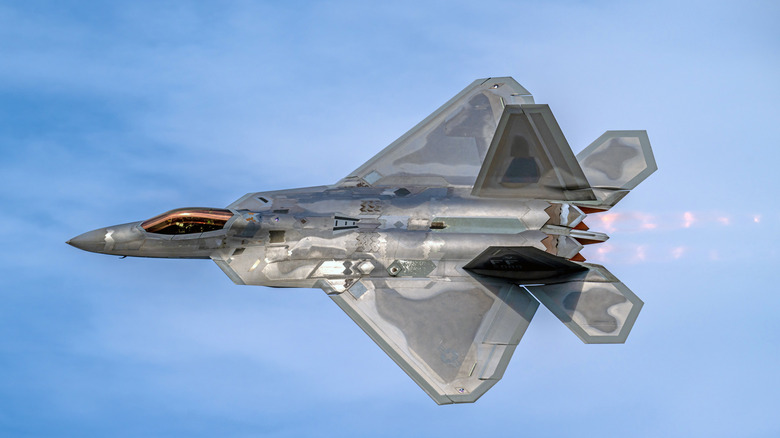
Radar detects aircraft by sending out a barrage of radio waves. These waves bounce off the aircraft and return to the antenna, revealing the plane's location and speed. After designing the iconic F-117 Nighthawk, Lockheed learned a thing or two about making an aircraft invisible to these systems, and ensured the F-22 would be no different.
From nose to tail, the Raptor was designed so that incoming radar waves are deflected away rather than returned to the source — that's why the fuselage and wings have such sharp angles, and it also explains the jet's bizarre-looking sawtooth engine nozzles. For additional protection, the entire plane is covered in a radar-absorbent material (RAM), which transforms the incoming radio waves into thermal energy and gives the plane its iconic matte look. Moreover, any wing-mounted bombs or missiles that could reflect radar signals are stored within the Raptor's internal weapons bay.
All this adds up to a practically undetectable plane, except for one key spot: the cockpit. Without protection, the pilot's body and the cockpit's interior components would strongly reflect any incoming radar waves. So, how do you make a cockpit stealthy? You coat the canopy in indium tin oxide (ITO). This coating gives the canopy its shiny appearance, while deflecting radar waves.
ITO helps beyond stealth
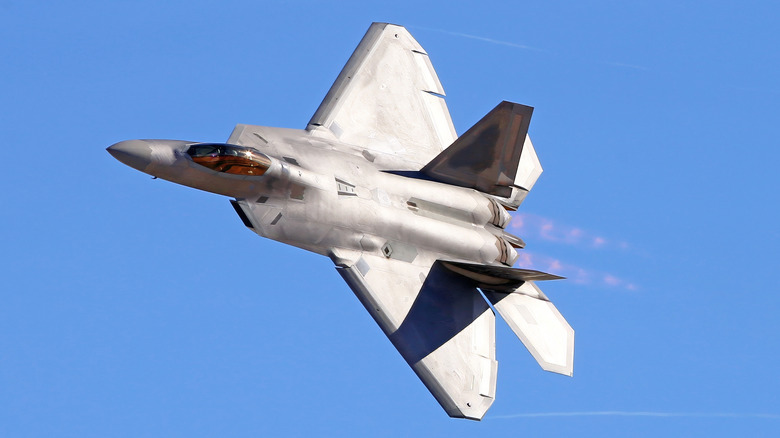
The tint also doubles as a shield, protecting the F-22's pilot from harmful electromagnetic radiation, while preventing interference with the cockpit's high-tech avionics. Pilot protection was the original purpose of ITO's use in combat aircraft, starting in the 1970s on the EA-6B Prowler. The electronic warfare plane emitted kilowatts of electromagnetic energy to jam enemy radars, and its gold canopy kept the four crew members from being cooked in flight.
Many F-16s feature a gold canopy for the same reasons. The "Fighting Falcon" implemented it not just for its reduction of RCS, but also for its ability to deflect infrared radiation, as the coating disperses heat from the canopy. That helps minimize the plane's heat signature, making it tougher for infrared-guided missiles to find a lock.
In the wake of the Raptor, nearly all fifth-generation fighters – including Lockheed's F-35 — have adopted some form of canopy tint. Military aircraft of the future will likely go with gold as well. Little is known so far about Boeing's F-47 sixth-gen fighter, but early renders show it may feature a canopy of the same shade.
With an upgrade package introduced in 2024, the Raptor could stay in the skies well into the 2040s. When it finally retires, it will undoubtedly be remembered as a plane that brought new technologies that transformed the air-combat theater — including making the cockpit shine like a pair of Oakleys.