

One Of The World's Only Twin-Turbo Flat-Four Engines Was Built By Subaru – And It Didn't Go As Planned

Although Subaru didn't invent flat engines, and isn't the only automaker still using them, those motors have become a defining characteristic of the brand. (The same can be said for all-wheel drive, of course, but we'll leave that for another day.) In fact, Subaru has relied on flat engines, also called boxer engines, for nearly all of its vehicles since the Subaru 1000 reached the road in 1966. And every gas-powered member of the current lineup — even the Subaru BRZ built together with Toyota — has one.
Naturally, Subaru's boxers have evolved since the 1960s, over time trying out many of the same refinements and upgrades as traditional internal combustion motors, including fuel injection, turbocharging, supercharging, and even diesel engines never sold in the U.S. In 1993, Subaru doubled down on forced induction by developing a four-cylinder boxer engine with two turbochargers, 247 horsepower, and 228 pound-feet of torque.
The mill was made mostly for Japan, where folks drive on the left-hand side of the road, and it actually wouldn't fit into cars with steering wheels on the left. Nor is this the only special Legacy from the early '90s we missed out on: There was once a Japan-only Legacy Touring Bruce edition honoring "Die Hard"-era Bruce Willis.
Regardless, the steering-wheel location wasn't the reason things didn't go as planned. It turns out using a sequential twin-turbo setup, like the Legacy did, has an inherent weakness when it comes to power delivery and isn't so great in terms of emissions, either.
How did Subaru's twin-turbo flat-four work?
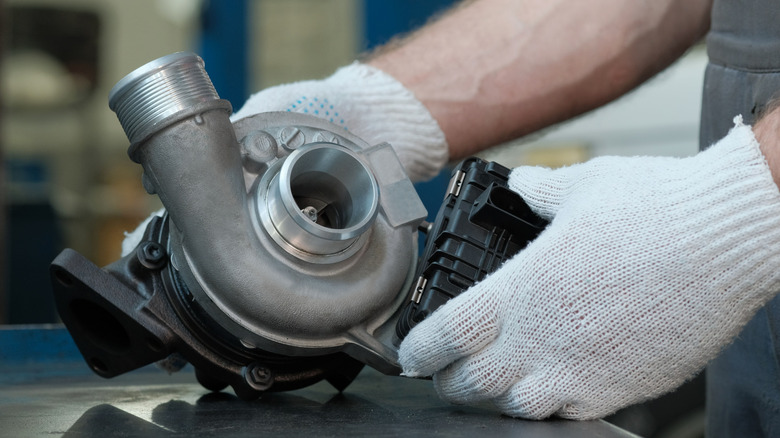
First off, let's look at how a single turbocharger works. It's a fairly simple process, as a traditional turbocharger is powered by the engine itself and relies on two small fans mounted on the opposite sides of a short axle. One side, the hot side, is driven by exhaust gas that's routed through the turbocharger before going through the actual exhaust system. As that turbine spins, so does the fan on the other side, the cold side, which sucks in fresh air to force more of it into the cylinders. More air mixing with the fuel means more power.
With today's typical twin-turbo engines, groups of cylinders have their own separate turbocharger that runs in parallel to the other. Subaru's setup used sequential turbocharging, where the air from the first turbo then spins the second, with the combined effort boosting all four cylinders together. In theory, the arrangement helps eliminate turbo lag: Subaru's first turbo was calibrated to deliver low-speed boost while waiting for the second to come into play at higher engine speeds.
But you can't really fix turbo lag, and this only moved the problem from one place in the powerband to another. When AutoSpeed tested an Australian-market Legacy, known as the B4 in that country — which, to be sure, drives on the right-hand side of the road — it noticed an "ugly 'hole' in the torque delivery" system that occurred while waiting for the second turbo to come on.
The history of Subaru's twin-turbo flat-four

Subaru's innovative engine had its issues, but it was just a small branch on the highly successful EJ20 family tree. Introduced in the Japan-only 1989 Subaru Legacy RS/GT, the original EJ20 engine was part of the automaker's first foray into performance engines and featured roughly 2.0 liters of displacement and a single turbocharger sourced from IHI. The motor delivered about 217 horsepower and nearly 200 pound-feet of torque when mated to a five-speed manual transmission in the 1989 Legacy RS. By the time the engine went out of production in 2003, it could make 276 horsepower/253 lb-ft.
Perhaps more important for automotive history is that it was the EJ20 that made the WRX a legend. Subaru's iconic sport compact welcomed a first-gen single-turbo EJ20 in 1992, letting drivers manage 236 ponies and 224 lb-ft with a five-speed stick for rally-inspired on-road thrills. A decade later, Subaru began exporting the Subaru WRX to the United States, delivering the same kind of performance as a contemporary Audi S4 but for thousands of dollars less.
The same engines would become a core component of many Subaru models over the years, and not just new ones. The EJ20 became plenty popular with tuners, too, who loved how easy it was to swap the motors for their builds. The automaker finally stopped EJ production in 2019, but it remains a highlight of our comprehensive guide to Subaru engines.