

Here's How Much A 2020 Mazda CX-5 Has Depreciated After 5 Years

The Mazda CX-5 is more than a popular crossover in a crowded segment; it's the automaker's bread and butter in the U.S. For more than a decade, the CX-5 has been one of Mazda's best-selling models outside Japan. Praised for its sporty handling and reliability, this compact five-door regularly scores high in many rankings, and is considered one of the most reliable new cars you can buy under $30,000. Yet, despite the acclaim, the CX-5 still takes a depreciation hit.
Major valuation trackers report that a 2020 CX-5 drops a little over 40% from its original selling price after five years, placing it towards the bottom of the pack against rivals. But why does depreciation matter on a 5-year-old car? Because vehicles of this age are often a sweet spot for used-car buyers, offering a balance of affordability and relative newness. The steeper the depreciation rate, the lower the selling price.
At the same time, a sharper drop in value translates into a lower trade-in offer. To understand what this means for the Mazda CX-5, we reviewed five-year data from CarEdge and iSeeCars. Out of curiosity, we compared the CX-5 to competitors such as the Toyota RAV4, Honda CR-V, and Nissan Rogue.
Five-year depreciation for the Mazda CX-5
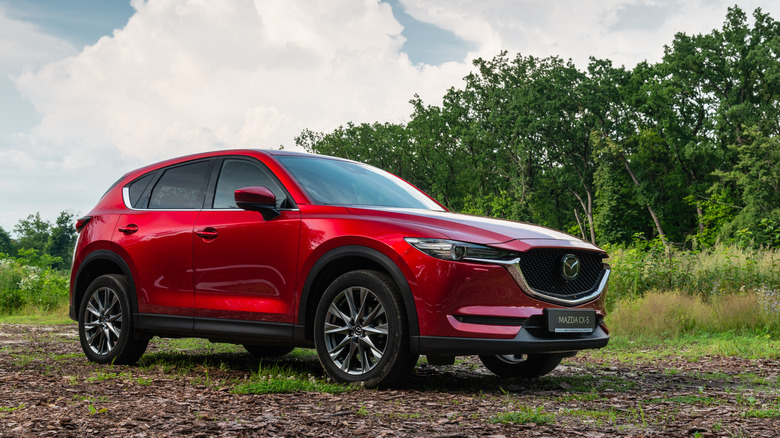
CarEdge reports that a 2020 Mazda CX-5 loses 41.8% of its original value after five years. That leaves a 58.2% residual value, translating to a vehicle worth $22,569 based on an original price of $38,778. The firm gives the CX-5 a mediocre ranking for retaining value, stating "it's not a standout one way or the other" in this area. It's too early to determine what depreciation will look like for the 2026 Mazda CX-5, the first model year of the third generation.
iSeeCars reports near-identical results, with a five-year-old CX-5 depreciating 42.4%. The website also points out that this Mazda slides in at just under the 44.1% average depreciation rate for all compact SUVs during the same period. In addition, the compact-crossover segment's value loss is better than the 49% average depreciation rate for all SUVs.
It's worth mentioning that CarEdge based its calculations on vehicles in good condition with an average of 13,500 miles driven per year. iSeeCars doesn't disclose its precise formula for determining depreciation beyond comparing the selling prices from its marketplace listings against original prices.
How Mazda CX-5 depreciation stacks up against competitors
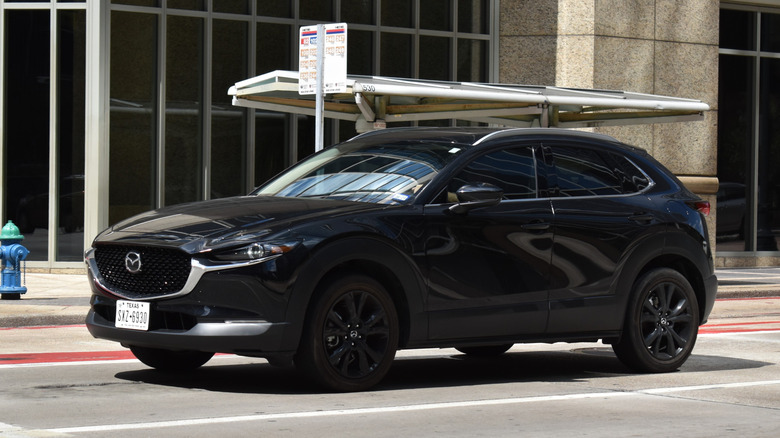
The CX-5's five-year depreciation rate of 41.8% becomes meaningful when compared with its peers. CarEdge data shows the Toyota RAV4 has the smallest five-year drop at 30.6%, followed by the Honda CR-V at 33%. However, the CX-5 fares better than the Hyundai Tucson (46.2%), Chevrolet Equinox (50.6%), and Ford Escape (54.3%). So, while these cars may be competitive in the showroom, there are clearly stronger performers when it comes to depreciation.
Dollar-wise, the RAV4's depreciation works out to a five-year loss of $11,551, compared with $13,059 for the CR-V and $16,217 for the CX-5. The numbers are worse for the Tucson ($17,639), Equinox ($17,792), and Escape ($20,378). CarEdge's findings aren't a one-off — iSeeCars data follows a similar pattern for five-year depreciation. The RAV4 has 30.3% depreciation, the CR-V comes in at 34.5%, and the CX-5 again lands near the middle at 42.4%.
Trailing the pack are the Tucson (45.9%), Equinox (49.6%), and Escape (51.3%). Both valuation tools confirm the CX-5's middle ground for depreciation in its class. The good news is that the CX-5 is not even close to the fastest depreciating cars on the market.