

Pontiac Made A Straight-6 Decades Before It Was Popular
Oh, Pontiac, your death in 2009 was a bitter pill, as memories of big block Trans Ams and GTOs flooded forth with the tears. Not that Pontiac's end was hard to see coming; the brand had been languishing for years. There were a few bright spots in the 2000s, such as the GXP versions of the Solstice and G8, but it was difficult to ignore the rebadged leftovers and platform-thieved mediocrity that comprised most of the lineup. And, of course, there was the Pontiac Aztek proving it can always get worse — standing in the corner, occasionally waving, eating all the hors d'oeuvres, and making uncomfortable eye contact while everyone tried to ignore it.
As inauspicious as the new millennium was for GM's former performance division, its beginnings in 1926 were promising. Indeed, they were more than promising, as Pontiac was the most successful new American automotive marque ever at the time. Unlike the image Pontiac enjoyed from the 1950s onward — thanks to the performance-obsessed Bunkie Knudsen and John Z. DeLorean — it was originally introduced as a budget version of Oakland, a General Motors division many of you may not be familiar with.
What was truly special about the '26 Pontiac was that it brought high-end features out of the realm of expensive, narrow-market vehicles in a "Prometheus giving humans fire" move to improve civilization. That's not hyperbole — that Pontiac set the trajectory for the industry, and marked the point where cars went from luxury items to primary transportation devices. It provided a reasonable $825 starting price, an enclosed body to protect occupants from the weather, and a large, powerful, inline-6-cylinder engine making about 40-hp (double the output of a Ford Model T). The 1926 Pontiac was a resounding success, with nearly 77,000 cars sold in the first year.
The straight-6story
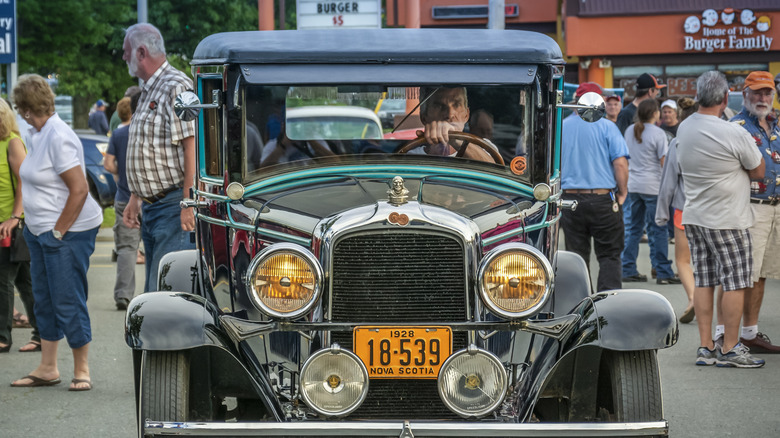
GM — which has a long history of killing its brands — had as many divisions as grains of sand on the beach in the 1920s: Pontiac, Chevrolet, Buick, Cadillac, GMC, LaSalle, Marquette, Oldsmobile, Scripps-Booth, Sheridan, Viking, Yellow Cab, and Yellow Coach. There were even more brands for foreign markets, but more importantly, there was also Oakland.
The same year Pontiac's $825 40-hp inline-6-powered coupe and two-door sedan debuted, buyers could step up to the $1,215 Oakland. It featured a little more horsepower, slightly better brakes, and a marginally nicer interior, but nothing terribly important to justify an extra 400-ish dollars. For context, $400 in 1926 is $7,321.49 today, and you can probably think of better ways to spend seven grand than upgrading to a nearly identical car. So, Oakland was Pontiac-ed in 1931, 78 years before Pontiac was Pontiac-ed.
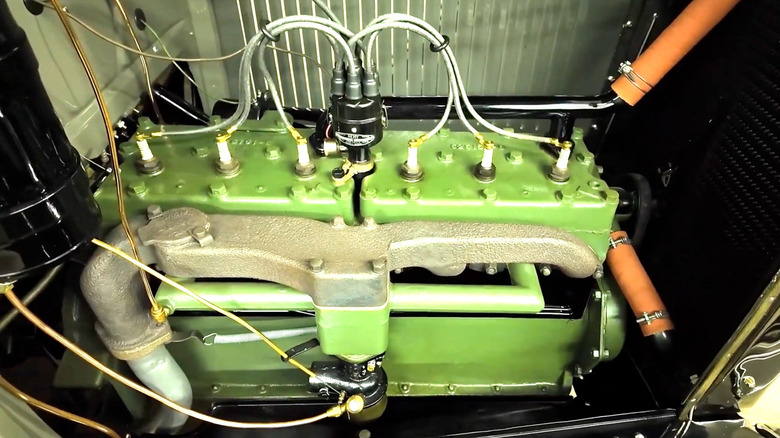
It wasn't just price that let the Pontiac outlast Oakland, though. The "lesser" marque's inline-6 was thoughtfully designed for easier servicing. While Oakland's flathead-6 used a single, long head, Pontiac's "split head" was essentially two heads covering three cylinders apiece. Since gasoline quality was awful at the time, heads had to be removed constantly so that carbon buildup could be scraped away. Mechanics were probably quite thankful they didn't have to manhandle a single, weighty head when working on Pontiacs. Plus, the distributor sat between the heads and could be removed quickly with no disturbance to other parts.
With an 186.5-cubic-inch displacement and a 4.8:1 compression ratio, its 40 hp matched the 200.5-cubic-inch, 4.22:1 compression Ford Model A four-cylinder. But Ford's four needed careful balancing to prevent unpleasant vibration (can confirm from driving a '29 model), while an inline-6 is already perfectly balanced and buttery smooth.
Modernity for the masses

Pontiac's straight-6 was not the first, as Spyker's 1903 race car featured a 60-hp straight-6 — yes, that Spyker, momentary Saab savior and producer of one of the most beautiful steering wheels ever. There were also already enclosed-bodied cars that protected buyers from rain, snow, and talkative passersby. Cheaper cars existed, too, as Ford's Model T started at $360 in 1926, less than half of the Pontiac. The revolution was Pontiac's combination of power, passenger protection, and price.
But the brand that made its name with inline-6 propulsion abandoned it for a straight-8 in 1933. And when Chevrolet introduced a straight-6 in 1929, Pontiac sales plunged. Buyers looked at the two brands, and didn't see a reason to step up to the Pontiac when it didn't offer anything substantially different (this feels like foreshadowing). Adding two cylinders fixed this issue, and while the eight didn't make much more power than the old six, it was smoother and more refined. However, the six couldn't stay dead. One could argue that it was the Great Depression that twisted Pontiac's arm to reintroduce the six in 1935, as buyers looking to save money could opt for a six-cylinder model starting at $615, or an eight that began at $730.
Sales favored the six again, but trends had reversed by 1949, and buyers wanted the power of the eight. Some 235,000 Pontiac Silver Streak straight-8 flew off showroom floors in '49, while Chieftain sixes only found 40,000 buyers.
Pontiac's six was dead again after 1954. Despite future attempts at making inline-6s cool again, such as the overhead-cam six in the Firebird Sprint, a car I try in vain not to be bitter over my father selling before I was born, the writing was on the wall. Only eight was enough.