

Chevy's 302 Small Block Engine Was Meant To Break The Rules
The Camaro, rest in peace (for now), usually got hand-me-downs from the Corvette, if it got anything unique at all. There were no production Camaros powered by the double overhead-cam LT5 from the C4 Corvette ZR-1. Corvettes had standard four-wheel disc brakes since 1965, but were optional on Camaros until 1993. '80s and '90s L98 Camaros only came with automatics while L98 Corvettes had optional manuals. C4 Corvette LT-1s made 300 hp, while 1993-1997 Camaros made do with 275 hp.
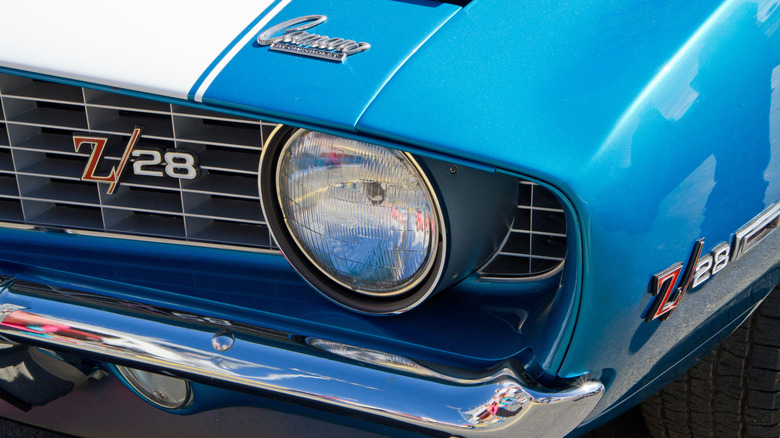
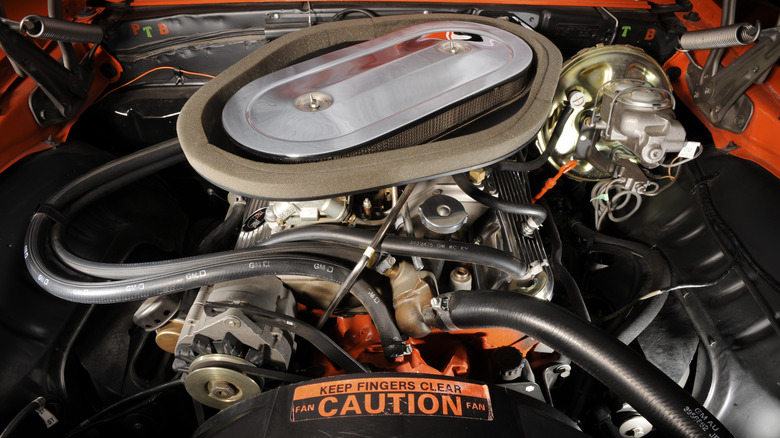
There was one item, however, that Camaros could boast about that Corvettes never had. No, not rear seats, we're talking about the high-revving 302 V8 in the Z28. (It was also in the Z/28. And, if period articles and books are to be believed, the Z-28.) To prepare the Camaro for racing, Chevrolet installed a forged 283 crankshaft in a small journal 327 block, creating a 302.4 cubic inch V8 that fit nicely in the rulebooks of the Sports Car Club of America's (SCCA) Trans-AM racing series.
So, how did the Chevy 302 "break the rules?" Well, it wasn't SCCA rules the engine broke, but muscle car rules. American V8s made power through sheer displacement, dangit! Forced induction could be found on '57 Fords and Oldsmobile Jetfires, yes, but they were outliers. And sure, the Corvette 283s and 327s got fuel injection from 1957 through 1965, but America's sports car couldn't resist the call of cubic inches for long, with the '65s getting an optional 396 that became a 427 the following year. Speaking of the plastic fantastic, that's the other rule the 302 broke: Corvettes never got one of the coolest engines! I couldn't even find evidence of central office production order (COPO) 302 Corvettes.
A revolution! 7,000 of them, actually
In 1966, racing was still verboten at Chevy thanks to the 1963 General Motors edict that factory-backed competition was stopping right dang now. But the allure of "win on Sunday, sell on Monday" was irresistible, especially since Ford and Chrysler were eating up the publicity in Trans-Am. GM saw dollar signs and management liked dollars so racing was back on for '67.
The 1967 Z28s weren't a separate trim, but rather an RPO code that prepared Camaros for Trans-Am racing. Z28s received the 302, heavy duty engine cooling hardware, stiffened suspension, front disc brakes, and deep-groove V-belt pulleys. Plus, the only transmission was a manual (as God intended) and it was the close-ratio M21 non-rock crusher Muncie four-speed. Maybe the coolest visual feature in the interior was an optional tach that displayed 8,000 rpm.
The 302's four-inch bore and three-inch stroke was a recipe for high-end power that thrives on racetracks. Engines with larger bore than stroke are called "oversquare." Other monster engines of the era were oversquare, too, such as the LS6 454, 426 Hemi, and the 427 FE; but the 302 was overly oversquare by comparison, and F1 fans knew that more oversquare meant faster spinning.
Few engines could rev to 7,000 rpm like that Chevy 302. If you bought a Ferrari 330 GTC to get a screaming V12, it would max out at about 7,000, too. Even the Corvette's LT-1 350 only spun to around 6,500 rpm, though its greater horsepower was attractive enough for Car and Driver to commit heresy in 1969 and put one in a Z/28 Camaro, calling it the Blue Maxi. A shame. The 302 might not have low-end torque, but it certainly screams from the top of its carburetor jets.
Dashes, slashes, and nothing in-between
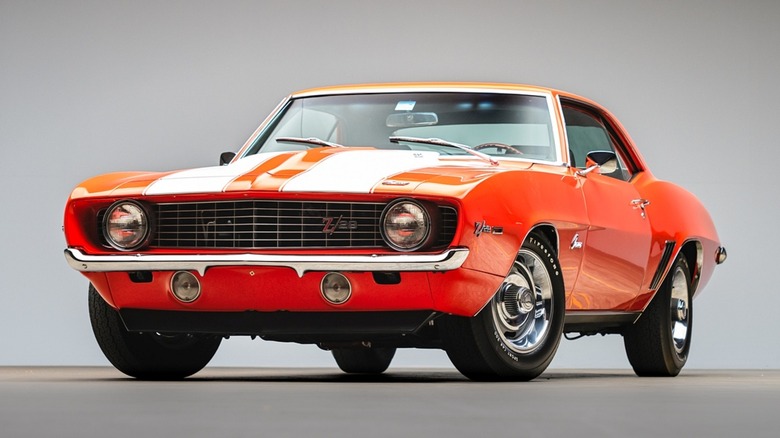
For 1968, the Z28 became a real trim styled as "Z/28" through 1969. Magazines and books, such as the May 1968 issue of Hot Rod I'm holding right now or the American Muscle Cars book (featuring a rare crossram, JL8 four-wheel disc brake example), printed "Z-28". Second-gen Camaro Z28s got LT-1 350s and lost the slash.
The 302 received steady updates throughout its three-year lifespan. First-year 1967 302s had small 2.30-inch main journals, while '68s got stronger, larger 2.45-inch journals. 1968 blocks also sprouted four-bolt mains in the middle three positions. For 1969, the standard Holley four-barrel dropped from 800 cfm to 780 cfm, though the optional cross ram used two 585 cfm Holleys. Early '69 cars also had the NC8 chambered exhaust system standard. These chambered pipes may shatter windows, but let that Chevy 302 sing.
Meanwhile, the Camaro's sibling, Pontiac's Trans Am, couldn't just Tetris together cranks and blocks for the right displacement. To have a chance at racing in the car's namesake series, Pontiac created a bespoke 303 cubic inch engine with Ram Air V heads. The heads had intake runners so big they could flow around 325 cfm, but the relatively tiny engine couldn't make use of all the potential airflow. Even though testing with modified Ram Air IV heads showed promise, Pontiac's 303 died on the vine while Chevy's 302 made fine wine. All 1969 Trans Ams are rare, but 303-powered Trans Ams (less than 25) are rarer than death by vending machine (about 37).
302 Z/28s were short lived, but led Chevrolet to numerous victories in Trans-Am in 1968 and 1969. That high-winding small block spun like a centrifuge, never graced Corvette engine bays, and broke muscle car rules. And that rules.