

The Napier Deltic Remains One Of The Strangest Engines Ever Built
Step right up, ladies and gentlemen, to our Hall of Internal Combustion Oddities! Hurry, hurry, hurry, and set your eyes on the strangest engines you've ever beheld! Witness BRM's H16, formed from the carcasses of a pair of flat-eights. Gaze upon Ford's experimental X8, unnatural and terrifying, featuring four banks of twin cylinders arranged in an X-shape. Honda's NR500 motorcycle engine may seem normal at first glance, but inside you'll find mutated, oval-shaped pistons with two connecting rods each. And don't get too close to the now-recalled Nissan and Infiniti variable compression engine lest you become caught in the whirlwind of its mighty failure.
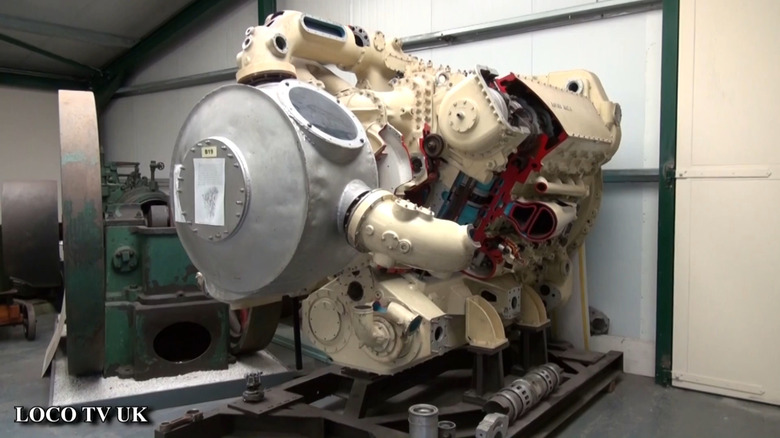
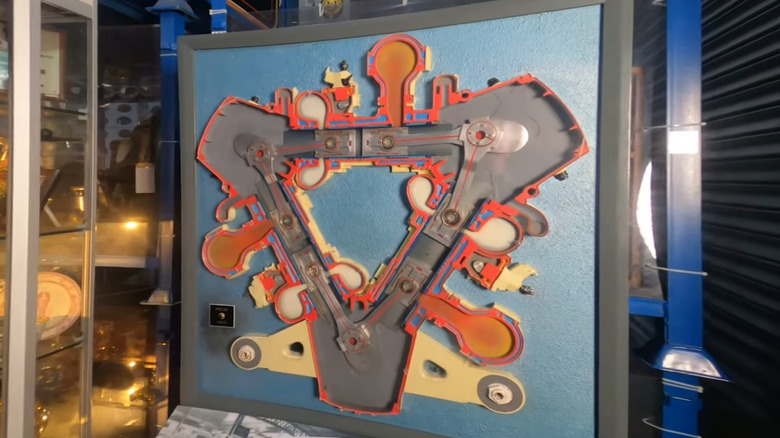
But all these oddities pale in comparison to our collection's crown jewel, the Napier Deltic diesel triangle-18! What's that? No, those are not cylinder heads you see, they are crankcases. In truth, there are no cylinder heads! This display of engineering wizardry features three crankshafts, each holding 12 pistons that rise not toward a head with valves, but toward each other, much like two fists meeting inside a tube. Think of it as three V12s with 36 total pistons. But there are two pistons per cylinder, so cut 36 in half to get 18 cylinders. Voila, a triangle-18!
Yes, compression exists because opposing pistons operate in the same cylinder, hence 18 cylinders with 36 pistons. These pistons approach and depart each other in a never ending cycle. Exhaust and intake ports are carved right into the cylinder walls in the same fashion as any two-stroke engine. One set of pistons is responsible for air intake, and the other set handles exhaust scavenging, aided by a blower, similarly to a Detroit Diesel. So come, marvel at this eighth wonder of the world, and learn its story!
If any engine should be called a boxer, it's this one
The genesis of Napier's pizza-slice-shaped engine began during World War II. At the time, England's motor torpedo boats ran on gasoline, which isn't friendly to sparks and open flame. So the British Admiralty wanted a high-speed diesel to improve safety for the boat crews.
This is where the story turns to a German engine manufacturer called Junkers. That's pronounced "Yunkers", unlike the term used for a fleet of terrible cars, and was named for its founder, Hugo Junkers. The engines were well-designed, and the company's two-stroke Jumo 204 engines used two banks of six cylinders with 12 total pistons that would shadowbox each other to create compression. These engines operated on a flat plane and stood vertically because apparently, laying them horizontally created oiling problems. Junkers' diesel two-strokes were ingenious, and ran as cleanly as a four-stroke, but were lighter (no cylinder head, after all) and less complicated.
In a bit of divine fortuitousness, English engine company Napier had licensed Junkers' design in 1933, and made its own version called the Culverin. The British Air Ministry contracted Napier in 1934 to build seven 720-hp Culverins for testing, but the engine was met with a resounding "meh", and no manufacturer bothered purchasing one. Then came the war, and everyone was a little too preoccupied to give a hoot about this engine, but good ideas and designs have a way of resurrecting at the right moment.
In 1942, Napier was purchased by English Electric. Then in 1943, the British Admiralty started searching for the right manufacturer to craft that high-speed diesel. Enter Napier and its 18-cylinder Toblerone bar.
Deltic frost
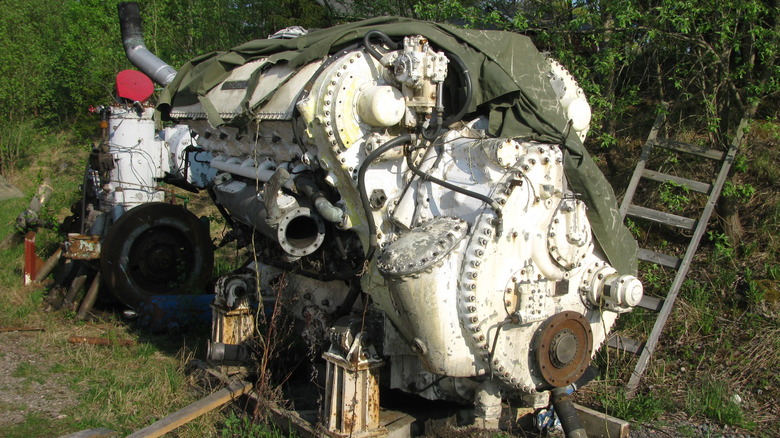
Napier didn't finish the engine before the war's end. But the Admiralty still wanted it, and in 1946, Napier won a development contract. After constructing a single cylinder proof of concept, Napier built a three-cylinder version it called "Deltic" after the Greek letter Delta. Why "Deltic" and not "Delta"? Curious Droid says it's a portmanteau of "Delta" and "Electric," as in Napier's owner, English Electric. The Gravesend Railway Enthusiasts Society, though, says "Deltic" means "in the form of the Greek letter (capital) delta." Pick which story you like better.
Finally, the coat-hanger 18 was born in March 1950. Its engineering was no mean feat, thanks to nasty phasing issues (the reason Junkers never adopted the layout). But, by rotating one crankshaft in the opposite direction of the other two it ran beautifully. At 11 feet long, 6 feet wide, and 7 feet tall, the 88.3-liter, 8,725-pound engine was never going to power Austin Minis, but dang did it power boats and trains.
It served admirably in locomotives starting in 1955. Deltics could go 5,000 hours before needing an overhaul. Napier even built a "Baby Deltic" nine-cylinder version that was more compact, and refined the 18-cylinder to make more power (up to 5,500 hp!). But by 1978, high-speed trains threatened the Deltic's future, and in January 1982, it made its final run from King's Cross to Edinburgh.
Though the world's attitude turned frosty on this monstrously-depthed yield sign, enthusiast groups such as the Napier Power Heritage Trust keep Deltics alive. Our readers even named it one of the best engines of all time. And six of 22 original Deltic locomotives survive, three of which belong to the Deltic Preservation Society.