

What Can Happen If You Get A Traffic Ticket In A Foreign Country?
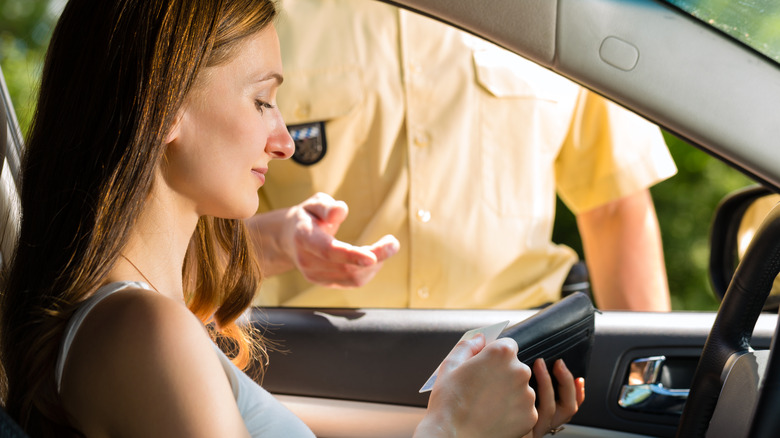
Travelers who rely on taxis and ridesharing, you can enjoy some smug satisfaction for the next 1,500 words. As for those of you who are willing to face terrible foreign driving experiences, the risk of a traffic ticket is legitimate and can become an undelightful headache down the line. The consequences may not be immediate, but you could get a letter in the mail, even a year after the fact, detailing the charges you owe.
Unfortunately for the speed-obsessed and violation-prone traveler, there's no blanket answer for how long you have to pay a fine, the consequences for non-payment, which transgressions the offended country will take most seriously, and whether you can escape consquences by just never going to that country again (that last one isn't the best course of action). If you crumple up that citation and push it to the back of your mind, you might still face holds on your credit card accounts, points on your license, license suspension, and even a warrant issued that would mean immediate arrest and possible jail time if you reentered that country.
Let's just say that most of the time, paying the fine makes your problems disappear, so don't let the worst-case scenarios scare you. Plus, if you rent a car, the authorities will usually send the fine to your rental company, which will just charge your card on file.
Canadian convictions and Mexican mindfulness

If you're driving to Canada (and you're almost certainly driving if the 70% reduction in Canada-U.S. air travel is accurate), exercise caution. Improperly converting kilometers per hour (kph) to miles per hour (mph) could mean trouble, and if your speeding's particularly egregious, you might be refused entry to Canada or even face jail time for your driving misdeeds. Then your own state may get on your case. Drunk- or drugged-driving cases in Canada, for instance, can cost you your New York driver's license for 90 days. If you're under 21, that could be a year or more.
Travelers driving in Mexico may get confused by some local customs, such as how drivers may flip on the left turn signal and then move right. This is to indicate, "You can go around me on the left, I'm driving slowly." But if you get pulled over, the process with the cops will be familiar. Show your proof of insurance and remain calm, just make sure you get a physical ticket you can pay via mail or by visiting the police station. If the officer takes your license after issuing a ticket, don't worry, it's not gone. You have permission to drive until the fine is paid. Remember, laws aren't more or less relaxed in Mexico, regardless of what your coworker's cousin's boyfriend's aunt said, just a little different. But if you decide to mouth off to the police or you're intoxicated/stoned, expect to be taken to jail.
Britain's bothersome, Europe's user-friendly
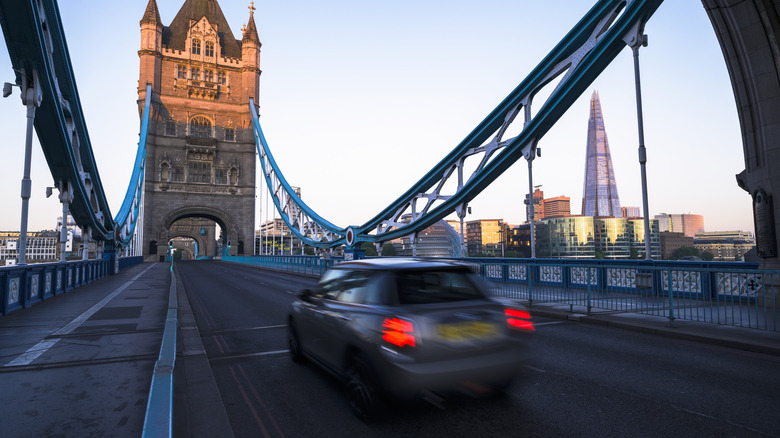
The UK famously rejects automatic transmissions, those blessed people. But even the stick-shift-familiar will still contend with driving on the left, unfamiliar traffic signs, and narrow lanes. When caught speeding, pay the 100-pound fine within 28 days and get three points on your license. Well, not your actual license, but a "ghost license" created by the Driver Vehicle Licensing Authority. This ghost license can haunt you; 12-plus points in three years might mean a U.K. driving ban. Even worse, if you're caught speeding by camera, authorities might not be able to find and ticket you. Unless you somehow check for ghost-license points, you might not know they exist.
If you get ticketed in European Union countries, some things are simpler. Payments are commonly in euro, most European countries give you 60 days to appeal fines, and you can even request a fine reduction (it sometimes works!). Tickets start at 68 euros in France, 100 in Spain, and 40 in Greece, though running Greek red lights can cost 700 euros.
Poland's an outlier as it doesn't use the Euro, but rather the złoty. Speeding fines start at 50 zlotys, but there are also fines for using phones while driving and for failing to observe the minimum required distance behind the leading car. Switzerland and Norway both issue income-based penalties, though Finland's arguably more famous for that thanks to a businessman's six-figure ticket.
Finnish fines and German generosity (but be careful on the Autobahn)

In Finland, tickets are calculated as "violation severity" (based on speed) times daily disposable income (monthly net divided by 60). A $12,000-a-month salary equals $200 daily disposable income, and 1 to 15 mph over is a severity multiplier of 12 (16 to 25 mph is 22, 26 to 35 mph is 32, and 36-plus mph is 42). So, a 15-mph ticket is $2,400. And yes, a Finnish businessman once got a $130,000 speeding fine. That said, non-Finnish-registered cars caught by speeding camera carry little chance of getting citations because technology isn't in place to send penalties abroad.
Germany's speeding tickets start at a bargain 35 euros, but speed cameras are triggered at 3% past the limit, and fines climb as speeds rise. You might think you're safe on the Autobahn, but nope. Sure, on the German-American Community Office traffic ticket page, the first two sentences are, "Whether you have just arrived in Germany or you have been here for a while, there is nothing quite like driving on the Autobahn. With frequent stretches without speed limits, driving in Germany brings out the lead-footed racecar driver in many of us." But the rest is rules and consequences.
The final line is, "Failure to pay your ticket may result in the German Court ordering jail time to induce payment of an overdue fine. Jail time is not a substitute for the fine!" So look for speed limit signs, and obey them.
Italian infractions and Japanese judiciousness

Fear the "Zona a Traffico Limitato," or ZTL. These are restricted traffic zones in historic Italian areas that are for local residents and their registered vehicles. The U.S. Embassy & Consulates in Italy website says, "Although most of the automated verification stations are clearly marked, if a driver passes one it is impossible to know at the time that a violation occurred or has been recorded. Violators are not pulled over or stopped, and there is no personal contact with a police officer. The fines imposed for these violations should be forwarded to the U.S. citizen's residence abroad within 360 days from the date of the violation." Yes, you might get a letter in the mail a year later. Even if the statute of limitations runs out, Italian authorities still expect you to pay or contest your charge.
In Japan, you'll notice that, in addition to having blue traffic lights instead of green, the police are stupendously friendly and might apologize for pulling you over. Oh, you'll still get a ticket, which will be white, blue, red, or yellow. White is for minor stuff like not wearing seat belts. Blue is worse, like running a red light. Red is serious, like going 40 kph over a highway speed limit. Yellow is for parking violations. Going from white to red increases fines and demerits, which are like points. Japan expects you to pay in cash in full, which you can do at banks or post offices.
Be cool, it's only a ticket
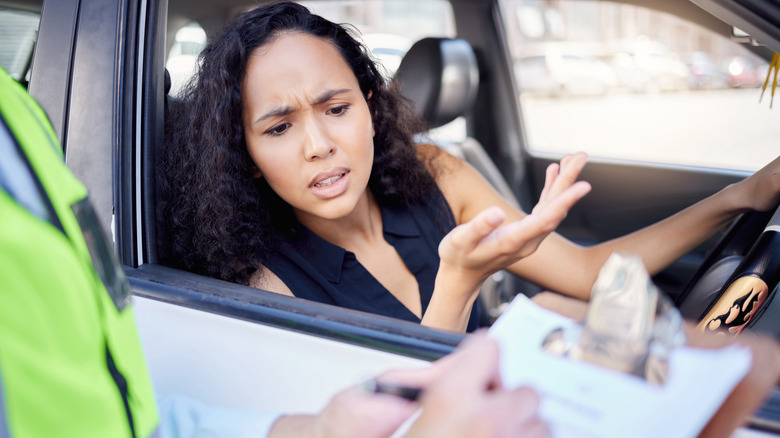
While we could detail all ticket structures, costs, fines, wrist-slaps, stern looks, and "tsk-tsks" of every country, the gist is simple: If you're caught by camera, expect a letter in the mail telling you to pay a fine or a notice from your rental car agency that you already did. If you're pulled over by a cop, be polite, scrutinize your ticket to make sure it's legit, and pay the fine in the manner they expect. If you think the ticket's unfair, research how you can contest it and how long you have to do so. Adhere to deadlines.
Depending on what country you visit, you may need an International Driving Permit (IDP) to even be allowed to drive. If you're in doubt, look up your country of choice on the U.S. Department of State website. Some countries only require an IDP for specific vehicles. In Norway, you need an IDP for a motor home or caravan, and in New Zealand, you need an IDP if you're driving a vehicle registered outside the country.
Getting an IDP is easy; just visit your local AAA office or passport agency. Depending on where you live, the cost is between free and $25. If you're a sovereign citizen visiting us here in reality, you'll need licensing to drive, too, which requires you to interact with government institutions. If you don't, that's okay — the court system will be more than happy to interact with you.