

2026 Nissan Leaf Isn't Perfect, But It's Light Years Better Than Before
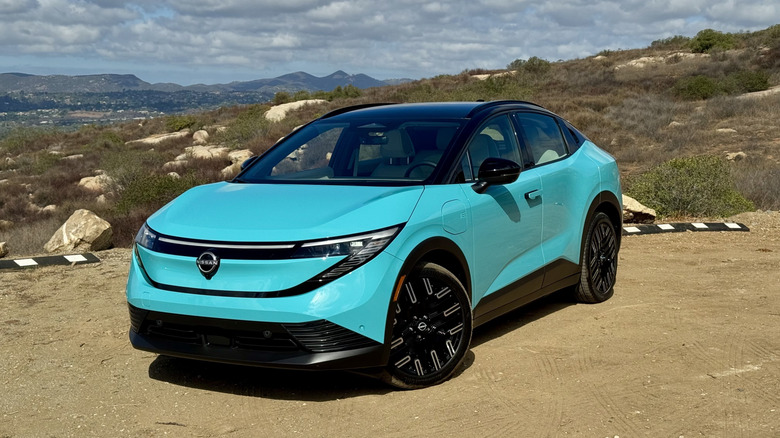
This year the world's first mass-market EV, the Nissan Leaf, celebrates its 15th year on sale, and to celebrate Nissan gave the little Leaf its most significant redesign yet. No longer a compact hatchback, the third-generation Leaf is now a front-wheel-drive crossover that's actually slightly smaller than the outgoing car. While I'm not normally a fan of automakers taking cars and redesigning them into crossovers, the 2026 Leaf is quite likeable.
The 2026 Leaf has a liquid-cooled and optionally heated 75-kWh battery that Nissan estimates will net a maximum range of 303 miles, nearly 100 more than the old model, and it boasts the cheapest starting price of any EV on the market at $31,485, including $1,495 destination. Beyond just the much longer range, there are numerous other upgrades that make the redesigned Nissan Leaf light years better than the car it replaces.
Full disclosure: Nissan put me up in a beautiful 5-star hotel in sunny San Diego for a night and fed me delicious food so I could sample its new Leaf.
It's a cheap and cheerful Leaf
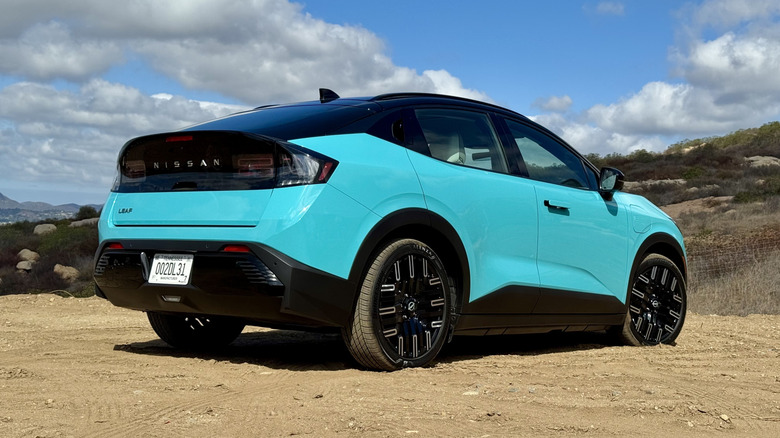
The new Leaf is expected to reach dealer lots in the next few weeks, and it will only be available with the larger 75-kWh battery at first, but an even cheaper base car with a 52-kWh battery will be available early next year. As it stands, the cheapest 2026 Nissan Leaf is the S+ trim, which starts at that $31,485 number and has the longest range of the lineup at 303 miles. The mid-grade (and anticipated volume seller) SV+ trim jumps to $35,725 and has a lower 288-mile range thanks to a heavier curb weight, while the top Platinum+ trim starts at $40,485 and has a 259-mile range due to its larger 19-inch wheels and even heavier weight. The smaller-battery base model will have a range of 196 miles.
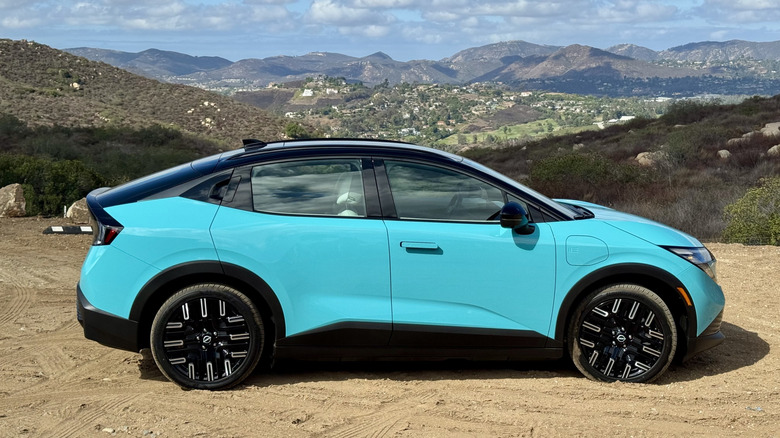
I only got to drive a Leaf Platinum+, which has lots of fancy options like a dimming panoramic sunroof, a hands-free power liftgate, 19-inch aluminum alloy wheels, a 10-speaker Bose sound system, and throwback Z-inspired 3D holographic taillights. Those lights also represent the word Nissan, since the Japanese word for the number three is "ni" and the Japanese word for two is "san," which corresponds to the three vertical outer lighting elements and the two trunklid-mounted horizontal lighting elements; all other Leaf trims only get the outer lighting elements, which is lame.
It's a deceptively small Leaf
Despite Nissan calling the new Leaf a crossover, it's actually 3 inches shorter in length (making it about the same length as a Kicks and 10 inches shorter than an Ariya) and 0.4 inches lower in height than the second-generation Leaf, and its wheelbase is 0.4 inches shorter, too. The 2026 Leaf is 0.8 inches wider, though.
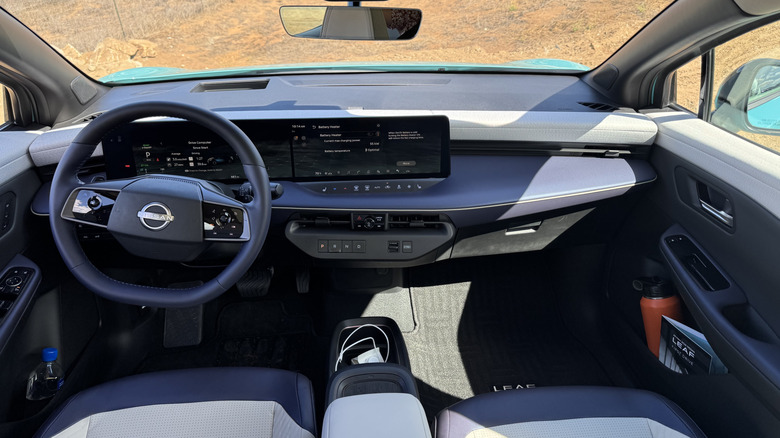
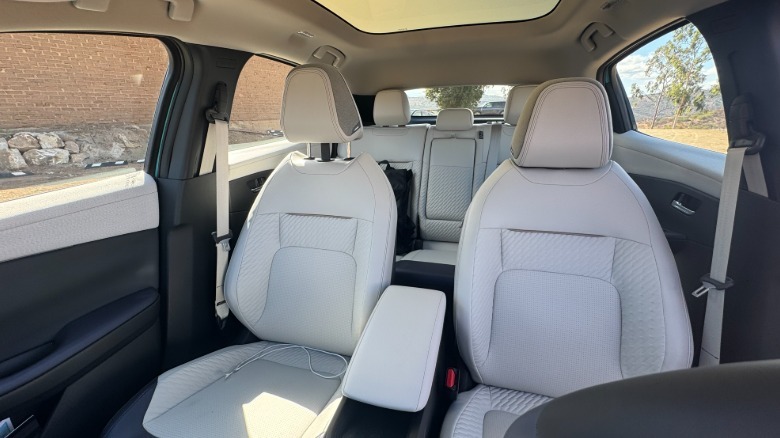
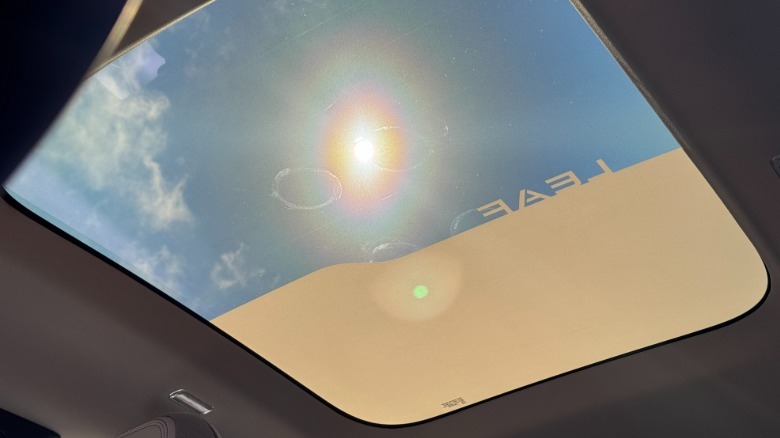
Inside the new Leaf, Nissan did a good job of making the interior look and feel premium and maximizing this small car's interior room. It has one inch less front-seat headroom than the old Leaf at 39.9 inches, and virtually the same legroom at 42.4 inches, but it is wider, with two additional inches of both hip and shoulder room. The interior felt airy and had reasonable passenger space for such a small car, but the front seats sit close to the floor, so if you have long legs like me your knees will be closer to your face than you may be accustomed to. Platinum+ trim Leafs like my test car come standard with a nifty panoramic glass roof that have dimmable sections that reveal a surprise Leaf badge when it's halfway 'open,' and I still found plenty of front-seat headroom for my 6'8" frame.
 Logan K. Carter/ Jalopnik
The rear seats, however, are tight, with 2 inches less legroom than the 2025 Leaf and nearly an inch less headroom with the panoramic sunroof; models without the sunroof have virtually the same headroom as last year's car. Because of how the front seats are mounted, I had no room for the admittedly significant cushioning on my Hoka shoes to slide under them, so I had to sit duck-footed with my toes pushed against the front seats and my heels wedged against the rear seat bottom. If you plan to carry tall passengers, the Ariya would be a better Nissan EV for you.
I think everything about the new Leaf looks great, inside and out. I like that it looks like it's larger than it is, I like the holographic Z-inspired taillights, and I like the fun Seabreeze Blue Pearl paint. Inside, I love the two-spoke steering wheel and its wide upper opening that gives a clear view of the gauges, I like the "TailorFit" seat material that feels like leather but is recyclable, and I really appreciate that Nissan gives you a nice ledge to perch your hand on when you need to use the touchscreen while driving. The infotainment screen was a long reach for me and a bit confusing to use, but I only had a few hours in the car to test and figure everything out so take that with a grain of salt. I'm sad that the funky joystick gear selector was replaced by a boring push-button arrangement, and it's still a shame to see another new car lose its physical climate controls in favor of touch sensitive "buttons."
 Logan K. Carter/ Jalopnik
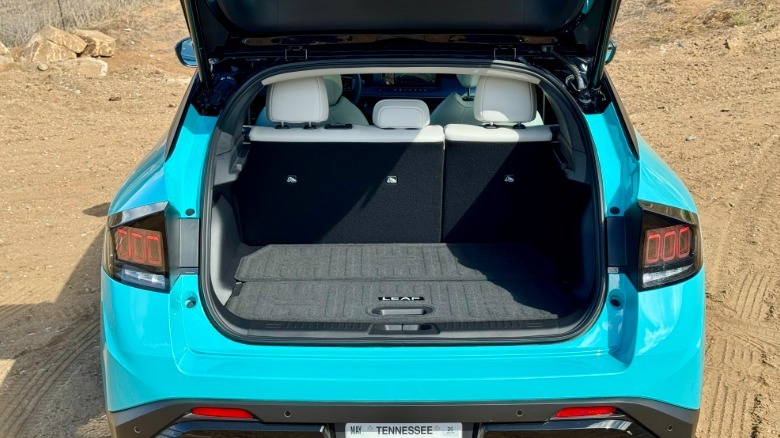
On the upside, when you open the Platinum+ trim's hands-free power tailgate, cargo space behind the rear seats is about 3 cubic feet smaller than last year, but there's nearly double the space at 55 cubic feet when the rear seats are folded down. The cargo space is nicely flexible, with under-floor storage that's hidden from sight by a frustrating split floor that is not hinged, just tethered by a bunch of straps that I couldn't figure out, but it can double as a cargo divider. There is no frunk here, though, so all your cargo needs to fit in the trunk.
It's a delightfully sprightly Leaf
All Leafs fitted with the 75-kWh battery pack have a front-mounted motor that sends 214 horsepower and 262 pound-feet of torque to the front wheels only; no all-wheel-drive option is currently available, though Nissan didn't rule out the possibility of AWD in the future. The upcoming base model's smaller front-mounted motor will produce 174 hp and 254 lb-ft of torque.
My fully loaded Leaf Platinum+ had ample power for accelerating and passing, without the neck-snapping immediacy of some EVs. When accelerating from a standstill the power to came on gradually, which should make the driving experience smoother for the first-time EV adopters that the Leaf is likely to attract. The driving experience is delightfully sprightly thanks to the Leaf's low center of gravity and a steering rack that feels a bit lazy when pointed straight but tightens up significantly when you turn it more than halfway. All new Leafs come with four selectable drive modes: Normal, which is normal; Sport, which increases throttle response and nicely firms up the steering Eco, which nerfs accelerator pedal inputs drastically to conserve battery; and Personal, which is customizable.
 Logan K. Carter/ Jalopnik
The Leaf's brakes are a mixed bag. The first few inches of travel when I pushed the brake pedal felt mushy and didn't actually seem to do much in terms of deceleration, but when I dug deeper into the pedal they worked just fine. There's no one-pedal drive mode, which is a disappointment, but there are four levels of regenerative braking as well as a not-quite-one-pedal-drive E-step mode that's solely engaged by pressing a console-mounted button. I was thrown off by the fact that the brake pedal physically depresses when regen deceleration is initiated with E-step mode engaged. When I was coasting with my foot off the accelerator in E-step and went to tap the brake pedal to reach a complete stop, the brakes grabbed harder than they would in any other drive mode because the brake pedal was already partially depressed, which threw me and my co-driver forward.
Nissan gave the new Leaf four-wheel independent suspension, which the company says allows for a quieter, more composed ride, and it has a nicely hushed ride that doesn't smack or crash over broken pavement. The cabin is well-insulated from the road, with some wind noise sneaking in around the wing mirrors and door seals, but it's mighty quiet at city speeds. The suspension allows a very natural amount of body roll in corners, but unfortunately, it also caused an unpleasant pogo-like behavior from the suspension on undulating road surfaces that felt like the car was see-sawing or bucking fore and aft. It's not a dealbreaker, especially at the Leaf's price point, but it might be troublesome for passengers who suffer from motion sickness.
It's a tech-forward Leaf
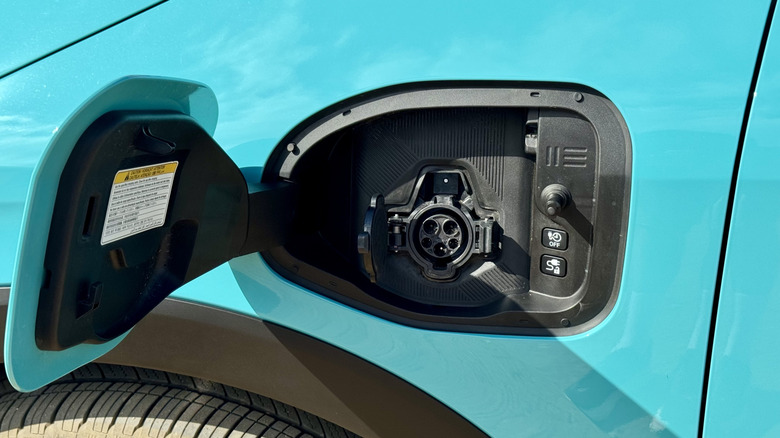
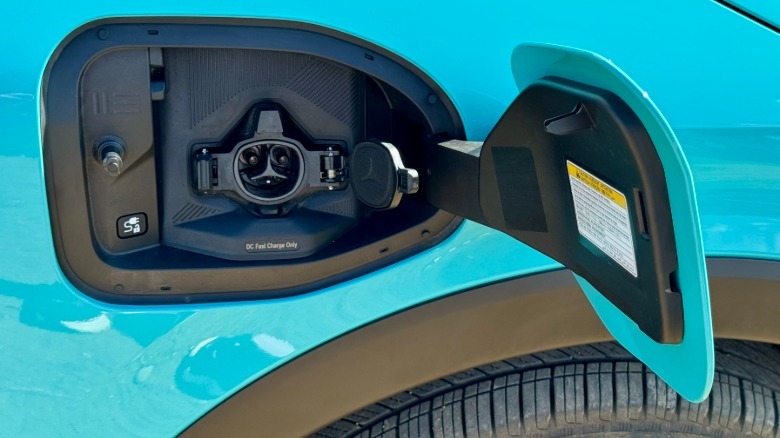
Two of the Leaf's most distinctive attributes are the driver-side-mounted J1772 AC-only charge port, and the NACS DC-only charge port on the passenger side. In theory, these two options open the Leaf to both Tesla chargers and other public chargers, but there's a complicated and confusing difference between the two. The J1772 charge port on the driver's side is only able to accept AC power, which includes up to Level 2 charge speeds, so if you charge your car at home, you can only use that J1772 plug. If you want to fast-charge your Leaf, you can only use the NACS port on the other side. So if you have a Tesla charger installed at your home or property or want to charge at an NACS slow charger, you will need an adapter, and if you want to fast-charge at a CCS station, you will need an adapter. This is sure to confuse the general public whose eyes just glazed over reading that paragraph.
At least it no longer has a CHAdeMO port, and Nissan finally gave the Leaf a liquid-cooled battery which will improve its longevity, vehicle-to-load capability, and a battery heater that's a $300 option on all trims and helps to maximize charge speeds in cold weather. Nissan says the 75-kWh battery can charge at up to 150 kW, and that a 10%-80% fast-charge takes 35 minutes, which is about 10 minutes less than the 2025 Leaf needed to achieve the same feat despite having a much smaller battery.
 Logan K. Carter/ Jalopnik
All Leafs come with Nissan's ProPilot Assist system that includes adaptive cruise control and lane centering, as well as the Safety Shield suite of automated emergency braking, blind spot monitoring, lane departure prevention, and rear cross traffic alert. The base S and S+ trims have a 12.3-inch gauge cluster display and a 12.3-inch infotainment touchscreen, while all other trims get dual 14.3-inch screens. All trims have standard wireless Apple CarPlay and Android Auto as well as two front USB-C ports, but only SV+ and Platinum+ trims get rear AC vents, a wireless phone charger and two rear USB-C ports. Platinum+ trim Leafs like my test car also get heated outboard rear seats, a head-up display, a 12-way power driver's seat, and a 10-speaker Bose audio system with speakers in both front seat head restraints, which I didn't find to be particularly high fidelity. Base cars get a measly 4-speaker stereo, and SV+ cars get a 6-speaker system. Those two upper trims also get Google built-in with Google Maps, Google Assistant, and access to the app store, and this is the first Nissan that allows video streaming when parked.
It's a lovely Leaf
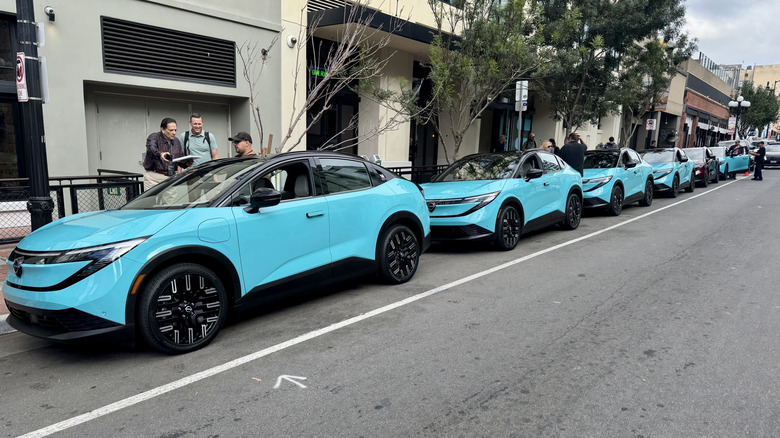
Overall, I really enjoyed driving the third-generation 2026 Nissan Leaf. Is it perfect? No, but it is the cheapest EV on the market right now, and it's a quantum leap forward from the second-gen Leaf. At a time when the average price of a new car is nearly $50,000, the new Leaf represents a great value, especially in its lower trim levels. The mid-grade SV+ trim has plenty of desirable features and still rings in at the $35,000 mark, and it's the trim I would go for if it was my money.
By the end of its life, the second-generation Leaf was totally brown and shriveled up, even sprouting some mold, barely clinging to relevancy. But the new Leaf is fresh and vibrant, a crossover that's reinvigorated and ready to bring affordable and even desirable emissions-free motoring to the next generation of affordable EV buyers.