

The US Navy Is Retiring Its Cruisers, Here's What's Replacing Them
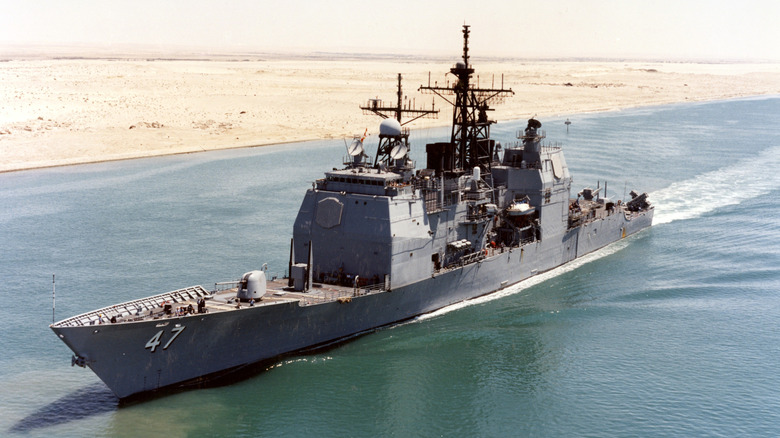
Cruisers have always been some of the baddest and most heavily armed warships in the U.S. Navy's fleet, but they're now officially on the way out, destined to be replaced by smaller destroyers –- and, eventually, a new vessel from the DDG(X) program to develop a large surface ship. Of the 27 Ticonderoga-class guided-missile cruisers that the Navy built from 1980 to 1994, only five are still in business, and by 2029, they will all be mothballed, according to Stars and Stripes.
Ticonderoga cruisers have cost the Navy about $1 billion each and are platforms for the Aegis Combat System, an insanely sophisticated radar technology that can manage numerous simultaneous threats from enemy missiles and aircraft. With this capability, Ticonderogas have performed a critical role in defending vulnerable aircraft carriers, but they also bristle with versatile weaponry, including Tomahawk land-attack cruise missiles, numerous surface-to-air and anti-ship missiles, plus naval guns and the Phalanx close-in system. They carry choppers and torpedoes, and they can hunt submarines.
Their mission emerged during the Cold War, when Navy strategists figured their all-important flattops would be giant sitting ducks in a major-power conflict, but Ticonderogas still saw plenty of action during the two Gulf Wars and later in the War on Terror. Arleigh Burke-class destroyers are the immediate replacement to secure the waves as the era of the big cruiser draws to a close and the Navy strives for a more flexible, high-tech fleet in the future.
Worn-out hulls and botched multi-billion-dollar upgrades
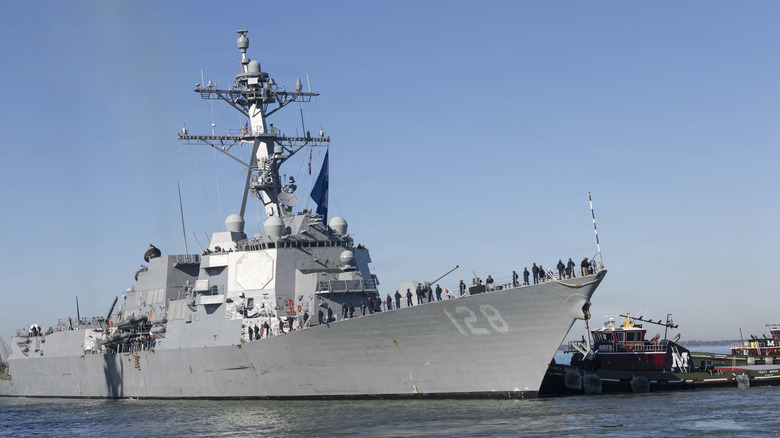
As innovative and generally dominant as the nearly 10,000-ton Ticonderoga class has been, these are some pretty old boats at this point, and only the U.S., Russia, China, and South Korea continue to keep ships that are large and well-armed enough to qualify as cruisers in their fleets. Decades at sea have degraded the hulls, critical systems have become outdated, and the cost of keeping the cruisers not just afloat but effective in battle has steadily risen. A brand-new Arleigh Burke Flight III destroyer might cost $2.7 billion, but modernizing a "Tico" still runs over $600 million.
The Navy has been aware of these issues for a while. Back in the 2010s, it hatched a plan to keep some of the Ticonderoga class in service, to maintain the ability to protect carrier groups, serve as air-defense command ships, and ensure that the U.S. could launch all the massive missile salvos it needed (Burke destroyers can't match a Ticonderoga cruiser's firepower).
It didn't go well. The U.S. Government Accountability Office (GAO) aggressively criticized a $3.7-billion effort to update 11 cruisers that started in 2015. In a 2024 report, the GAO said that "The Navy wasted $1.84 billion" because four cruisers were decommissioned before they were returned to service. The three that ultimately made it through -– USS Gettysburg, USS Chosin, and USS Cape St. George -– will avoid being scrapped until the entire Ticonderoga class calls it quits in about three years.
Asking more of Arleigh Burke
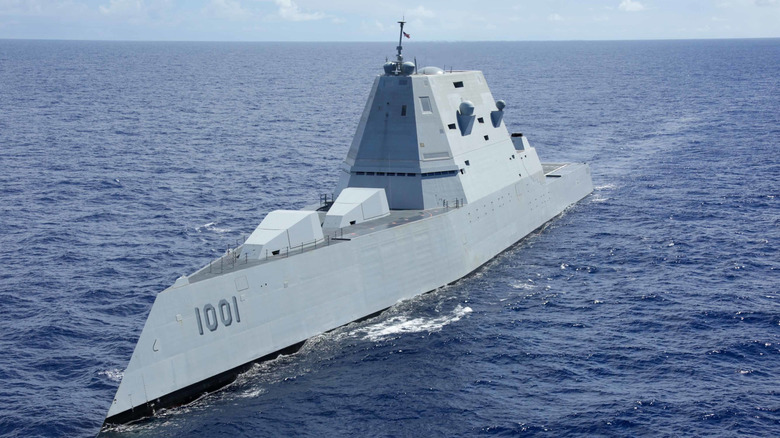
While the Ticonderoga class might have been among the Navy's most potent warships for decades, as the cruisers are phased out, the role of bringing Aegis and high-impact missile tactics to surface warfare will increasingly fall to the stalwart Burke-class destroyers. The Navy doesn't have a choice. The stealthy Zumwalt-class destroyer program was cancelled after appalling cost overruns and some fairly embarrassing operational failures, including the USS Zumwalt itself having to be towed out of the Panama Canal in 2016.
The pressure is on. The Ticonderogas are sailing off into retirement like their WWII battleship predecessors that have become floating museums. The Zumwalts are an expensive bust, and whatever now comes out of the DDG(X) program isn't arriving until the early 2030s. The U.S. Navy is staring down a Chinese Navy that has been building ships at a furious pace. It is also contending with a North Korea that's building destroyers (for now, North Korea is so bad at launching them that it needs giant balloons to save the capsized warships). Furthermore, the Navy is dealing with an intense tempo of deployments in the Middle East that has caused stressed-out crew members to attempt jumping overboard from the carrier USS Abraham Lincoln in response to poor conditions.
The Navy is also losing the Ticonderogas' missile-load capacity, meaning that it basically needs more Burkes to make up the difference. Adding to the challenges, the destroyers will have to shoulder the air-defense burden on their own. The bottom line is that it's going to be hard to say goodbye to those mighty cruisers, even if they are aging legends that have cost a fortune to keep in the fight.