

LED Traffic Lights Have A Winter Problem The Old Bulbs Never Did
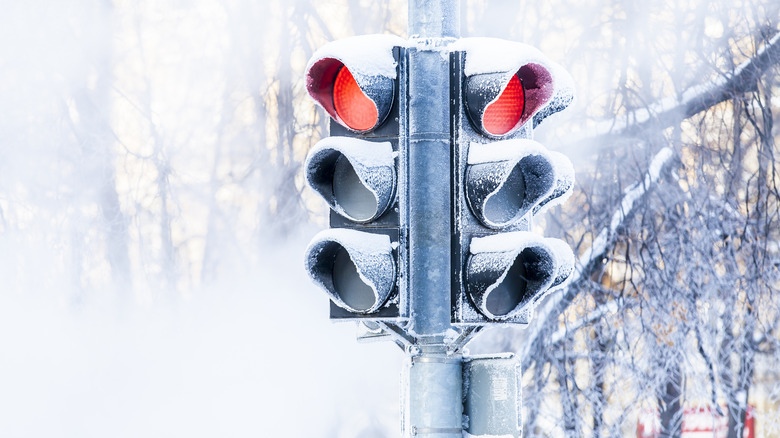
People don't often think about how evolving technology creates unforeseen issues. There's the obvious, like when good AI image generators became more accessible circa 2022. That caused the internet to become absolutely flooded with AI images, resulting in things like your grandma commenting on images of Shrimp Jesus and Dodge posting AI slop of its own cars. However, some unintended consequences of new technology are more subtle.
One example is the switch from incandescent bulbs to light emitting diodes (LEDs) in traffic lights. Incandescent bulbs were the standard for a long time, but the potential power savings of the initially more expensive LED traffic lights were worth the switch. Plus, LEDs are more visible than equivalent-wattage incandescent bulbs, and they last a lot longer before they need to be replaced. However, in colder climates where snow and ice are common, LED lights can get obscured and don't generate enough heat to melt the frozen precipitation. Snow-and-ice-obscured traffic lights have been linked to crashes and at least one fatality. Winter driving is already full of bad experiences, and not being able to see traffic signals compounds the unpleasantness.
LEDs aren't hot enough
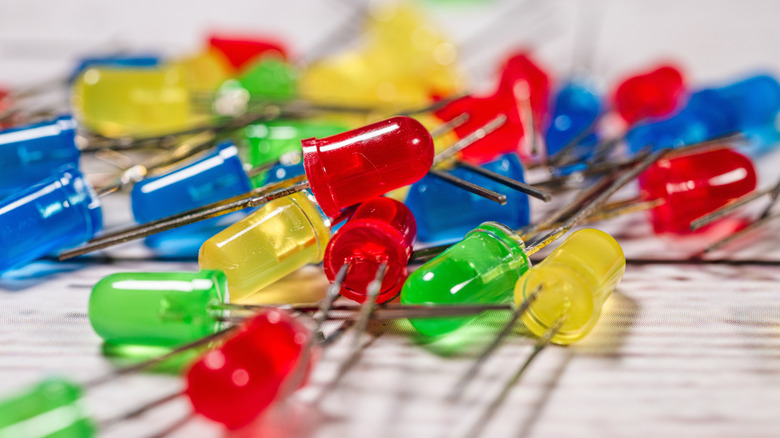
LEDs work by moving electric current across a semiconductor material. As the electrons move, the semiconductor emits light particles called photons. This is a very efficient process, as the majority of the electricity an LED uses generates visible light. In contrast, about 5% to 10% of the electricity that goes into incandescent bulbs generates visible light. The rest is just wasted heat energy. That's because incandescent lights work by heating up a thin, conductive piece of metal called a filament until it literally glows.
The wasted heat energy from incandescents is useful for melting snow accumulated on traffic lights in the winter, but equivalent LEDs are around 90% more efficient. That increased efficiency — plus the fact that LEDs can last 10 times longer than incandescents — is why governments and municipalities switched away from incandescent bulbs to LEDs. Another reason for the switch has to do with regulatory pressure. Part of the Energy Policy Act of 2005, signed into law by President George W. Bush, mandated minimum energy efficiency targets for traffic and pedestrian signals.
But there are solutions to the problem

The inability of LED traffic lights to melt snow and ice has been recognized since at least the early 2000s, and traffic equipment suppliers went to town engineering solutions. Some were more high tech, like Calienté's temperature-and-humidity-activated heated hoods for LED signals. Others were simpler, like Fortran's polycarbonate lens cover. Cities and municipalities came up with their own, albeit more hodgepodge, methods, ranging from applying chemical deicer before storms to manually removing precipitation with a telescoping brush.
The problem is that not all snow and ice storms produce the conditions to obscure signals. High humidity, near-freezing temperatures, and wind speeds greater than 10 mph are considered some of the biggest contributing factors causing obscured traffic lights. Also, not all states are affected equally. For example, in a 2002 feasibility study, the Arkansas Department of Economic Development concluded that snow accumulation on LED traffic lights is "not a major problem in Arkansas where severe snowstorms are rare." Local governments are also in control of how they approach the issue. For example, it might make more sense for snow-prone Utah to spend the time and money to retrofit a heating element to its traffic signals than it would for Arkansas. The number of variables involved with the problem is why there isn't a universal approach to clearing snow for LED traffic lights.