

Oldsmobile Once Let You Buy The Same Police Package It Sold To The Cops
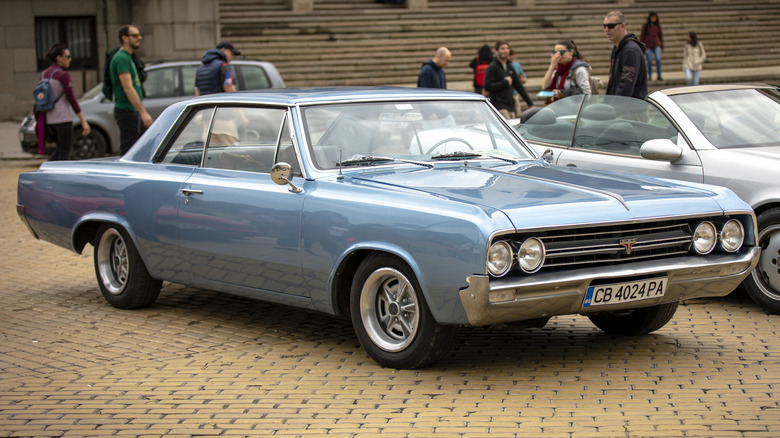
Most cop cars today are produced as standalone models. Ford, for example, offers pursuit-rated models like the Police Interceptor Utility and F-150 Police Responder. Civilians can't typically buy a pursuit-rated vehicle straight from the factory or dealer without special permission, either. At the dawn of the classic American muscle car era, though, Oldsmobile offered its 1964 F-85 Cutlass with the B09 Police Apprehender Pursuit package — and regular folks could actually buy it for just $285.
"B09" may sound like a boring options-list slot filler, but the package offered much more than some police-themed wheels. With it, buyers were treated to over 300 horsepower, a stiffened suspension, and a whole host of other goodies that transformed the F-85 Cutlass into a formidable performance machine. You may know it as the 442.
The thought behind Oldsmobile's B09 package was a competitive one. Prior to its release, Pontiac put its Le Mans GTO on the market for the first time — a model that's largely credited with kicking off the classic American muscle era. Oldsmobile felt it needed to get the new B09 F-85 Cutlass on the market quickly to meet the ultra-hot GTO. Once it arrived on the scene, it managed to carve out Oldsmobile's muscle car image going forward.
The B09 package turned the F-85 Cutlass into a true muscle car
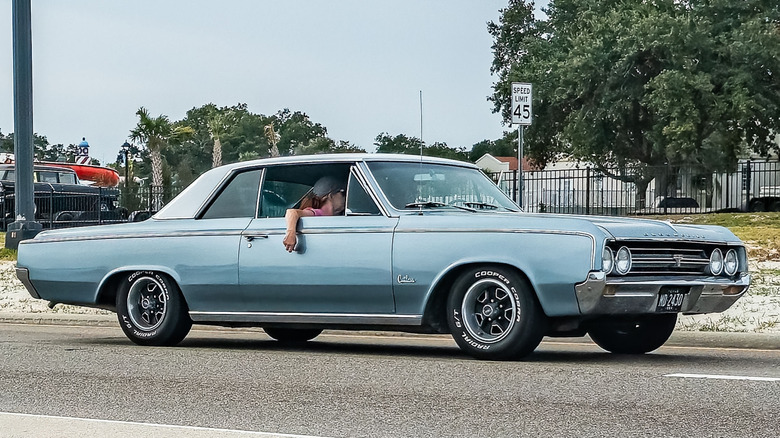
Oldsmobile already had a couple of police packages for its F-85 Cutlass, one of which was called the B07 Highway Patrol package. With the B07 option selected, Cutlasses would come equipped with a 310-horsepower V8 and a beefier suspension setup. Using the B07 as a baseline, the B09 package took shape.
Right off the bat, Oldsmobile's B09/442 Cutlass ran into some issues. Pontiac's then-general manager, Pete Estes, had been more than happy to bend the engine displacement limits in place at the time to further the division's GTO project. Jack Wolfram, Oldsmobile's boss, was less enthusiastic about rule-breaking. Regardless, he greenlit the B09 project.
It came with a 330-cubic-inch V8 — 59 cubes smaller than the GTO's — and offered just 310 horsepower, as opposed to the Pontiac's maximum of 348 hp. At the time, Oldsmobile had a 345-horsepower, 394-cubic-inch V8 on hand, but opted not to use it for the B09 Cutlass. The Olds also used a single four-barrel carburetor, whereas the GTO offered a Tri-Power setup consisting of three two-barrel carbs.
Despite some performance shortcomings compared to its rival, the B09-optioned F-85 Cutlass was well-regarded for its performance and handling prowess. Period reviews praised its handling characteristics thanks to its addition of rear sway bars, stiffer springs and shocks, and wider wheels than the standard F-85 Cutlass. Plus, its 310 horses could rocket it from 0-60 mph in roughly 7.5 seconds, though this was about a half-second slower than the '64 GTO.
The package laid the path for the Oldsmobile 442
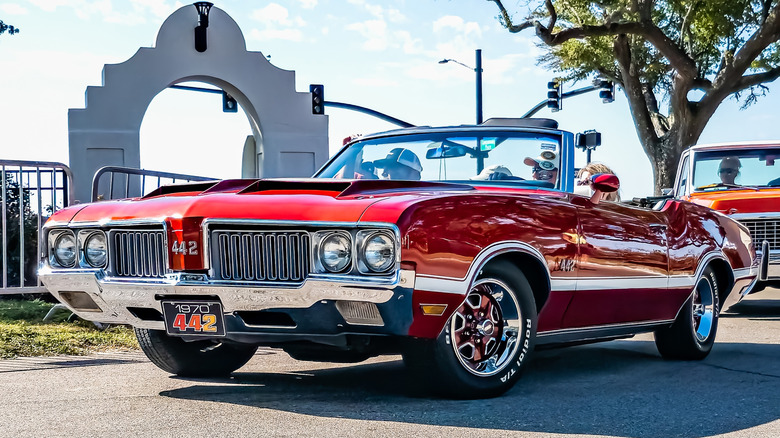
It wasn't long before Oldsmobile had the idea to exchange the not-so-exciting B09 name for something better. The package was renamed 442, which originally stood for 4-barrel carburetor, 4 on the floor, dual exhausts. By the end of 1964, Oldsmobile had sold 2,999 Cutlass 442s. The model entered 1965 with a few big changes — the largest being an all-new 400-cubic-inch V8, pumping out 345 GTO-fighting horsepower and 440 pound-feet of torque.
Come 1968, GM's A-Body platform — upon which the Cutlass was based — was given a redesign. At the same time, the 442 shifted from being an option package to a standalone model based on the Cutlass. In 1970, the 442 saw its most powerful iteration yet, with up to 370 horsepower on tap courtesy of a 455-cubic-inch V8. From there, horsepower figures began to drop as new emissions standards took effect, with the 442 moniker being relegated to something reminiscent of an appearance package beginning in 1975.
The 442's final swan song took place in 1991 as an option package for the front-wheel drive Oldsmobile Cutlass Calais. From there, Oldsmobile would only survive as a brand for another 13 years before its final model would roll off the assembly line. Had it not been for the B09 package, Olds may have never been able to break into the muscle car game, and may never have made a name for the 442 as the comfortable car with an attitude.