

What Are The Different Classes Of Campers, RVs, And Motorhomes?
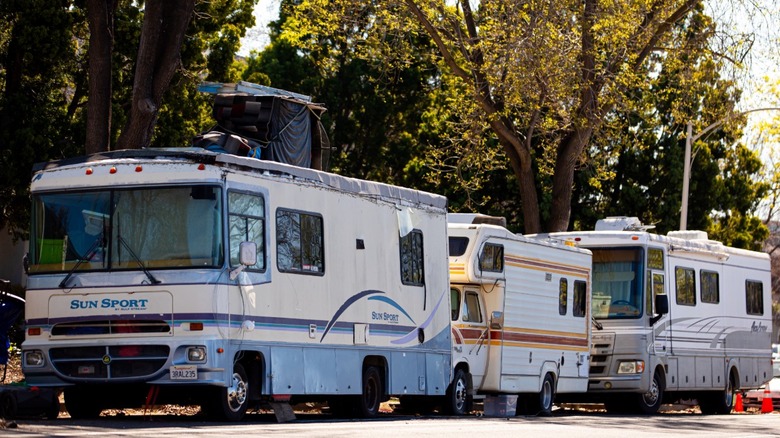
There is a wealth of choices when it comes to the types of campers, RVs, and motorhomes you can spend your free time in, so much so that you can find one of them for just about any style of camping and almost any budget. They range from small pull-behinds that aren't much more than a step up from a tent to those mammoth rolling McMansions you see plodding along the interstate. With so many choices, how do you know which one is right for you? One place to start is our list of five things to know before you buy a used RV.
It also helps to understand the different classes and types of RVs, motorhomes, and campers. "RV" is a general term for all campers and motorhomes. "Motorhomes" refer to RVs that you can drive. There are three classes of motorhomes: Class A, Class B, and Class C. Class A motorhomes are the largest, Class B are the smallest, and Class C is in between, with some overlap in size with the other classes.
Next, you have towables — campers that are towed. This includes large travel trailers — which utilize a ball hitch linked to the towing vehicle's frame or rear bumper — bigger fifth-wheels attaching to a hitch over the truck's rear axle, and foldable campers like pop-ups and A-frames. Even though they don't have a drivetrain, slide-in truck campers aren't technically towables since they're hauled. You also have hybrid campers expanding out to the sides and rear, as well as park models, which aren't meant to do much traveling, but are designed to be towed to a spot and left there as a resort unit.
Class A motorhomes – The big boys
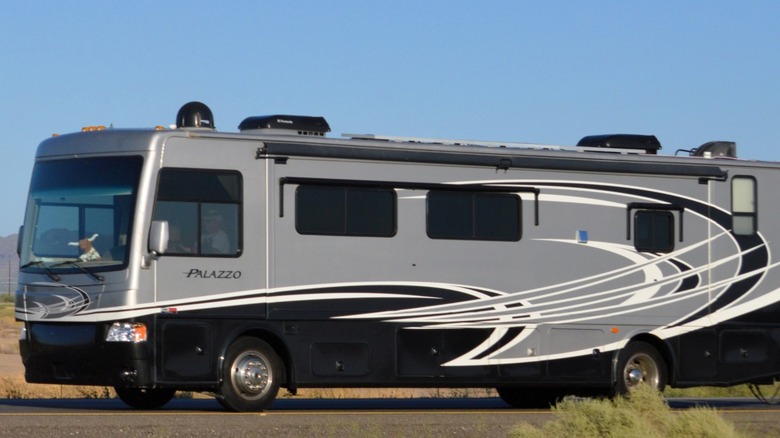
If you've ever done an interstate road trip, you've passed more than one of those behemoth RVs, usually driven by some retiree taking their time in the slow lane. The really big RVs that look like a bus are Class A motorhomes. Thor Industries says that this class can range from approximately 25 to 45 feet in length and weigh from around 12,500 to 54,000 pounds. You'll also find a maximum of four slide-outs and room to sleep up to ten people, which, frankly, is more than we could comfortably put up in our house. Some of these bad boys have a loft and a patio on the back. The Thor Aria 4000 is particularly posh, offering a spacious master bedroom, a set of bunk beds, a full stack washer and dryer, four spots for TVs (including one on the outside), and two full bathrooms — one of which has two sinks. Then you have Class A toy haulers, featuring a garage that can carry an ATV or motorcycles.
Since Class As often have all the comforts of home, it makes sense why some luxury models can cost as much as houses in nice neighborhoods. The Newmar King Aire, for instance, is listed at over $1.7 million. Granted, that's the company's top-of-the-line luxury model. The least expensive Class A it offers, presumably for the poors, lists at over $250,000. Many Class A motorhomes are built on a commercial bus or truck chassis, and usually have a flat front end. You can find them in either gas or diesel.
Class B motorhomes – The campervans
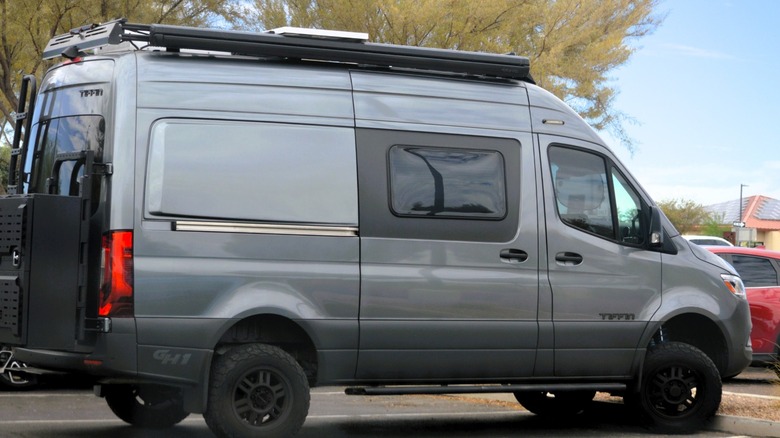
If you can bear to go camping without loading up everything from your house, or if you'd like to stay the night somewhere without taking up the entire back parking lot of a Cracker Barrel, then maybe Class B motorhomes are for you. They are much smaller than Class A motorhomes, usually around 17 to 24 feet in length, and weigh around 8,550 to 11,000-plus pounds, though these ranges can vary based on whom you ask. Thor says Class B motorhomes can sleep up to four people. Maybe. When it comes to the ones we've seen, sleeping four people would be pretty tight.
That's not to say some models can't be fancy. The VACANZA-ion 22 comes with an impressive galley that includes a combination microwave-convection-air fryer and a nicely sized refrigerator-freezer. It also comes with AWD and a power awning with a wind sensor.
These RVs are also called campervans, and are typically built on a Mercedes-Benz Sprinter, Ford Transit, or Ram ProMaster chassis. Still, these are not the same as the vans that vanlifers on YouTube build out. Class B RVs are sold new, completely self-contained, with a bedroom, kitchen, bathroom, and running water. The vehicles DIY vanlifers usually start with are regular cargo vans that they've stuck a bed, a sink, and often a bucket into. Some of them aren't even tall enough to stand up in. In certain cases, buying a van like a Ford Transit and converting it won't save any money.
Class C motorhomes – The Goldilocks of RVs?
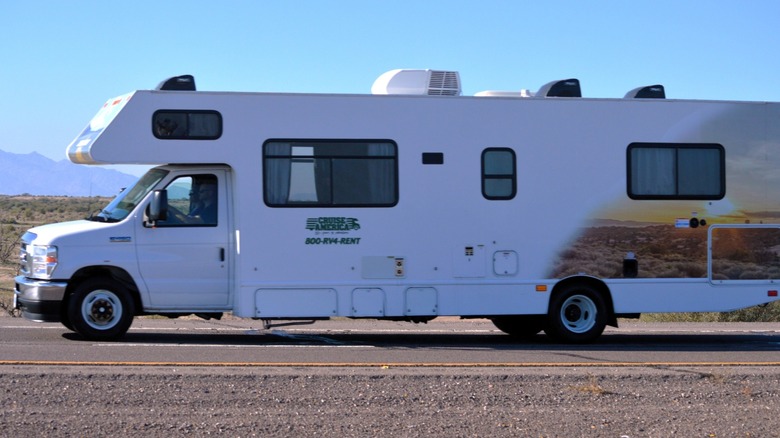
So, if Class B motorhomes are smaller than Class A, then Class Cs must be smaller than Class B, right? Ha ha, no, that would be too logical. Class C motorhomes fit in between, not as big as Class A RVs, but larger than Class B RVs. If the three bears each owned RVs, Goldilocks would probably find the Class C to be just right. Class C RVs are built on cutaway truck or van chassis and usually have a sleeping compartment over the cab. The elements combine to form a distinctive silhouette. Thor says Class Cs run from 23 to 39 feet long and weigh about 11,000 to 32,700 pounds. As you can see, there can be some overlap in size between Class C and Class A motorhomes.
Some RVs are given the designation "Super C," but that's a marketing category, not an official class. Each manufacturer has a different definition of what a Super C is, but what they have in common is that they are essentially really large Class C motorhomes, usually on a medium- or heavy-duty commercial truck chassis. One example is the Entegra Coach Accolade. Depending on the floorplan, you could have an electric fireplace, as well as a full-size couch and a full-size dinette, not a dinette that doubles as a couch.
It's much the same with the term "B+," which is used to describe smaller Class C motorhomes that look like large Class B RVs, since they often lack the overhead compartment. They are still Class C RVs, though, because they are built on a cutaway van or chassis.
Fifth-wheel trailers
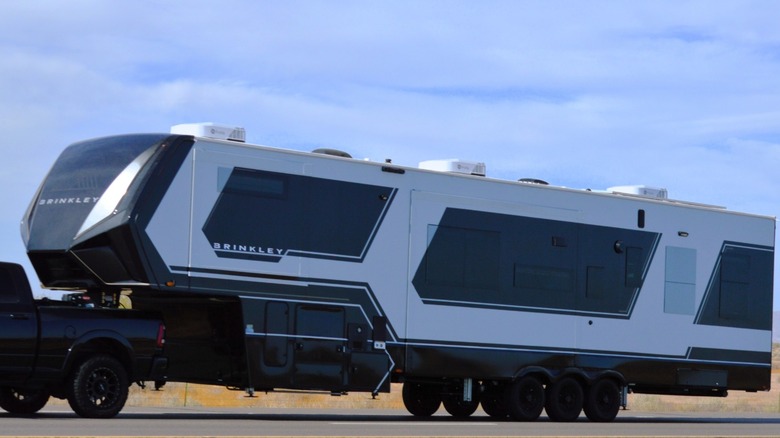
Most regular readers of Jalopnik know what a fifth-wheel is. We are a car website, after all. In case you don't know, a fifth wheel is a large hitch for big trailers. You've seen a semi-truck without its trailer. That big horseshoe-looking thing on the back of it is the fifth wheel. Fifth wheels can also be installed in the beds of heavy-duty pickups, and the hitch can connect with fifth-wheel RV trailers, which tend to be pretty large.
While this references Thor's own lineup rather than a broader industry range like the previous examples, Thor says fifth-wheel trailers measure from 36 to 45 feet long. That means they can have more living space than even a Class A motorhome, especially if you consider the compartment that comes out over the hitch. Some of these trailers are big enough to be toy haulers, as well.
But living space isn't the only advantage of a fifth wheel over a motorhome. Imagine you've backed, with great difficulty, into your camp spot, set up the chairs, grill, outside lights, mat, and other items. You rolled out the awning. Then it occurred to you that you forgot to pack plastic silverware. It's just one item, but how are you supposed to eat dinner without forks? With a fifth wheel, you don't have to pack everything back up and break down your site just to go to the store. You can just disconnect your truck, leave your trailer at the site, and go.
Conventional travel trailers
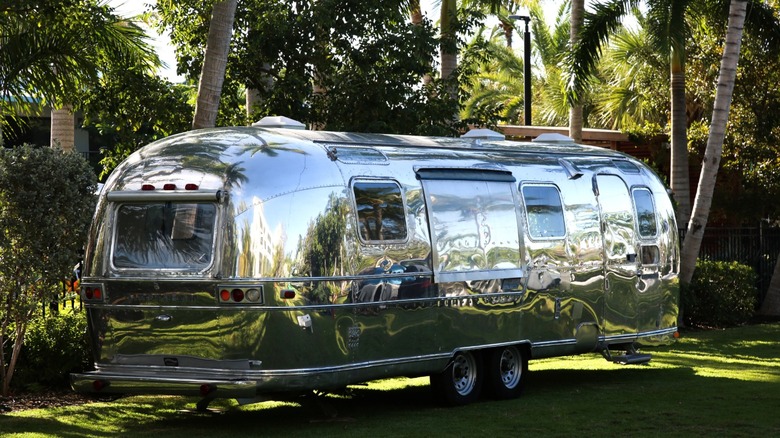
You don't necessarily need a big dually equipped with a fifth wheel to pull a camper around. Conventional travel trailers are made to be towed with a standard receiver hitch (frame-mounted receiver) attached to the back of an SUV or pickup, most commonly full-size. Some campers are light enough to be towed by a small car. Honda recently built a prototype of a trailer designed to be towed by EVs and small crossovers. Of course, you'll always want to check the towing capacity of your vehicle against the weight of a fully-loaded camper before trying to pull one. Travel trailers can range in size from around 15 feet all the way to over 40 feet. They can weigh as little as a couple thousand pounds or as much as nearly 14,000 pounds.
The biggest ones have pretty much everything a fifth wheel has, except for the sleeping compartment that would go over a fifth wheel hitch. The smaller and mid-size travel trailers can come in a variety of shapes. You might be familiar with the small teardrop trailers. Some teardrop trailers may contain a kitchenette and a wet bath, while the smallest ones don't even have enough room to stand up in. Still, it's better than sleeping in a tent.
Prices vary wildly. Runaway Campers sells a tiny pull-behind, the CoolCamp, for just over $6,000. The 28-foot Airstream Trade Wind 27 FB is probably mid-size for a travel trailer, but is not mid-priced at almost $163,000. The 36-foot Prowler 3202DSB starts at around $42,000.
Folding camping trailer
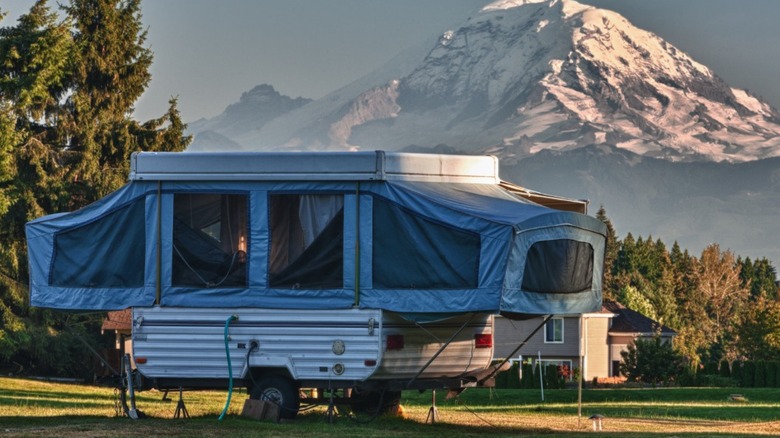
If you'd like a camper that's lighter than a small conventional travel trailer, is easier to maneuver, and doesn't take up as much storage space (yet often has more room than a typical teardrop), you might look into pop-up campers. These campers stay folded down into a very compact trailer while they are stored or are being towed, and then fold out into a nice-sized living space at the campsite.
Traditional pop-up campers additionally extend their ends, providing two separate sleeping areas. These are soft-sided sections, meaning the experience is sort of like being in a tent, but without sleeping on the ground. Pop-up campers can come equipped with a simple toilet, shower, sink, and sometimes even air conditioning. However, basic ones lack amenities like a bathroom.
Another type of folding camper is the hard-sided A-frame. The roofs on these campers fold out to a point, resembling an "A", and can feel smaller than pop-ups, though they sometimes have the same amenities. Others are very simple, being just one step above a tent. Hybrid campers are a little different. Generally, they do not fold down, but they do pop out on the ends to provide more space.
Truck campers – a whole RV in the back of your truck
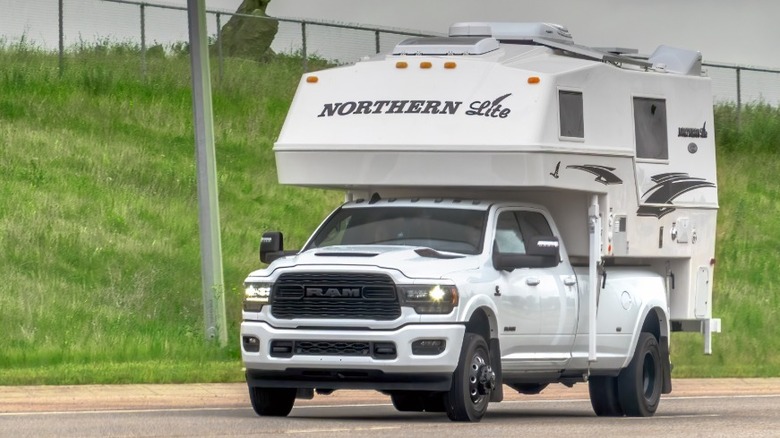
If you've ever watched "Doctor Who," you know that the hero travels around space and time in a machine they call Tardis. On the outside, Tardis looks like a 1960s-era police call box you'd find in the U.K., but on the inside, it was a huge, multi-room ship. That's sort of the sensation you get stepping into some truck campers — they seem a lot bigger on the inside than they look on the outside, so much so that you might forget you're standing in the back of your pickup. You should take a look at the Host Cascade to see what we mean. This thing can come with, depending on your chosen floor plan, two recliners, a sectional couch and dinette, a sizable kitchenette, a dry bath with a full shower, a bedroom, and even a simulated fireplace that is actually an electric heater. We don't mean to gatekeep, but at what point does camping stop being camping and just become staying in another house?
There are simpler truck campers, of course, and most are, in fact, much more modest. A dinette, a sink and stove counter, a bathroom, and a bed compartment are pretty standard for most slide-in truck campers. Some are even simpler, with a pop-up soft-side roof, a bed platform, and maybe some benches. What all of these different RV classes and types boil down to is that you've got plenty of camping choices.