

Nobody Knows What This Space Object Is Or Why It Can Move Against Gravity
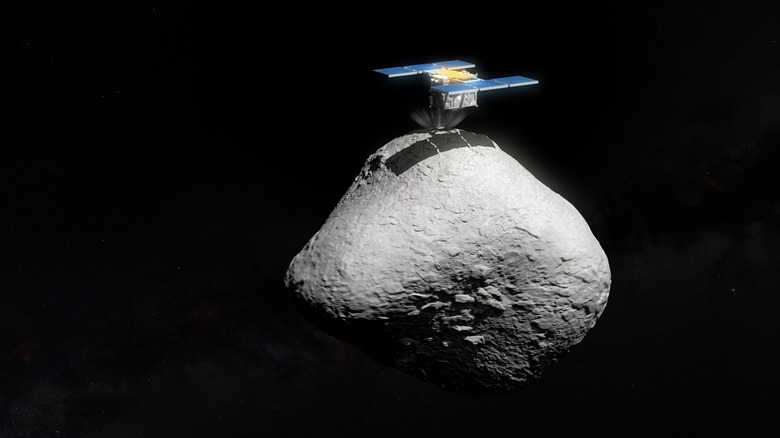
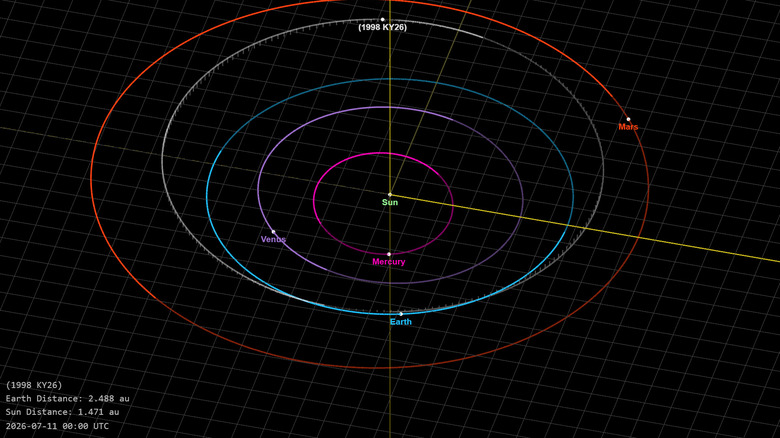
A small object orbiting the Sun has long befuddled scientists, and recent research has simply befuddled them more. Called 1998 KY26 and discovered that year by astronomer Tom Gehrels of the University of Arizona, it is quite simply not following the laws of gravitational dynamics. In other words, it's accelerating, someway, somehow. Multiple theories have been proposed as to what could be happening, but with new evidence coming in, none of those theories quite seem to fit. It's probably not aliens. But it just might be communists.
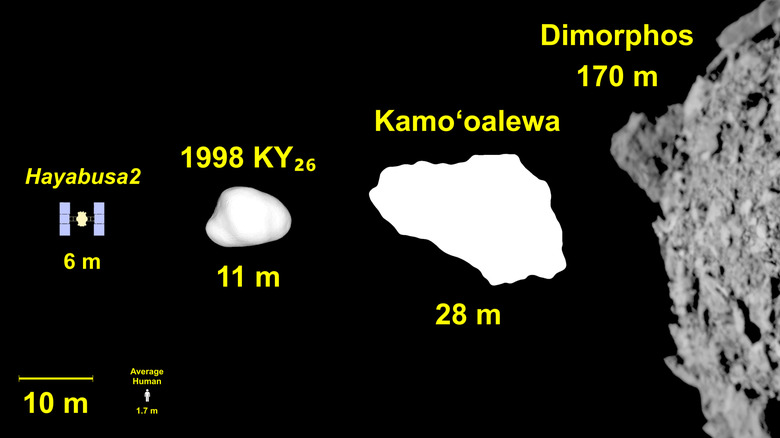
So, what do we know for sure? Not much. Whatever it is, it's about 36 feet across. That bit is relatively new information, since scientists initially estimated it was about three times larger, per the BBC's Sky at Night Magazine. It's also in a very rapid spin, rotating about once every five minutes. It has a very high albedo (no jokes, straight to jail with you), meaning that it reflects more sunlight than is typical for a space object. Earth's Moon, which lights up your night, reflects 12% of the sunlight it receives; 1998 KY26 reflects about 50%.
Oh, and there's the minor detail that it's accelerating. Again, there are theories about what it is, but none of them fit quite right.
How to accelerate in space
Comets are true cosmic beauties, with their long tails streaking behind them. But those tails aren't just for looking pretty: they are the emissions of the comet's ice, going straight from solid to gas and skipping the liquid water stage altogether ("sublimating"). That process also knocks off particles from the comet's rock, and as the law of conservation of momentum stipulates, shooting these particles away from the comet means the comet experiences a slight push forward. Acceleration! There's just one problem: 1998 KY26 has no tail. Oops.
Fourteen such objects have been discovered in our solar system. Called "dark comets," the thinking is that they are in fact sublimating like a normal comet, but for some reason, the process isn't visible. So, Theory Number 1 is simply that 1998 KY26 is indeed outgassing, you just can't see it (again, no jokes, straight to jail with you).
Case closed? Not quite. Per the New York Times, recent research demonstrates that the object has a temperature of minus 53 degrees Fahrenheit, which is far too warm for ice (things are weird in space). If there's no ice, then there's no sublimation, and in fact the object cannot be a comet at all, let alone a dark one. There are other options. But they get weirder.
Light and heat and temper tantrums
Here's something you may not have known: photons of light, which have no mass, have momentum. That means that sunlight actually exerts pressure, which might have an appreciable impact on an object's velocity over time. There's also the Yarkovsky effect, or the force generated by emitting heat (in this case, again from sunlight). So Theory Number 2 is that these forces have created enough thrust on 1998 KY26 that it's pushed past where gravity alone would have taken it. The New York Times quotes NASA as preferring this explanation. Unfortunately, other scientists claim that these effects simply do not provide enough forces to explain the object's acceleration.
Theory Number 3 has the object as an asteroid, not a comet. Remember, this thing is rotating once every five minutes; that's fast enough that it might well be yeeting pieces of itself off into the universe. If, for some reason, that yeeting is all in a similar direction, you'd have extra thrust. But why would the asteroid throw a temper tantrum only in one direction?
If you have at last reached the "aliens, bro" stage of your thinking, calm down, because not even Harvard's resident alien guy thinks it's them. But he does think it's the Soviets.
In Soviet space, object accelerates you

Last year, our solar system was visited by an object from the outermost reaches of our galaxy. Called 3I/ATLAS, it drew all manner of speculation as to its nature, but there was one man who questioned its intentions. Harvard astrophysicist Avi Loeb became something of an internet darling for proposing that it was an alien spacecraft. Would you believe he's also got opinions on 1998 KY26? Per Newsweek, he once again does not believe that it's a natural object. But this time he thinks he knows exactly what it is: Phobos 1, a probe intended to study Mars and its moon Phobos for the glory of the Soviet Union in 1988. The glory of Phobos 1 was short-lived, as the proud comrade manning the control console for the probe entered a typo, which deactivated crucial systems and lost them the craft. Spelling matters, kids.
It didn't blow up, but nobody knows where it went. So, with 1998 KY26, we have an object that is roughly the same size, on roughly the right trajectory, that is freakishly reflective. That sure does sound like a metallic probe with solar panels. Theory Number 4 holds that Phobos 1 came to its current orbit via two thruster burns (presumably via faulty circuitry), on September 2, 1988, and May 19, 1996. This is pure conjecture, however, and not that much more sophisticated than "aliens, bro." There is no direct evidence that 1998 KY26 is non-natural. NASA rejects this theory.
Where does that leave us? As with the astrophysicists studying it, it leaves us with more questions than answers. The good news is, Japanese space agency JAXA launched the Hayabusa2 probe to go there and find out what it is once and for all! The bad news is, it's already aborted from that mission due to an engine problem. So the mystery remains, as it slowly orbits the Sun, too quickly for gravity's math, dancing on its own.