

The Longest Stretch A Sports Car Has Gone Without A New Platform Is 84 Years

Sure, the 2027 Chevy Express is the same as the 2026 model, which was the same as the 2025, which was the same as the 2024, and so on. But all joking aside, the Bowtie brand's body-on-frame van has only been riding on the same platform for about three decades. That's nothing compared to what Morgan did with its sports cars. The company introduced a steel ladder-style chassis with its 1936 Morgan 4-4, and from that point through 2020 — a span of 84 years — nearly every four-wheeled Morgan featured the same basic setup.
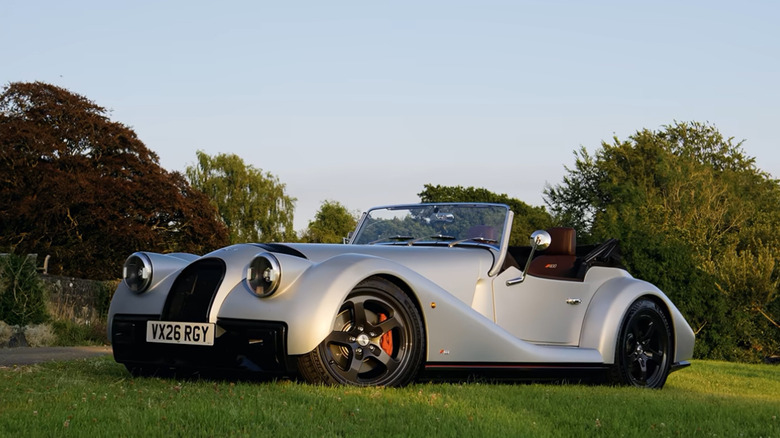
Of course, Morgan cars have remained true to their original 1930s vibes in a lot of ways, right down to their appearance. Even the new Morgan Supersport 400, the company's most powerful vintage-look roadster yet, maintains its flowing pontoon-style fenders, ash-wood body frame, and disdain for most modern technologies. Despite being the first Morgan to come with hands-free calling, the Supersport doesn't have a touchscreen — just a small and simple driver display with a trip computer and a digital speedometer. As for advanced driver-assistance systems, well, the car doesn't even have a rearview camera. It's exempt from most federal safety regulations due to its highly limited production numbers. The company produced approximately 35,000 steel-chassis cars before switching to a new platform, representing an average of roughly 417 cars per year.
Morgan's long-running steel chassis was likewise fairly old-fashioned. Essentially just a pair of Z-shaped steel rails connected to each other by five cross-members, the chassis rode on a basic leaf-spring suspension at the back and a sliding-pillar configuration up front. And the roots of that front suspension go back even further, as it was developed by Henry Frederick Stanley (HFS) Morgan in 1910.
The evolution of the Morgan chassis
Just to be clear, Morgan actually started using aluminum chassis in 2000, when it introduced one for its relatively short-lived line of Aero cars — starting with the Aero 8, which also stands out as the first Morgan model with a BMW powertrain. However, other Morgans continued to ride on the steel setup through 2020.
Meanwhile, Morgan was ready to introduce its new CX platform made from bonded aluminum. It first underpinned the 2019 Morgan Plus Six, which was named for its BMW-sourced I6 turbo engine. The lightweight chassis weighed a mere 220 pounds, but it was so stiff that the Plus Six had twice the torsional rigidity of the car it replaced in the Morgan lineup.
Then, in 2025, Morgan premiered the new Supersport with a further evolution of the CX chassis. The Supersport's CXV setup stiffened the chassis by 10%, plus another 10% when the detachable hardtop was in place, and enabled Morgan to enhance the steering and suspension systems as well. As regards the former, the results included a 13% quicker steering speed backed by improved feedback for the driver. The new suspension, now with standard anti-roll bars and revised geometry, promises "a compliant ride, better body control, and enhanced handling."
And yes, the Morgan Supersport is available in the U.S. The one major catch, though, is that we only get the four-cylinder model — a 2.0-liter TwinPower turbo-four with 255 horses and 258 pound-feet of torque. It's plenty peppy for a car weighing around 2,500 pounds. But the European Supersport 400 can deliver up to 402 horsepower from its turbocharged 3.0-liter BMW straight-six, taking the Morgan experience to a whole new level.