

Diesel Prices Used To Be Cheaper Than Gas - Here's Why That Changed
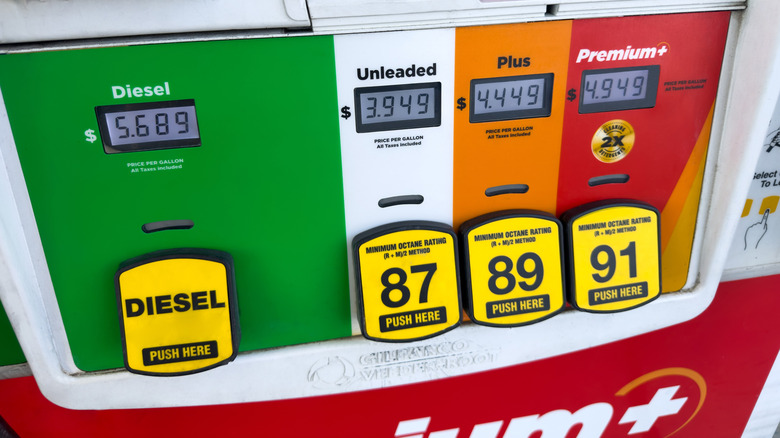
Many Americans are not particularly happy about the country's soaring gas prices. Currently, the national average for diesel is $6.06 a gallon, and gasoline is at $3.87, according to AAA. While tensions in the Middle East have some part to play in increasing global crude oil prices, diesel being more expensive than gasoline is not something new in the country.
In fact, "On-highway diesel fuel prices have been higher than regular-grade gasoline prices, on a dollar-per-gallon basis, almost continuously since September 2004," according to the U.S. Energy Information Administration (EIA). Before that diesel was typically cheaper than gas, except during winter months when demand was high, as the fuel is commonly used in home heating.
Relatively high demand across Europe, China, India, and the United States is one of the reasons why diesel got more expensive than gasoline over the years. Beyond the usual supply-demand dynamics, other variables, like the push for low-sulfur diesels, also raised the fuel's production and distribution costs, due to the additional refining involved. Another contributing factor, per the EIA, is the federal excise tax for on-highway diesel, which is 6 cents a gallon higher than gasoline. Throw geopolitics and supply constraints into the mix, and you start to see why prices are so high.
The rate at which diesel prices rose when compared to AAA's data from the same time last year is quite staggering. While gasoline's national average was $3.08 a gallon, diesel's was at $3.76, meaning diesel jumped more than 60% during that period. And that's despite the U.S. running a diesel surplus and refineries churning out at near-maximum capacity with 97% utilization. So, why are diesel prices so high?
Supply constraints are a major factor

Despite less than 3% of U.S. passenger cars using diesel, the economy, whether it's shipping, logistics, agriculture, or construction, relies heavily on diesel. Compared to gasoline, diesel is a bit more inelastic, meaning price changes won't necessarily impact its demand. "People still drive a lot when gas prices go up, but consumers do vote with their pocketbook, and they will cut back on trips and stuff," says Gregg Ibendahl, an associate professor of agricultural economics at Kansas State University (via Scientific American). "When it comes to diesel fuel, though, it's not that way at all," Ibendahl continues, "Diesel price is $2.50 higher than what it was in spring, but that's not going to stop a single farmer from running their combine out there."
According to another EIA report, high crude oil prices and reduced refining activity in Russia, China, and the Middle East are part of the reason for the rising diesel prices in recent months. Ukraine targeted many of Russia's refineries, China suspended its fuel exports to protect its domestic stocks, and the Strait of Hormuz ... well, you know what's happening there. This naturally increases demand for exports from the United States, as the country is one of the largest producers of refined oil products in the world. If you weren't aware, the U.S. exports about 1.5 million barrels of diesel per day. Domestic consumption is around 3.6 million barrels per day, and the country refines roughly 5.3 million barrels per day, according to the American Action Forum. So, why not cut the exports like China did? Won't more domestic supply reduce diesel prices?
That could backfire

An export ban won't necessarily make things any better, reckons the aforementioned American Action Forum. According to its report, while an export ban may initially cool wholesale prices in the Gulf Coast (where major U.S. diesel production is concentrated), lower prices may not translate to other parts of the country because of logistics and infrastructure constraints.
In the case of New England, for example, it's much cheaper to import diesel from Canada than to source it domestically. The West Coast, Hawaii, and Alaska also import diesel to supplement their domestic supply. A sustained ban would eventually force U.S. refiners to cut back on production as they might face trouble finding options to absorb the excess supply. If refineries reduce production, it would drive up prices of all petroleum products, including diesel, which defeats the whole point of having the ban in the first place.
If global tensions continue and supply constraints remain, it's unlikely that diesel prices will come down. President Trump claiming "We don't need a deal with Iran" is certainly not a positive sign. Hopefully, the Democrats, now having won the midterms, could perhaps turn things around.