

This 40-Year-Old Econobox Has The Top EPA MPG Rating Of Any Non-Hybrid Production Car
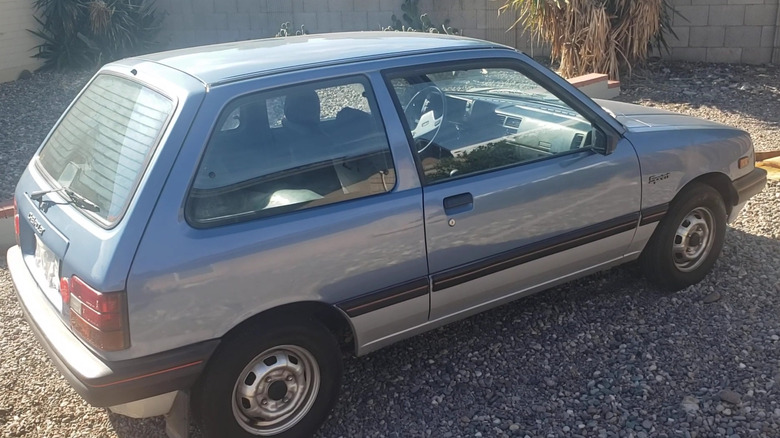
Welp, we may have finally reached a turning point. Yes, short-sighted automakers have been supporting Trump's move to roll back fuel-economy standards. But voters seemed to have had other ideas on Election Day 2026, when the Dems secured both the Senate and House. Of course, while that may stop some of the madness, we're unlikely to see another fuel-sipper like the 1986 Chevrolet Sprint ER anytime soon. Chevy's tiny captive import originally posted an EPA highway rating of 60 mpg, a mark that no other non-electrified production car in the country has matched since. Plus, that highway score was complemented by ratings of 55 mpg in the city and 57 mpg combined.
Now, we'll get into some of the details about the Sprint ER below, but first let's head off some possible objections at the pass. The most important is that the EPA made a major change in how it calculates fuel efficiency back in 2007 and then retroactively updated its database. As a result, the 1986 Sprint ER currently shows an EPA line of 44 mpg city/53 mpg highway/48 mpg combined. That makes for decreases of approximately 20%/12%/16% compared to its original fuel-economy grades.
Some drivers have also topped 60 mpg in real-world diesel driving. A writer for Car and Driver, for example, hypermiled a 2017 Chevy Cruze diesel to the tune of 70 mpg over a test run of about 160 miles. It's just that diesel engines have some drawbacks of their own.
A short history of the small Chevy Sprint
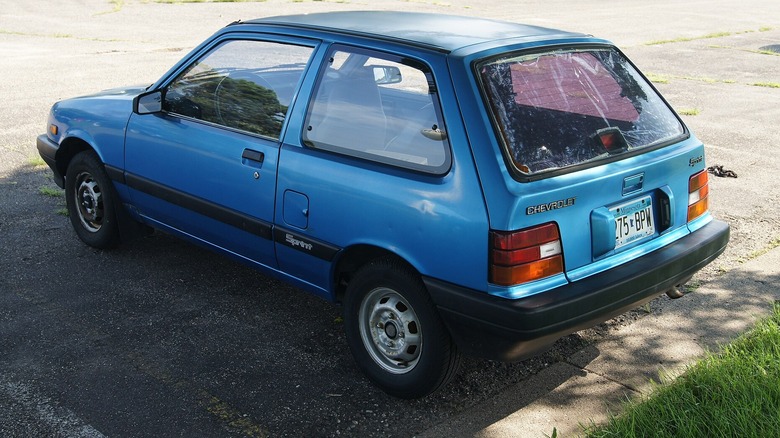
In a way, the genesis of the Chevy Sprint goes back to some of America's earlier meddling in the Middle East. The CIA had put Shah Mohammad Reza Pahlavi in control of Iran in 1953 — forcing out that country's democratically elected prime minister — and the shah was then overthrown himself as part of the 1979 Iranian Revolution. That led to the oil crisis of the same year, which helped convince GM to enter a three-way partnership with Isuzu and Suzuki in 1981. The goal was to build high-efficiency cars that were, basically, too small for GM to build at the time.
One of those cars was the JDM Suzuki Cultus, a car that would be renamed the Swift in Europe in 1985 and be rebadged as the Chevrolet Sprint for the same year. It also served as the Pontiac Firefly, but only in Canada. Now, this wasn't as tiny as a kei car, but it certainly wasn't big. That 1986 Sprint checked in at 144 inches long, 60 inches wide, and 53 inches tall — so it was about 1 inch longer than the 2022 Chevy Spark, but also 2.8 inches narrower, 5.4 inches shorter in height, and 774 pounds lighter. After all, the Sprint ER, a three-door hatchback, tipped the scales at only 1,504 pounds.
Yet svelte dimensions weren't the only factors in play. The regular Sprint was motivated by a 1.0-liter I3 engine capable of 48 horsepower, and Suzuki had revised the camshaft for the ER version. It made a significant difference, since the non-ER model had an original EPA line of 44/50/47 (37/45/40 in today's ratings).
How does the 1986 Chevy Sprint ER compare to today's cars?
For this section, please keep in mind we're going to level the playing field by using the post-2008 EPA ratings for the Sprint ER — which, as a reminder, features a fuel-economy line of 44/53/48 with its standard five-speed manual gearbox. Nowadays, the most fuel-efficient non-electrified car in the country is the 2026 Honda Civic that can see 32/41/36 with its 2.0-liter I4 motor and CVT. The 2026 Civic Hybrid, as an FYI, can raise the efficiency bar to 50/47/49.
The latter model isn't the country's most efficient hybrid, either. For that, we have to turn to the Toyota Prius. Sure, it gets an electric boost from its hybrid setup, yet the Prius may be the next gas-powered car to reach the 60 mpg club. The latest EPA line, for the 2027 Prius, is 59/50/55. Oddly, the 2026 Prius is listed at 57/56/57, and Toyota hasn't revealed what's changed. The same year Prius further led the way among hybrids with the best real-world gas mileage, at least according to Consumer Reports.
And the most efficient EVs can routinely see triple-digit MPGe figures with the EPA. The Lucid Air Pure, with rear-wheel drive and 19-inch wheels, sets the pace in this regard. It can squeeze out 149 MPGe in the city, complemented by grades of 142 MPGe highway and 146 MPGe combined.