

5 Generations Of The Chevy Impala SS Ranked From Best To Worst Horsepower Ratings
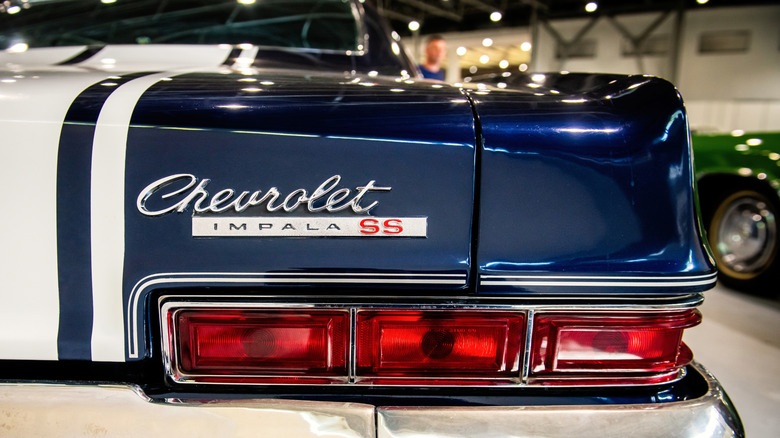
Mention a Chevy Impala, and thoughts of an unremarkable family sedan may come to mind, but add an SS next to the nameplate and things change. The Impala SS (Super Sport) is a pure horsepower play that dates back to 1961, two years after the Bowtie brand launched the Impala as a standalone model. Its numbers are still impressive, even by 21st-century standards. The retail version of the Impala SS from the 1960s, which covered two generations, produced up to 425 horsepower. The later Impala SS generations from the 1990s and 2000s were less brutish, offering between 240 and 303 hp, but they were still a step up from their more mundane counterparts.
However, these horsepower numbers come with a catch. The output figures for 1960s Impala SS models reflected gross horsepower ratings, which generally didn't account for intake, exhaust, and accessory loads. When the 1970s rolled around, the auto industry was dealing with tighter emissions regulations and insurance companies that took a dim view of high-powered cars. By the 1972 model year, Detroit switched to net horsepower calculations to better reflect real-world engine configurations. Because gross horsepower ratings often varied from manufacturer to manufacturer, there's no standard way to convert horsepower ratings between the methods, but both still measure horsepower at the crankshaft, not the wheels.
Our ranking of every Impala SS generation by power takes into account the highest advertised horsepower ratings for regular-production SS models, regardless of whether it's gross or net. Special race versions and modified cars are excluded. Here's how every Impala SS generation compares in maximum power output.
1961-1964 Chevrolet Impala SS: up to 425 hp
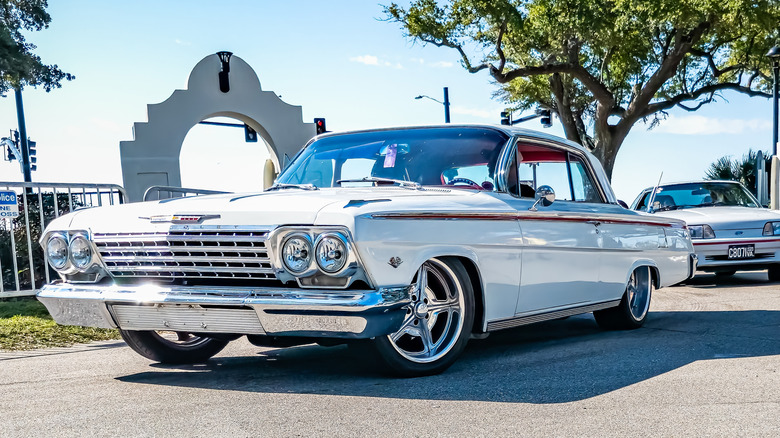
The first Impala was a variant of the 1958 Bel Air, but the SS designation didn't arrive until the third-generation Impala in 1961. The second generation, without a Super Sport option, filled the two-year gap as the free-standing Impala model. The first Impala SS model's power output is a story of progression. The 1961 Impala SS arrived with a choice of V8 engines: 348-cubic-inch units rated at 305, 340, or 350 horsepower and a 409-cubic-inch V8 officially rated at 360 horsepower. In 1962, that king-of-the-hill powerplant could also be configured with dual four-barrel carburetors, increasing output to 409 horsepower.
Thanks to solid lifters, dual exhausts, and an 11:1 compression ratio, the 409's output rose to 425 gross horsepower for the 1963 model year. Chevy history buffs may also recall a 1963 Z11 lightweight drag-racing Impala with a 430-horsepower 427-cubic-inch V8. Keep in mind that this one wasn't a Super Sport model, nor was it a part of regular production, as only 57 were ever produced. The 1964 Impala SS continued with the same 409 from the previous year.
1965-1969 Chevrolet Impala SS: up to 425 hp
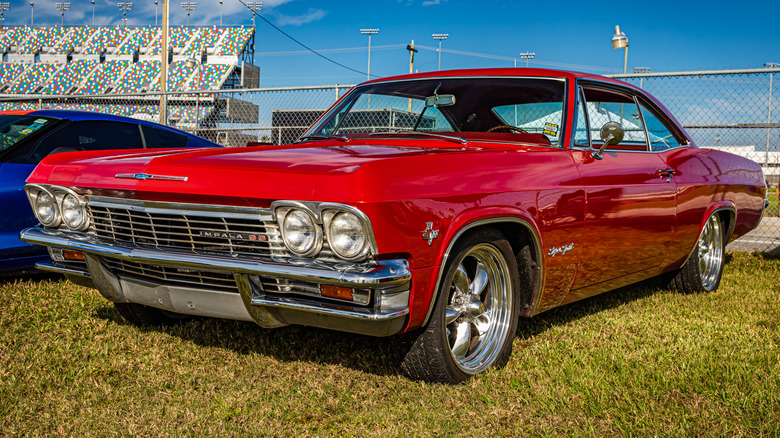
Horsepower for the second iteration of the Impala SS was in familiar territory, with peak outputs sitting at 425, but the Impala eventually took a different route to get there. To start, Chevy launched an entirely new Impala with a sleeker exterior and a perimeter frame, ditching the X-type architecture of the outgoing model. The new looks helped the 1965 Impala become the best-selling single model of all time. A record 1,046,514 units were sold, with roughly 23% being SS variants. Impala SS examples from this generation still attract a lot of attention online.
The top engine for the non-SS 1965 Impala was the familiar Turbo-Fire 409-cubic-inch V8, making 400 horsepower. For the SS, Chevy also offered the L78 V8, a 396-cubic-inch V8 rated at 425 gross horsepower. A year later, the L72 427-cubic-inch V8 joined the options list, also rated for up to 425 hp. The powerplant featured a forged crankshaft and pistons, solid lifters, and a dual exhaust system. The SS 427 continued into 1967 and 1968, but with a slightly different L36 engine, still with 427 cubic inches, but now rated at 385 hp. In 1969, output increased to 390 hp.
2006-2009 Chevrolet Impala SS: 303 hp
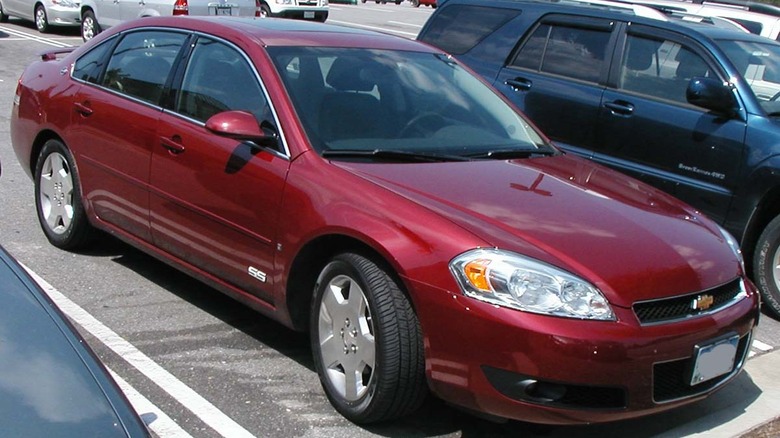
The final Impala SS came with 303 hp, which is the most of any modern generation. The supercharged V6 in the previous eighth-generation SS was replaced with a naturally aspirated 5.3-liter LS4 V8. That results in a zero-to-60 mph dash of 5.6 seconds, which is on par with a modern-day Mazda Miata – but remember, this was 20 years ago.
That seems straightforward enough, but the final-generation Impala SS has some quirks that don't match its muscle-era badge. Notably, the ninth-generation Impala was front-wheel-drive, and naturally, so was the SS variant. Power traveled through a four-speed automatic transmission, albeit a heavy-duty version. Despite having an upgraded suspension that helped this SS go beyond a rental car-spec version, reviews of the day weren't particularly kind to the SS. In a 2006 road test, Car and Driver stated, "The SS seems to have been created to produce impressive numbers on paper with little regard to driver enjoyment." Nonetheless, the Impala SS's swan song continued through the 2009 model year.
1994-1996 Chevrolet Impala SS: 260 hp
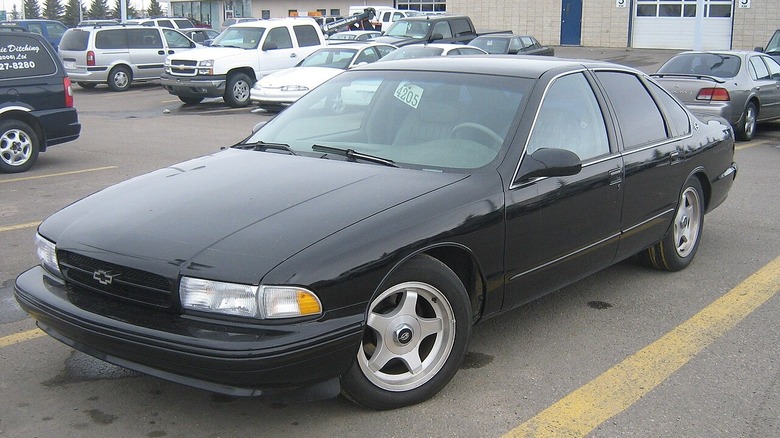
After a quarter-century hiatus, Chevrolet resurrected the Impala SS for the 1994 model year. This time, it was packaged in a rear-wheel-drive sedan with a 260-horsepower 5.7-liter V8 engine under the hood. Engineers didn't have to dig too far into the parts bin. This LT1 V8 already saw duty in the Camaro and Corvette, although there are different LT1 versions over the years. However, the engine in the Impala SS was modified with cast-iron cylinder heads and a different camshaft. It was also tuned for more torque: 330 pound-feet in this application. By today's standards, a 0-to-60 mph dash of seven seconds is nothing exciting, but this was three decades ago, and this Impala SS weighed about 4,300 pounds.
That bulk came from the full-sized Caprice, which underpinned this seventh-generation version. In effect, you could say that Chevrolet made a civilian version of the Caprice police car. The vehicle included an upgraded suspension, improved cooling, larger disc brakes, and a limited-slip differential. The five-spoke aluminum wheels and subtle strips of exterior chrome trim helped distinguish this Impala from its workhorse siblings. Leather upholstery was another clue. For its final production year, 1996, the column-mounted shifter was moved to the center console, and a tachometer was added. That's why low-mileage 1996 Impala SS examples still hold strong collector appeal.
2004-2005 Chevrolet Impala SS: 240 hp
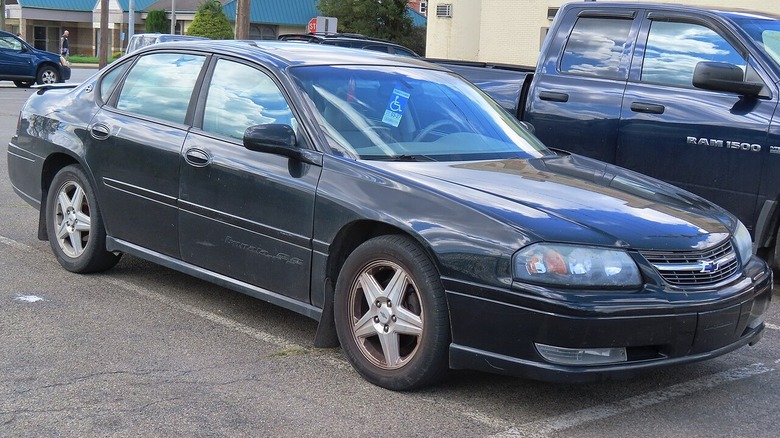
The short-lived eighth-generation Impala SS (2004–2005) stands out for a couple of reasons besides having the lowest engine output (240 horsepower). Namely, it's the only Impala SS with a V6 engine. Yet this is no ordinary six-cylinder powerplant; it's General Motors' 3.8-liter Series II engine with an Eaton supercharger, known for its broad torque band.
This Impala SS is based on the eighth-generation Impala, which was introduced for the 2000 model year as a front-wheel-drive sedan. Fast forward to 2004, and Chevrolet added the SS variant to the lineup, marking the first Impala SS that spins the front wheels. An upgraded four-speed automatic transmission controls the setup, but this Chevy also has larger anti-roll bars, modified springs, and Goodyear performance tires. As a result, 0-60 mph came in 6.5 seconds.
To go beyond a plain-Jane Impala, the automaker also added four round taillights (marketing language called this a Corvette-inspired treatment), black-only exterior paint, a small rear spoiler, leather upholstery, and a slathering of SS badges inside and out. This Impala was axed after 2005 to make way for the aforementioned 2006 Impala SS with a more powerful V8 engine.