

Hummer H1s May Be Nearly Indestructible, But Some Serious Flaws Live In That 'Nearly' Part
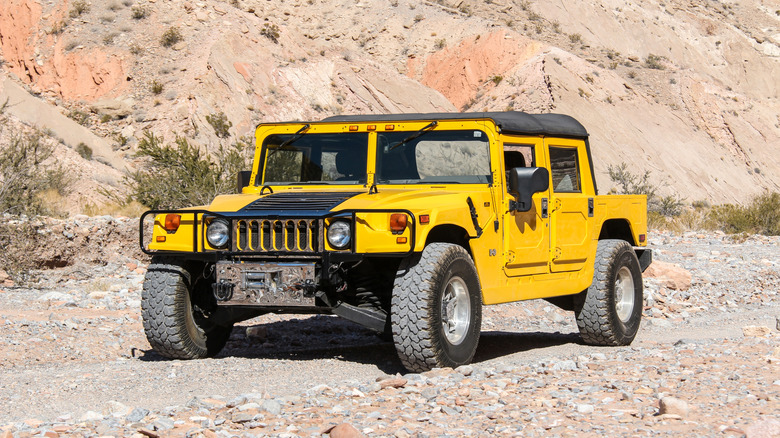
The Hummer brand officially launched in 1992 with the debut of its AM General High Mobility Multipurpose Wheeled Vehicle military-based civilian model. Much like the popularity of the Willys Jeep in post-WWII America, the H1 capitalized on rah-rah post-Gulf War nationalism and a personal endorsement from Arnold Schwarzenegger to find its place in the automotive zeitgeist. After being awarded its first military production contract in 1983, the big diesel-powered machine was well-proven by the time John Q. Public could place an order a decade later. If the HMMWV can be relied on by our fighting finest in the Muthanna Province, then surely it'll withstand the rigors of your suburban commute, right? Well, as it turns out, the answer is a cryptically Schrödinger-esque yes and no.
When it comes to imposing four-wheeled machines, there's nothing quite as eye-catching and road-commanding as the original Hummer. Between 1992 and 1999, the vehicle was sold in small quantities by AM General's civilian division, but General Motors purchased the rights to market and distribute the Hummer brand for the new millennium. With just shy of 12,000 units sold across the truck's entire production run, these things are a bit thin on the ground, but they maintain a strong cultural significance today, and the appeal of a genuine mil-spec vehicle is hard to deny.
Because of its high profile and rarity, every variant of the H1 generally still commands a pretty penny, even two decades after production ended. A high-mileage early non-turbo diesel model might bring as low as $35,000, while a low-mileage 2006-only H1 Alpha runs into the low six-figure range. If you're going to be spending that much money to get yourself one of these rolling monuments of gender-affirming care, what trouble should you expect and look out for? Let's dig into it.
What could go wrong?
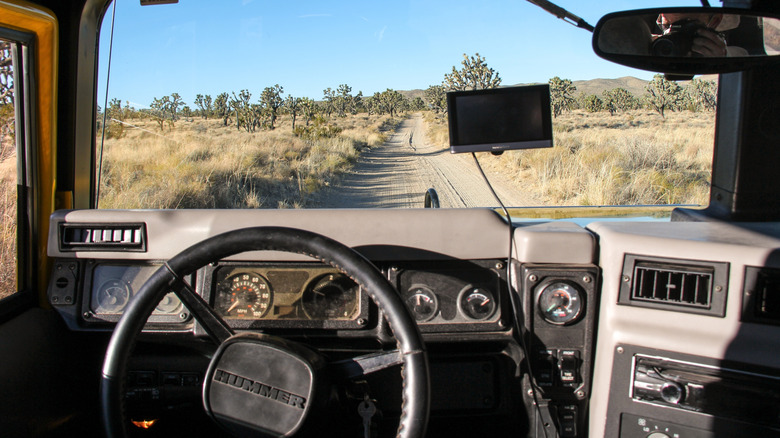
The first issue is that, simply due to their size and material density, they're really heavy. At around 7,500 pounds, you're moving a lot of metal around. Weight translates to atrocious fuel economy, like about 10 miles per gallon bad. Another downside: due to the military-based nature of these trucks, driver comfort is hardly a concern, and the noise, vibration, and harshness engineers were not really consulted in the design phase. According to a Hagerty review, the "engine sounds like a jackhammer inside the cockpit." Oh, and it doesn't have airbags.
On the plus side, a Hummer H1 is mostly indestructible, except for one major flaw. If you're a long-time reader of Jalopnik, you'll probably know where this is going, because over a decade ago our own Doug Demuro found out firsthand what breaks on the Hummer H1. I'll let him explain it.
"Beginning in about 1996, every single Hummer was fitted with a 6.5-liter Detroit Diesel turbodiesel V8, which combined the 194 horsepower of a Toyota Camry with the 438 lb-ft of torque from an angry farm tractor.
Well, there was one little issue: every single one of these engines was manufactured with a casting flaw that resulted in a crack on the number eight cylinder. Fortunately, the fix was easy: you just replaced the engine.
But check this out: it affected every single Hummer manufactured from 1996 to 2000... Every single Hummer built from 1996 to 2000 has either had its engine fail due to the number eight cylinder issue, or will have its engine fail."
The pre-1996 non-turbo Detroit Diesel-powered models, the rare gasoline-powered model, and the 2001-2006 models are unaffected. Check the engine casting number and make sure it was made after March 15, 1999.
Just an exploding engine? Is that it?

There is another major issue with Hummer H1 trucks, but it's significantly less catastrophic than a failed engine. The onboard tire inflation-deflation system leaks because, of course, it does. Especially after a couple of decades of sitting on display with low-mileage odometers, the rubber lines of the system tend to crack and drop pressure. It's possible to replace all of the lines and make it function again, and there are ways to bypass the system altogether and inflate your tires the old-fashioned way.
There are plenty of other issues that come with buying a twenty-year-old truck. Just like anything with decades of wear, keep an eye on worn suspension components, leaks, rust, ill-maintained brakes, and maintenance records. According to TireRack.com, a set of H1 tires will cost up to $2,240, so that information might help you negotiate. Also, because this is a rare machine, you probably won't find any of the parts you need for things like the tire inflation system at your local corner parts store. The parts exist, but you might want to keep the Hummer Parts Guy on speed dial.
There are plenty of options for '96 to 2000 trucks that haven't had their engines replaced yet. If you can get one for cheap, it might make the basis of an interesting project truck. I'm imagining a rare two-door pickup H1s with a Duramax "Mongoose" 8.3-liter turbo diesel V8, the one found in the current Chevrolet and GMC HD trucks making 555 horsepower and 1,230 lb-ft of torque. That might be the only way to make an actually fast Hummer.