

How Much Power Would An EV's Solar Roof Provide?
When looking at modern EVs, it's all about efficiency. Manufacturers boast about impressive drag coefficient numbers, door handles that retract, large dish-style wheels, teardrop-shaped exterior design, as well as flat, covered underbodies. Furthermore, closed grilles, tapered rooflines, and active aerodynamic features that change the car's aero profile depending on usage are becoming increasingly common.
You could also point to cameras in place of side mirrors, low-rolling-resistance tires, and heat pumps that keep the cabin warm in winter without massively draining the battery. The list goes on. However, you might be wondering about solar roofs. By pure logic, an EV covered in solar panels would be more efficient overall, since every mile the sun puts back into the battery is a mile you don't have to plug in for. Or would it? Actual output naturally depends on sunlight, weather conditions, and location. We'll expand on why solar roofs aren't mainstream on EVs later, but for now, let's evaluate how much power an EV's solar roof could theoretically provide.
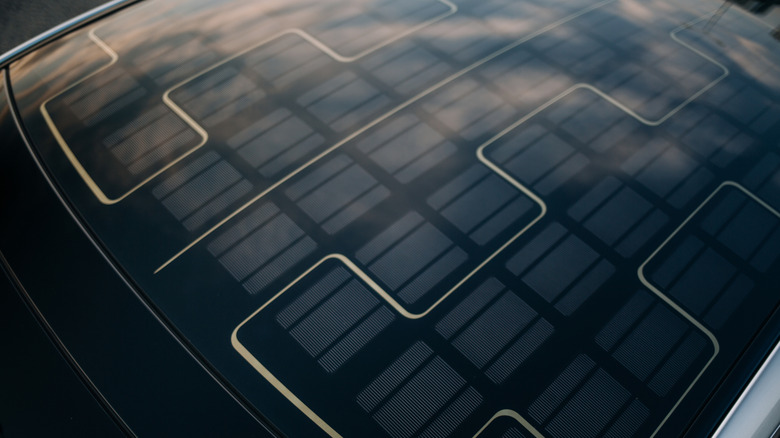
The Fraunhofer Institute for Solar Energy Systems reports that its prototype solar roof's integrated photovoltaic cells produce approximately 19.5 watts per square foot under nominal conditions. On a 21.5-square-foot roof, by our math, that's roughly 420 watts of peak power. Fraunhofer says its roof could add approximately 6.2 miles of driving range per day in peak summer sun. Over a full year, Fraunhofer's figures for Freiburg, Germany, which assume no shade, point to about 10% more range. Let's take a closer look at how much a solar roof can realistically do within the context of Los Angeles and a Tesla.
Tesla Model 3 solar roof example: Let's do the math
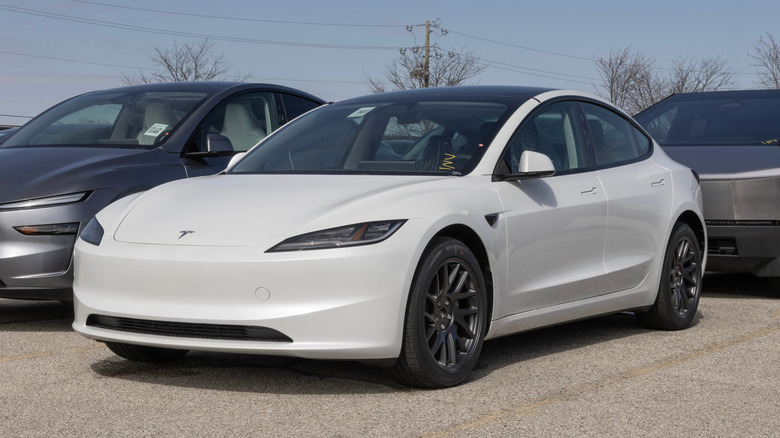
Picture a good old Tesla Model 3, one of the most popular EVs offering a leading range. Tesla doesn't list its roof area, so we'll stick with the 21.5-square-foot roof from earlier. Covered in cells rated at 19.5 watts per square foot, that roof would peak at 420 watts. Sunlight is measured in peak sun hours, the number of hours a day that add up to full-strength sun. Let's park it in sun-kissed Los Angeles, where data shows 5.62 peak sun hours a day as an average.
That gets our roof about 2.36 kWh (420 watts x 5.62 hours). In Edmunds' testing, the 2026 Model 3 Standard averaged 0.23 kWh per mile. Divide 2.36 by 0.23, and the roof adds about 10.3 miles a day (without energy losses), around 3% of the car's 321-mile EPA range. Summer's 6.14 hours bump that to about 11.2 miles, while winter's 5.03 drops it to 9.2. Again, those figures ignore the energy lost in charging, the added weight, aero penalties, etc.
Best case, that beats Fraunhofer's 6.2 miles, partly because the Model 3 uses 23 kWh per 100 miles versus Fraunhofer's assumed 27.4. And, for fun, how many Harbor Freight panels for 30 miles a day? That takes 6.9 kWh, or seven Predator 200-watt foldables in LA ($1,609.93 at the time of writing). That's 1,400 watts, more than triple the roof. Using 10-watt Thunderbolt trickle chargers, it's 123, for $5,533.77, plus a power station or inverter to feed the car. Ultimately, even in the best possible scenario, you still need to keep your charging cable handy.
Why don't EVs have solar paneled roofs?
EVs haven't jumped on the solar roof bandwagon for a few reasons. To start, there really isn't much roof to work with (as our Harbor Freight examples showed). A car roof is a small surface, and a panel only hits its rated output in full, direct sunlight. Overcast skies, winter's shorter days, and a layer of road dust all chip away at what the panels make, and a car that regularly parks in a garage collects next to nothing. The aforementioned Fraunhofer estimate is very optimistic, since it assumes a sunny, unshaded day. Solar Team Eindhoven's Stella Terra, a lightweight, student-built off-roader with a smaller battery, drove across Morocco to the Sahara, covering 621 miles without plugging into a charger. Now picture it in Seattle in January.
Then you have the added weight and complexity that comes with these panels. This can work against the efficiency promise, since added weight means the car burns more energy to get moving. Additionally, unless the panels are built flush into the roof, they become one more thing for air to trip over, undermining aero efficiency. These obstacles don't mean solar can't provide supplemental range, but the application isn't as practical as some might perceive it to be.