

Charles Lindbergh Flew 3,610 Miles Despite The Disadvantage Of Not Having A Windshield
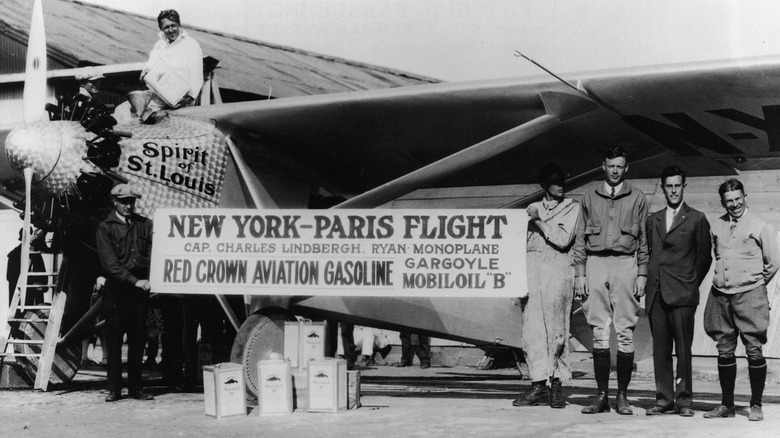
First off, let's keep in mind that Charles Lindbergh wasn't the first person to fly across the Atlantic Ocean. Some 66 to 80 people had already made the trip before him. Lindbergh, though, became the first person to fly solo and nonstop, from New York to Paris, in 1927.
Naturally, that achievement took a special kind of plane, so LIndbergh's Spirit of St. Louis had been modified for the attempt. And perhaps most importantly, that meant making room for enough fuel to cover his route of more than 3,600 miles. In the end, the plane carried 450 gallons of the stuff, an amount that weighed 2,750 pounds, representing more than half the craft's gross vehicle weight. Yep, that GVWR is as important for pilots as for RV and truck owners.
Of course, the engineers had to find a place to put all that fuel. The result was that the Spirit of St. Louis featured a main gas tank in front of Lindbergh's seat and extra tanks in the wings. Now, carrying all that fuel made sense, given the flight's nonstop nature. But Lindbergh had requested that the forward tank should fit between the engine and the cockpit for safety reasons in case of a crash. That may seem counter-intuitive, but Lindbergh was apparently worried about being crushed between the engine and fuel tank if the latter was mounted behind the cabin.
You can probably see where this is going, but Lindbergh certainly couldn't. With a large gas tank directly ahead of him, he had no way to look out the front of the plane. So it wasn't like the Spirit of St. Louis lost its windshield in flight, exposing Lindbergh to the elements. It didn't have a windshield in the first place.
How did Lindbergh fly the plane if he couldn't see forward?
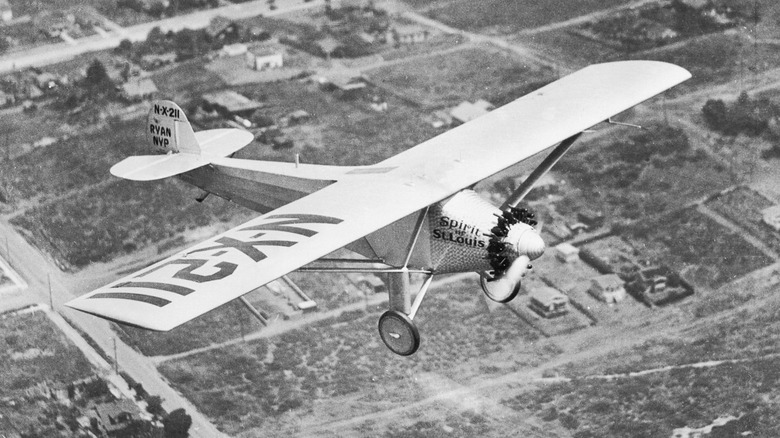
Lindbergh had a few tricks up his sleeve when it came time to fly the Spirit of St. Louis, starting with one he picked up in his days as an airmail pilot. Packed into relatively small planes crowded with bags of mail, he developed the skill of looking out his side windows to fly the craft. In fact, modern pilots are still taught how to use the so-called "Lindbergh Reference" method when something blocks their forward vision. It's basically a way of learning to use just the view from the left-hand corner of a windshield to understand a plane's roll, pitch, and yaw.
Helping matters — at least somewhat — was a retractable periscope Lindbergh could extend from the left-side window. The scope wasn't exactly easy to use, however. Lindbergh had to rely on a small mirror mounted to the instrument panel to get a view. Still, it's too bad that modern cars with terrible visibility don't have something similar.
Some modern pilots may wonder what the big deal is about Lindbergh not seeing what was in front of him, since flying, taking off, and landing can all be accomplished today in zero visibility. Well, the Spirit of St. Louis lacked the kind of sophisticated technology that makes that sort of feat possible. Heck, Lindbergh's plane didn't even have a radio or gas gauges — he kept track of fuel by penciling marks directly on the instrument panel. It all seems to have worked out, though. After taking off from New York's Roosevelt field on the morning of May 27, 1927, he touched down at the Le Bourget Aerodrome in Paris 33½ hours later.
How much did the Spirit of St. Louis weigh?
Logically enough, Lindbergh was sharply focused on the airplane's range — which explains why he carried so much fuel and so little else. Not only did he ditch the radio, he said goodbye to the parachute, navigation lights, and even a traditional pilot's seat. He sat on a wicker chair instead, designed his own lightweight flying boots , and skipped unnecessary maps.
The work paid off, as the unladen Spirit of St. Louis weighed only 2,150 pounds. Built for Lindbergh's transatlantic flight, it was based on a Ryan M-2 mail plane and adapted to meet the challenge. For example, its wings were stretched to a span of 46 feet, which required a longer tail, too. Meanwhile, the forward-mounted fuel tank extended the fuselage. The outcome was an overall length of more than 27 feet.
Providing motivation for the aircraft was a Wright J-5C Whirlwind engine. The air-cooled nine-cylinder mill delivered 220 horses and was known for its durability. Experts at the time claimed the motor could run for 9,000 hours, giving Lindbergh a cushion of roughly 8,965 hours in the Spirit of St. Louis. FYI: The plane was named for the city that hosted the first real gas station in the nation; it in St. Louis that Lindbergh found a group of businessmen to sponsor the flight.
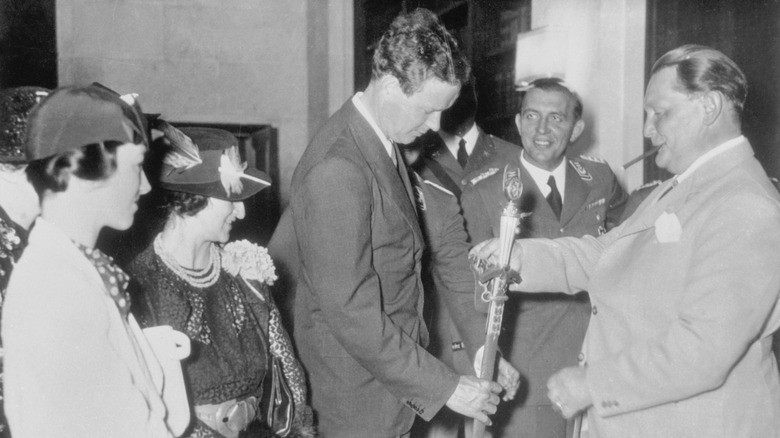
Also, in an odd bit of foreshadowing, Lindbergh had a "Native American swastika" painted in the plane's nosecone for good luck. Just nine years later, he discovered a different use for that symbol at the 1936 Olympics in Berlin, where he and his wife were special guests of Nazi leader Hermann Goering. Lindbergh must have liked what he saw, as he became a full-on Nazi sympathizer and antisemite.