

Was The Tesla Roadster Reveal Realistic? Engineering Explained Fact Checked It
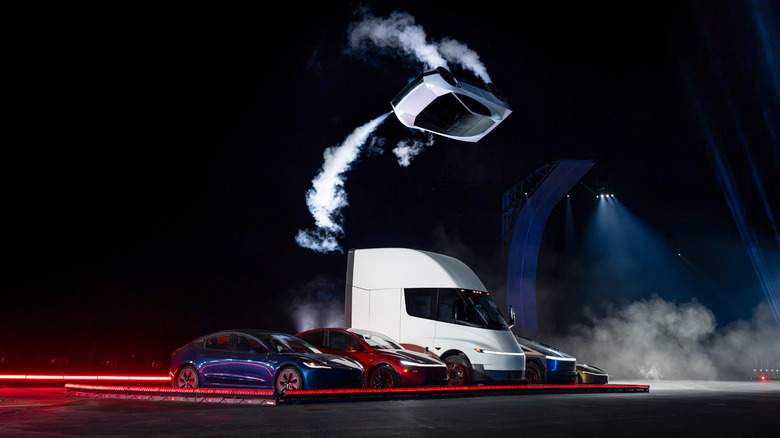
Unless you've been living under a rock, it's unlikely that you've missed Tesla's wild Roadster event, or at least haven't heard about it. In all honesty, the reveal (or rather re-reveal) was actually pretty insane. While the upside-down stunt was already accomplished by the McMurtry Spéirling, the rest of the show (regardless of whether you're a fan of Elon) left enthusiasts in genuine awe. The car flew, did a kickflip, and even managed a crazy 0-60 time (without rollout) of 0.81 seconds.
If only there was someone with a whiteboard who could break down the physics and legitimacy of the new Roadster and its many engineering feats. That's precisely what Jason Fenske from YouTube's Engineering Explained set out to do. Because specifications of the Roadster aren't available yet, including weight distribution, dimensions, and so on, Fenske had to improvise with assumptions. But the gist is: the new Tesla Roadster reveal appears to be legit, though with a few caveats.
Fenske begins by analyzing the Roadster's fan-assisted aerodynamics. For the Roadster to stay upside down (as seen in the demo), the estimated pressure differential is around 11.5 kilopascals (kPa), — an 11.5% vaccum — achieved with help from fans that suck air out of a small area underneath the car that's sealed using deployable skirts.
That 11.5 kPa is the pressure difference between the top of the car (1 atmosphere, or approximately 100 kPa) and the bottom of the car (88.5 kPa), arrived at using the downforce figures from Tesla's demo and Fenske's assumption of the Roadster's skirt area. While he reckons the system could theoretically generate up to 90,000 kilograms of downforce (if that 88.5 kPa is brought down to zero, i.e., 100% vacuum), the car only needed an 11.5% vacuum to stay upside down.
Dissecting the Roadster's flight demo and 0-60 claims
Next up, Fenske breaks down the Roadster's brief flight and kickflip demonstration. For that, the mass flow rate of the 250 kilograms of available nitrogen (stored at 10,000 pounds per square inch in the two storage tanks) is determined using rocket science and a few assumptions. Dividing the available mass of nitrogen (250 kilos) by the mass flow rate (37 kg/s) reveals that the Roadster (in Rocket spec) can hover in the air for about seven seconds. Fenske reckons that both stunts are possible, considering each took around four seconds to complete. Whether Tesla used larger storage tanks or a lighter shell is debatable, but the demo appears to be plausible.
As for the 0-60 times, Fenske starts with the Base Roadster, which is yet to be confirmed as a production model. In any case, plugging the variables (most of which are assumptions) into a fancy equation reveals that the Base Roadster can achieve a maximum acceleration of 0.99 g. This translates to a 0-60 time of around 2.76 seconds. On the Performance variant, which comes equipped with the fans, Fenske arrives at an estimated 2.3 g and 1.2 seconds for its 0-60. However, he does mention caveats, as variables like the friction coefficient and pressure distribution can influence the final number.
To see whether the Thrust version can actually run a 0-60 of 0.81 seconds, he connects the model's acceleration of 3.37 g to the mass flow rate of nitrogen (37 kg/s). According to Fenske, if you only need around 40 kilos of nitrogen to deliver 1 g for 1.0 seconds, the 200-liter storage tank has enough and more to hit 3.37 g. As for the Rocket variant, Fenske estimates a 0-60 time of 0.5 seconds, pulling a whopping 5.5 g based on his assumptions.
Now for the caveats
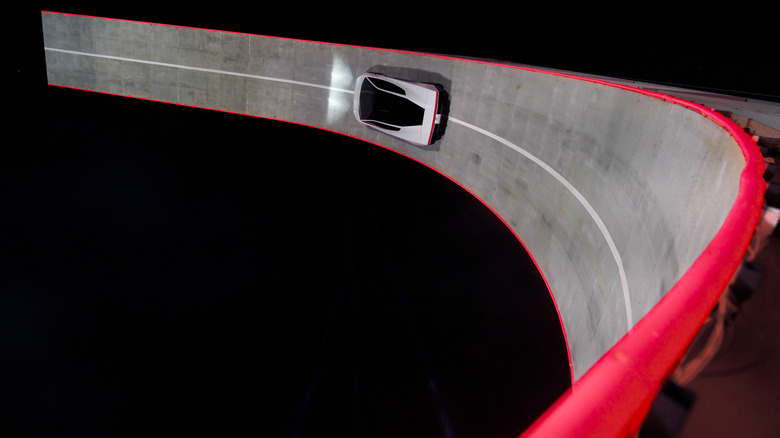
At the end of the day, this event was a great marketing stunt. And that's pretty much how Fenske sees it, because the Roadster's upside-down trick has a few real-world nuances to consider. For instance, the skirts are a wear item, as are the fans. Using the McMurtry as an example, he explains that debris can still enter the fans no matter how efficiently the system filters out the air. Also, the downforce levels depend on the surface, and the demo uses an ideal setup, according to Fenske, which is far from the typical unevenness of actual road surfaces. So real-world performance may be different.
Perhaps the bigger question is: Will this Roadster ever end up in the hands of a consumer? After all, we have seen many of Musk's promises never materialize. There was the promise of a 500-mile Cybertruck and Model S. Those never happened, and neither did many of the previous Roadster's claims. That car was supposed to have four seats and a 620-mile range. The new one is a two-seater (or single-seater, depending on the model), and Tesla's VP of vehicle engineering, Lars Moravy, told Top Gear it will end up with only around 310 to 320 miles of real-world range. Heck, the new car isn't even really a roadster — it's a T-top.
Musk claims the production Roadster will do even better than what was shown in the event, and Tesla says it will enter production in 2028. But as Fenske points out in the video, "Tesla says things and then they do not do those things ... You really don't know with this company until the product actually ships." So let's leave it at that.