

Tesla Roadster Re-Reveal Promises New Design, Flight, Production In 2028
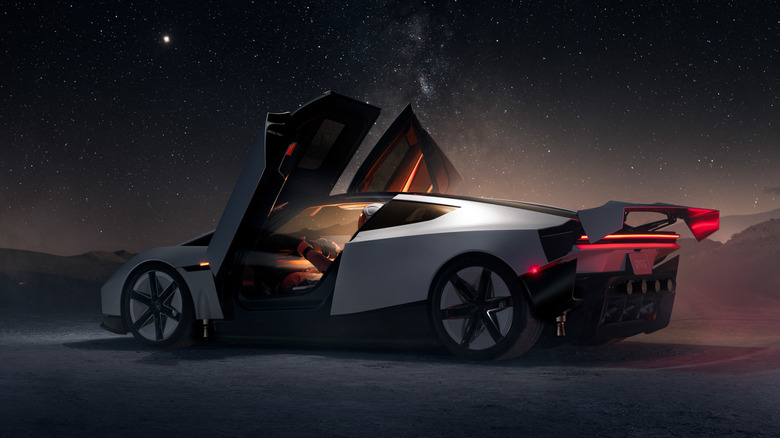
The Tesla Roadster is back, at least in concept form. The second-generation car was first revealed back in 2017, when CEO Elon Musk bragged about its sub-two-second zero to 60 time and 620 miles of range. Well, throw all that out the window, because the car that all those folks spent millions to preorder is gone — instead, there's a new second-generation Roadster, one that leans into Tesla's connection to SpaceX more than anything so boring as range. Welcome to the age of flying cars, supposedly.
The new car, according to Musk and the demonstrations at the re-reveal event, flies. Tesla also claimed a zero to 60 time of just 0.81 seconds, a fan installation beneath the car to generate ground-effect downforce, and of course that little "capable of flight" thing. The new car is also apparently a two-seater, will come in three trim levels based on how much you want it to fly, and will be produced starting in 2028. According to Musk, on that production date: "Actually."
The new design
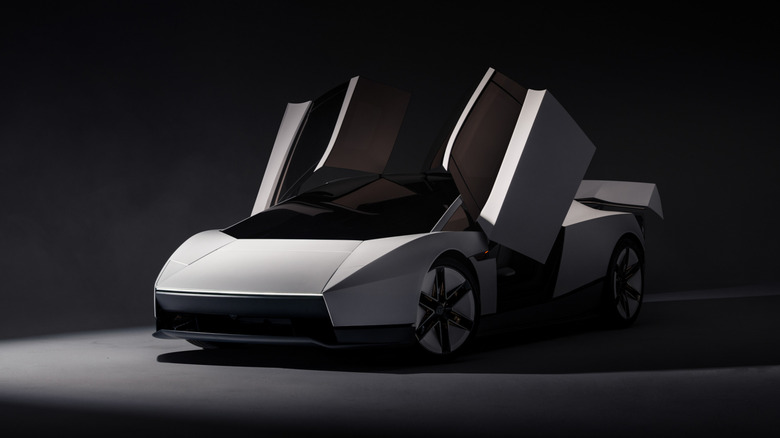
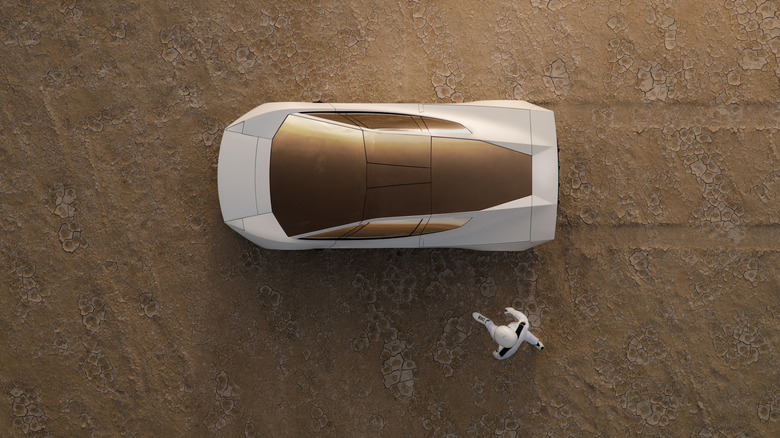
Before we get too into the weeds on tech, let's start with the shape of the new Roadster. This is a completely new design from what Tesla revealed back in 2017, and the company cited the aeronautical features as inspiration for the new look. The company referenced the F-35 and SR-71 jets as design inspiration, as well as the Wet Nellie submarine Lotus from the James Bond film "The Spy Who Loved Me" (a design similarity I noted last month). Most directly, though, the new car seems to be influenced by spaceflight — its white paint and gold-tinted windows are meant to evoke Apollo space suits.
Beneath the skin, even more of the updated Roadster is new. The rear wing, revealed to be an active aero component in patent drawings, appears to function exactly as described in those documents — and exactly like any number of other sport car wings that extend both upward and rearward. The suspension on the car has also been moved inboard, at least in the front, which may be a packaging concern meant to leave room for all the new air hoses. The interior, too, has been changed: The Tesla Roadster is no longer a 2+2 grand tourer, but a two-seater with both seats molded into the car in a manner not unlike the Ford GT.
Okay, the flying car thing
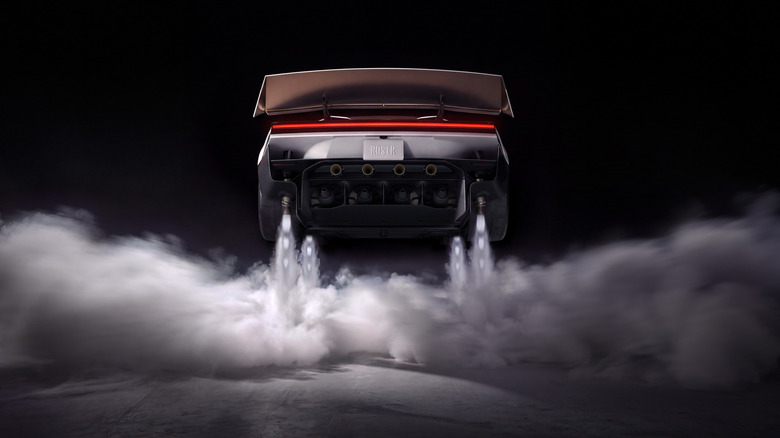
The first demo in Tesla's livestreamed reveal event did, indeed show a Roadster engaged in a bit of flight. Most of the Roadster's new wildest claims come from its cold thruster system, a 158-gallon carbon-wrapped tank behind the seats into which the car compresses air to then push out through ten separate exhaust ports — one in each corner to push the car upward, one on each front fender to push the car to the sides, and four in back to move it forward. Tesla showed demos of the car sticking to an upside-down track, righting itself in midair after jumping off that track, jumping cars, and performing a standing flip.
The car seems capable of engaging those cold gas thrusters for only short periods of time, giving it the ability to hop moreso than really fly, but according to Tesla the thrusters do generate real force: The rear thrust was quoted at "over 80 kilonewtons," which would come out to about 4,500 pounds of thrust each. The base Performance trim of the car appears to include no thrusters — perhaps the space that would go to the air tanks is instead used for cargo in this trim — but does still include the fan system.
Stepping up to the "limited' Thrust trim adds the four thrusters in the rear, while only the "invite-only" Rocket trim includes all ten thrusters. That trim only claims seating for one occupant, as well as an undefined "full flight system," so it's unclear whether the passenger side contains another air tank or something else equally fantastical.
Performance specs
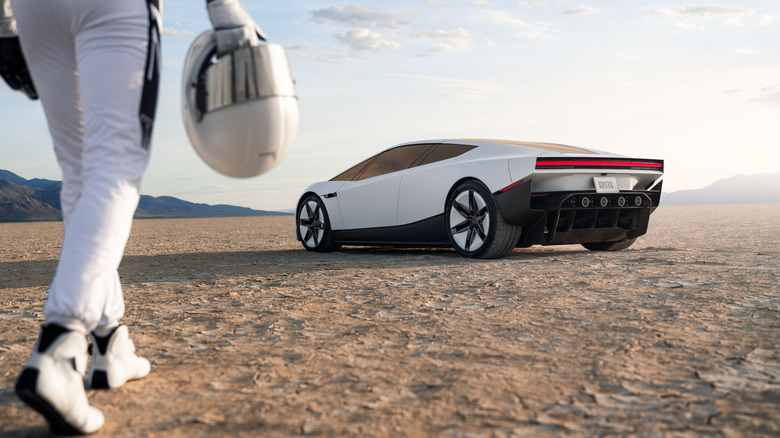
Tesla initially showed a recording of the Roadster making a one-second run to 60 miles per hour, before making another run live during the event — a run in which Tesla claimed, with no live timing, that the car hit 60 in just 0.81 seconds. This was all thanks to the rear-facing thrusters, and the car that made the acceleration run appears to be the Thrust trim due to the lack of visible downward-firing thrusters behind the front wheels (thrusters which are notably absent from the press shots, despite being clearly visible on the jump car used for demos). Tesla also said the production car would likely beat that 0.81 second number.
Tesla claimed the production car would be able to corner at "greater than 2g" of lateral force, and that it would be able to reach speeds of "over 230 miles an hour" — a number that Musk immediately shot down on stage, claiming that the production car should "crack halfway to the speed of sound. Mach 0.5, maybe higher." Mach 0.5 works out to 383.64 miles per hour, over 100 miles per hour fastest than the current fastest production car on record.
Does any of this matter?
Elon Musk himself said, on stage at this event, that he wasn't sure whether any of the demos the company would put on would actually work: "By the way, success is not guaranteed. I mean that. It'll probably work, but if it doesn't work, we're at a safe distance." Tesla has long been the automaker of party tricks, and now it's come up with some new tricks that make the car simply worse to use — I, for one, use my trunk a lot more than I would use the ability to do a standing flip in a car. Tesla folks also made sure to specify that there were no people in the Roadsters used for the demos, as some of the maneuvers done would likely do real harm to a human strapped within.
Tesla has long made up specs for its cars, made wild claims that weren't substantiated by users, and now it's making more big impressive claims. The "cars" used for the demos were likely nothing more than shells outfitted with exactly enough equipment to make the tests work. The 0.81 second zero-to-60 number wasn't even shown with an on-screen timer during the event, let alone independently verified. Tesla has yet to prove anything about the new Roadster works in the real world, or could even exist within the realm of physics that those of us not named Musk occupy.
Roadster preorders have reopened, with the company once again taking $50,000 checks to reserve a car that'll theoretically be made two years from now. It hasn't yet said what will happen to the people who placed a reservation for the car Tesla announced nine years ago, which looks and functions completely differently to the one that bears its name today. And — arguably most concerning — we don't know, if Tesla rakes in more money off the Roadster name, just how much will go to some malicious end.