

Could The Original Jaguar E-Type Really Do 150 MPH?
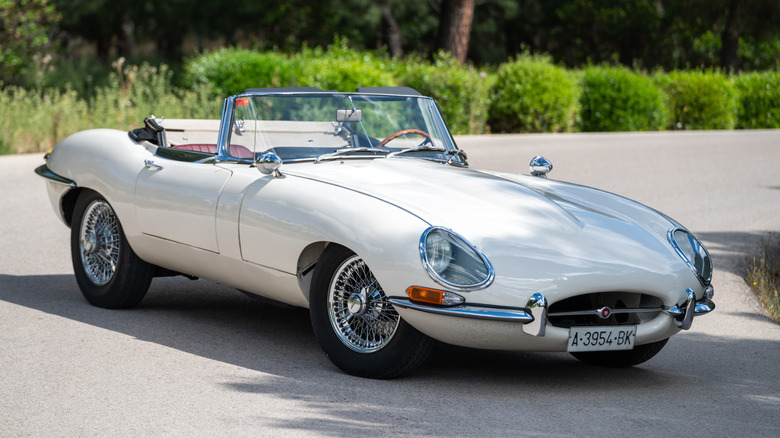
A top speed of 150 miles per hour is achievable by many reasonably powerful cars these days. If we consider EVs, it gets more absurd. Even the seven-seat Lucid Gravity SUV can do the 0 to 150 mph run three seconds quicker than a Corvette Z06. However, in the 1960s, a 150 mph run meant something entirely different — think of the 1968 Dodge Charger R/T Hemi or the Shelby Cobra 427.
Even among sports cars and exotics, the 1960 Ferrari 250 GT Coupé maxed out at 140 mph, while the Aston Martin DB4GT topped out at 153 mph, and the 1960s Porsche 911T reached 124 mph. At the top end of the market, the fastest cars, like the Lamborghini Miura or the Ferrari 365 GTB/4, could hit about 174 mph. The absolute top end belonged to the 1969 Dodge Charger Daytona, which lapped Talladega at over 200 mph in 1970, though the car that did it was a Chrysler development test car. The Jaguar E-Type, one of the most alluring cars from the 1960s, is cited as a 150 mph car from the factory, but is that really the case?
According to Autocar, the 150 mph figure came from press cars, not showroom ones. The coupé Autocar tested (9600 HP) recorded 150 mph at Jabbeke, Belgium. Another publication, The Motor (which later became part of Autocar), drove a roadster (77 RW) and managed it in one direction only. Autocar's retrospective notes 9600 HP's gas-flowed head and states: "Not that standard E-types would have reached 150." So the claim is real, but the story is complicated.
What the tests actually showed
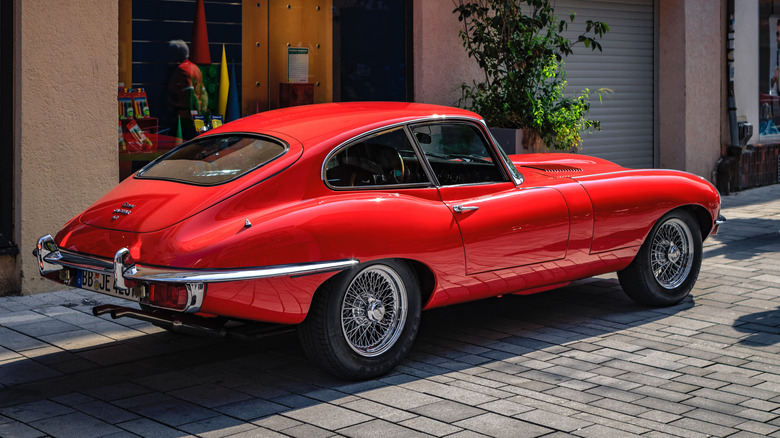
Autocar's 9600 HP recorded 150.4 mph and a 0 to 60 mph time of 6.9 seconds, while The Motor's roadster (77 RW) managed 149 mph and 7.1 seconds. Both ran on Dunlop R5 racing tires and, most importantly, Autocar's own history says 9600 HP was "most likely specially prepared for those tests."
So, what does "specially prepared" mean in this case? Well, 9600 HP's XK150S engine had a gas-flowed head, adding about 20 to 25 bhp. In 1994, Motor Sport Magazine's Bill Boddy, who had also tested the car, reported a claim that 9600 HP had a "D-type racing cylinder head, valve gear and breathers."
Later cars followed a similar pattern. As recounted by AROnline, The Motor's 4.2-liter E-Type coupé (ARW 732B) reached only 148 mph in its 1964 test. Jaguar then took the car back, and the published figure became 150 mph. On that same car, 5,000 rpm equaled 130 mph, so 150 mph would have needed close to 6,000 rpm. In May 1965, Autocar took another coupé (AWK 349B) to 153 mph on Dunlop R6 racing tires.
So what could a normal car do? Maurice Smith, one of the Autocar testers of 9600 HP, later owned a 3.8 roadster and put its best speed at 137 mph. Motor Sport writer Denis Jenkinson's 4.2 coupé reached 143 mph on an Italian autostrada, though with a lower-compression engine. In 2015, a driver took a restored production coupé (chassis 860001) to 146.49 mph on a German autobahn. In the real world, a standard E-Type would top out at around 137 to 146 mph.
What makes the E-Type special?
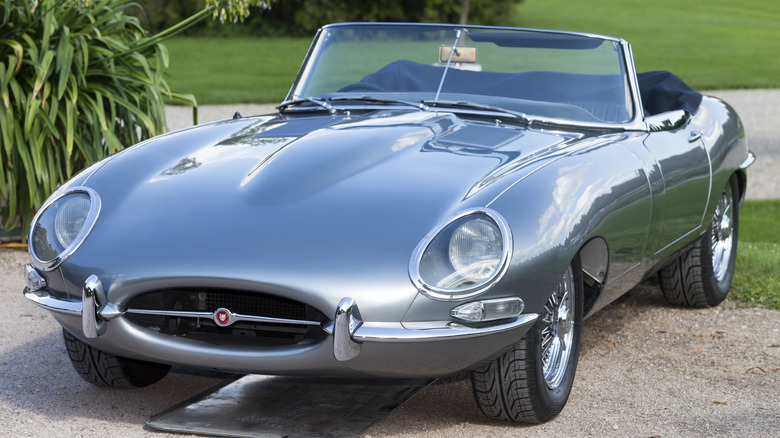
Nowadays, Jaguar is busy with cars like the 2028 Jaguar Type 01, a fully electric four-door GT with up to 1,015 horsepower and a clear goal of being noticed. Back in the 1960s, things were a little different. The E-Type was introduced at the Geneva Motor Show in 1961, and the moment it came out, it captivated the industry. Rumor has it that Enzo Ferrari himself called it the most beautiful car ever made.
The design was largely inspired by aircraft engineering: its designer, Malcolm Sayer, had worked as an aeronautical engineer at the Bristol Aeroplane Company during WWII. Jaguar had also been very involved in Le Mans and racing in the 1950s, and the E-Type took direct inspiration from the iconic C-Type and D-Type racing cars — think aerodynamic bodywork, four-wheel disc brakes, and rack-and-pinion steering.
One of the more impressive things about the E-Type was its price of roughly $5,600 to $5,900 in the U.S. Compared to a 1960 Ferrari 250 GT Pininfarina Coupé, which listed at $12,600 — more than twice as much — the E-Type seemed like a bargain. Today, the Jaguar E-Type is widely considered an iconic sports car from an era when Jaguar really was serious about motorsport. Value-wise, Classic.com lists an average price of $72,601 at the time of writing, with some examples selling for hundreds of thousands of dollars.