

Compact Trucks Were Everywhere In The '70s, And They Might Be Making A Comeback
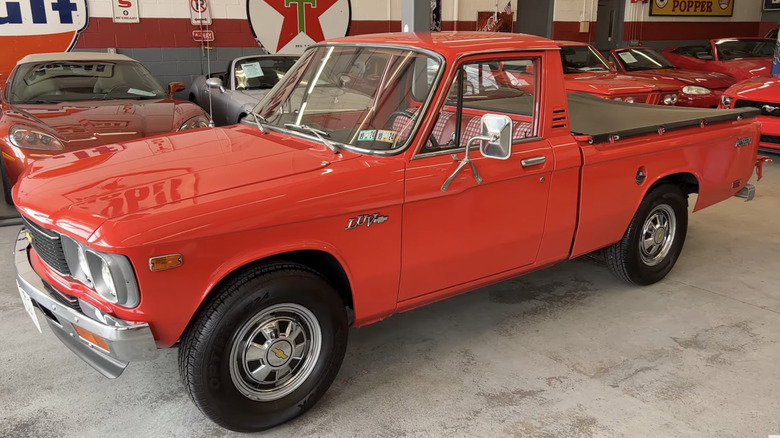
Unless you've been living under a rock, you've probably heard all the chatter about small trucks making a comeback. As you may already know, the compact Maverick has been a runaway success for Ford, and there's a lot of buzz surrounding the upcoming Fathom pickup. Meanwhile, Slate Auto is expected to begin deliveries of its small truck by the end of 2026, Ram is readying a Maverick-sized competitor due to hit U.S. shores by 2030, and Kia has promised a midsize body-on-frame pickup by the end of the decade.
Although it feels as if automakers have found a groundbreaking formula and every brand is trying to capitalize on it, the idea is not new at all. In fact, Datsun brought the first compact truck to the U.S. in 1959. Much of the '70s actually saw such pickups thrive. Why? They were honest work trucks — small, affordable, and practical, with reasonable utility.
Leading the charge were Toyota and Datsun, with their respective models enjoying strong sales. But it wasn't just Japanese brands, mind you. Domestic (albeit rebadged) offerings like the Chevy LUV, Ford Courier, and Plymouth Arrow were also part of the '70s compact-truck scene. In 1979 alone, Chevy managed to shift over 100,000 units of the LUV truck, which was essentially an Isuzu underneath.
While the small-truck trend continued into the '80s, GM and Ford developed their own models instead of badge-engineering Isuzu and Mazda trucks. Thus came the Chevy S-10 in 1982 and the Ford Ranger a year later. These trucks eventually grew in size with every redesign, and fast-forward to today, things are at a point where a top-spec Ford Ranger (now a midsize truck) costs north of $60,000. Size-wise, the current Ford Ranger is about an inch longer than a 2026 Mercedes-Benz S-Class.
The case for modern compact trucks
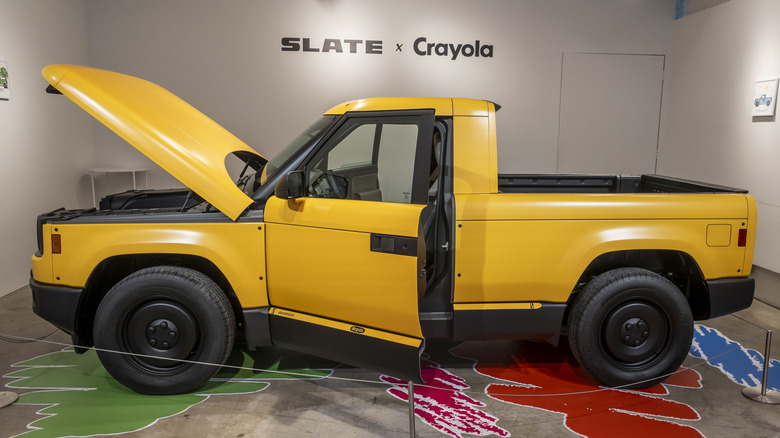
Since modern pickup trucks have largely transitioned from their utilitarian roots to city-dwelling behemoths, it's easy to see why compact trucks like the Maverick are so successful. Not everyone has a huge F-150-sized hole in their life. Some people may still want a truck but don't want to put up with a full-sizer's massive dimensions or its gas-guzzling temperament.
The Maverick, for example, offers reasonable utility (up to 1,500 pounds of payload and a maximum towing capacity of 4,000 pounds), is fairly affordable (starting below $30,000), and has the safety tech and creature comforts that you'd expect in a modern automobile at that price point. Front-wheel-drive hybrids can also manage up to an EPA-estimated 42 mpg in the city.
The size argument, however, is a bit overblown. The "compact" Maverick, as it turns out, isn't that compact after all — it's over two inches longer than a midsize Land Rover Defender 110. The Slate Truck, on the other hand, is two feet shorter than the Maverick and has a longer bed. Think of it as a single-cab Maverick, if Ford ever offered one.
But if you find the Slate's electric-only propulsion a bit discouraging, there's the REO Runabout T4X that might be worth waiting for. Although it's still not production-ready, the truck is expected to be around 180 inches long (roughly half a foot longer than the Slate Truck) and feature a four-cylinder engine, four-wheel drive, and a towing capacity of 4,500 pounds, all while starting at $21,500.
Sure, some of these compact trucks may not mirror the simplicity of the compacts from the past, but there's a level of honesty about them that should appeal to buyers who want a fairly small and capable truck at a reasonably affordable price.