

Diesel Pickups Get Better MPGs Than Gas, But Is It Enough To Counteract Diesel Prices?

For this piece, we're placing ourselves into the shoes of a pickup truck buyer who wants to get the best value-for-money deal possible from a new truck. Fuel prices remain near record highs, even after Trump's dirty Russian oil deal, so it's reasonable to expect buyers to make fuel costs a major deciding factor when looking at which truck to take home.
In fact, as of this writing, the latest EIA figures see gas at $4.28 per gallon, while diesel sits at $6.27. On the face of it then, it would appear that gas is the way to go, but the math isn't that straightforward. Diesel trucks are more efficient per gallon, as a general rule, so that gallon will return more miles, in theory. If it returns sufficient additional miles, it then becomes the more cost-effective fuel, despite setting owners back more at the pump.
Now, heavy-duty trucks are exempt from standard EPA fuel economy testing, which makes picking between gas and diesel a little trickier. Thankfully, Car and Driver has been testing such trucks on a 200-mile fuel-efficiency highway route for the last 10 years, so we can use its data to determine whether diesel- or gas-powered trucks work out to be the more cost-effective choice.
As it happens, the outlet's 2024 roundup highlighted that diesel trucks on average return 18 mpg, while gas trucks net 15, so there's a 20% increase in fuel efficiency when running on diesel. Sounds great, but using the aforementioned figures, diesel is 46.5% more expensive, so a thirsty gas-guzzling truck is still kinder on the pocket.
Even the best diesels fall short
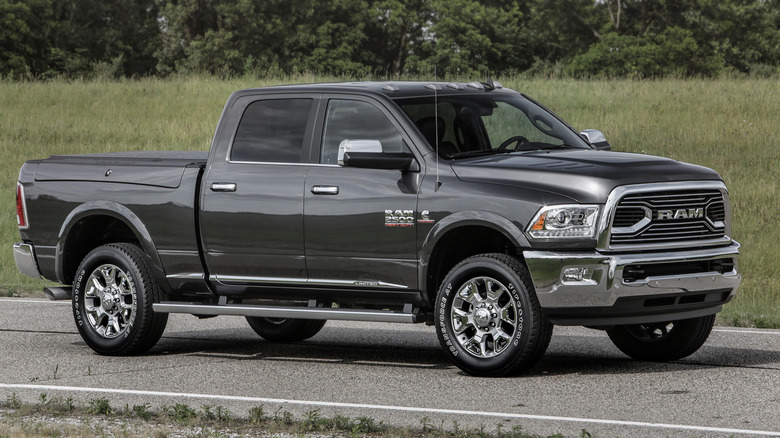
Of course, those are only generalized figures taken from across all models tested. The outlet has run a total of 22 heavy-duty models on its 200-mile efficiency route. Of those, the top five most efficient models were all diesel-powered, and the top two managed to eke out 20 mpg. They are the 2018 Ram 2500 Limited Crew Cab, and the 2023 Ford F-250 Super Duty Platinum Tremor Crew Cab, powered respectively by standard-output Cummins and high-output Power Stroke engines.
Putting a Cummins against a Power Stroke engine highlights pros and cons for each camp, but regardless of which each individual favors, it's hard to argue with how impressive 20 mpg is, considering the size and heft of the trucks they each power. Still, that extra 2 mpg sadly doesn't make the difference when it comes to cost-per-mile, although it does help to close the gap significantly.
Using the above per-gallon prices, a 20-mpg diesel truck still costs around 10% more than a 15-mpg gas truck, costing $0.31 each mile, against the gas truck's $0.29. For the math to swing into the diesel truck's favor, it would have to be returning at least 22 mpg, at which point, it would cost almost exactly the same per mile as the gas truck.
How to get better fuel economy
We aren't about to suggest you start employing hypermiling techniques to get a few extra miles out of an old Cummins-powered Ram, like overinflating the tires, or stripping weight out by throwing air-conditioning units and back seats away. However, there are some useful tips you can follow to get better fuel economy.
Start by scrutinizing your own driving habits. If you're constantly tailgating, riding the brakes, and not anticipating upcoming obstacles, this will be killing your economy. Take a more leisurely and proactive approach, keep distance around you where possible, and you'll notice each tank stretches a little further. In addition, keep the truck properly maintained, and ensure tires are inflated to the correct pressure. Those mean-looking all-terrain tires won't be helping your case at the pump either, so consider swapping them out for something with a little less rolling resistance.
Finally, aerodynamics matter. A rooftop tent or other such accessories might be useful every once in a while, but if they just spend most of the year decorating your truck instead of being used, store them in the garage instead, as they are costing you money. In fact, according to the Department of Energy, a bulky rooftop cargo box can sap anywhere from 10% to 25% of your fuel economy at interstate speeds. Couple that with ill-inflated tires, bad driving habits, and a bed full of heavy junk weighing the truck down, and there is some serious room for improvement to be had.