

If You Want A Hyundai Tucson With A Manual Transmission, Look For These Years
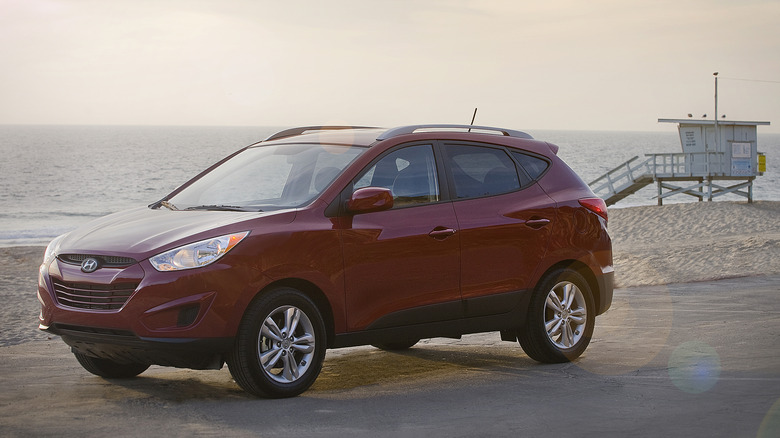
There's a lot to be said for owning a car with a manual transmission. Beyond a more engaging behind-the-wheel experience, a manual may cost less to repair than an automatic. The vehicle's purchase price may be lower, too. The idea of a stick in a used compact crossover may even appeal to some, but that ship sailed two decades ago for the Honda CR-V and Toyota RAV4. However, Hyundai kept do-it-yourself shifting alive for much longer in the Tucson.
We'll cover the details by looking at the 2005 through 2013 model years for the Tucson, separated by generation. We'll include a breakdown of the applicable powertrains (think base engines), available model-year reliability ratings from Consumer Reports (CR), and other considerations buyers of second-hand Tucsons should be aware of (the infamous Theta II engine issue rears its ugly head).
Ordinarily, we'd include marketplace pricing, but this is hard to do for a Tucson with a stick. As of this writing, a cursory search of dealer listings on Cars.com shows only a couple nationwide, both with fewer than 100,000 miles (well below the average for cars 15 to 20 years old). In other words, anything goes for what you'll pay for a Tucson with a manual transmission, assuming you can find one.
First-generation Hyundai Tucson (2005 to 2009)
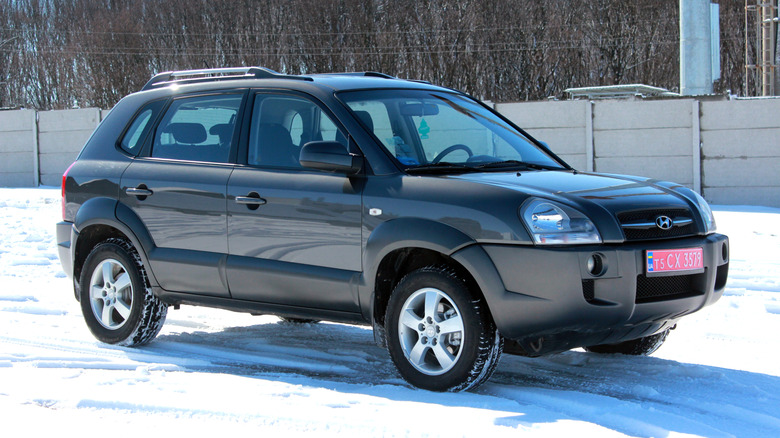
Hyundai launched the Tucson in the U.S. for the 2005 model year, which was also the final year of the second-generation RAV4 and the last RAV4 offered with a stick shift. By 2026 standards, the inaugural Tucson's specs were modest, with a base 2.0-liter four-cylinder engine making 140 horsepower. This unit was exclusive to the entry-level GL trim, as was a five-speed manual transmission. A four-speed automatic gearbox was optional on the GL and standard with the higher-grade GLS and LX, which came with a 2.7-liter V6 engine making 173 horsepower. Front-wheel drive (FWD) was standard, with all-wheel drive (AWD) optional across the trim range. However, on the GL, AWD required the manual transmission.
Hyundai maintained a three-trim lineup with the same engine range throughout the first generation, which ended in 2009, but changed the trim names over the years. For the 2008 and 2009 Tucson, Hyundai dropped AWD availability in the base GLS grade but kept the manual transmission as the base gearbox. By 2009, Hyundai also offered the top-tier Limited trim with the entry-level four-cylinder engine, but it couldn't be equipped with the manual. For the first generation, Consumer Reports only scored the 2006 model year for reliability, giving this Tucson an average rating. Newer examples, like the 2025 Tucson, have higher CR scores.
Second-generation Hyundai Tucson (2010 to 2013)
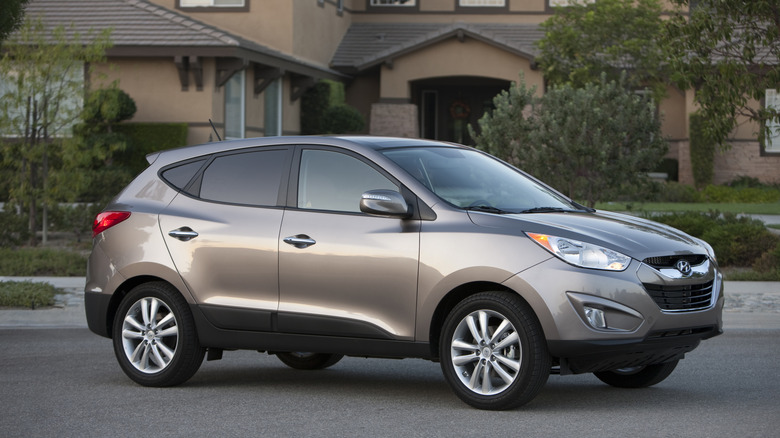
The second-generation debuted for the 2010 model year and lasted through 2015. However, Hyundai dropped the manual transmission after 2013. The previous generation's stubby presence was replaced with a sleeker exterior and an upscale cabin. Hyundai also made changes under the hood. For 2010, the only engine offered was a 2.4-liter four-cylinder Theta II unit making 170 to 176 horsepower (depending on emissions classification). On the starter GLS trim, a six-speed manual was standard, with a six-speed automatic optional and included with the top-of-the-range Limited edition. Both trims came standard with front-wheel drive, which could be upgraded to all-wheel drive (with the automatic only).
For 2011, the automaker brought back a base GL trim equipped with a 2.0-liter four-cylinder engine making 165 horsepower. This powerplant also had Theta II architecture. The front-wheel-drive-only GL came standard with a five-speed manual (one gear less than in 2010), with the six-speed automatic available (and standard on the higher trims). Hyundai continued this arrangement through 2013, dropping the base GL trim and the manual transmission for 2014. The 2011 through 2013 Tucsons received average reliability ratings from Consumer Reports (CR didn't review the 2010 model year).
Hyundai's Theta II engines rank among the worst, but second-generation Tucsons with manual transmissions have an interesting quirk. While the 2010 manual Tucson used the 2.4-liter engine, the 2011 to 2013 manual versions had the 2.0-liter, the less troublesome of the two engines. Hyundai's bearing-related engine replacement campaigns and factory warranty extensions have covered the Tucson's 2.4-liter engine, including the 2010 version paired with a manual. Those programs don't cover the 2011 to 2013 Tucson's 2.0-liter engine. Turbocharged, direct-injected 2.0-liter versions used in the 2013 to 2014 Santa Fe Sport and Sonata were recalled for potential bearing failure caused by manufacturing debris.