

Henry Ford Killed The Patent That Claimed To Own The Automobile
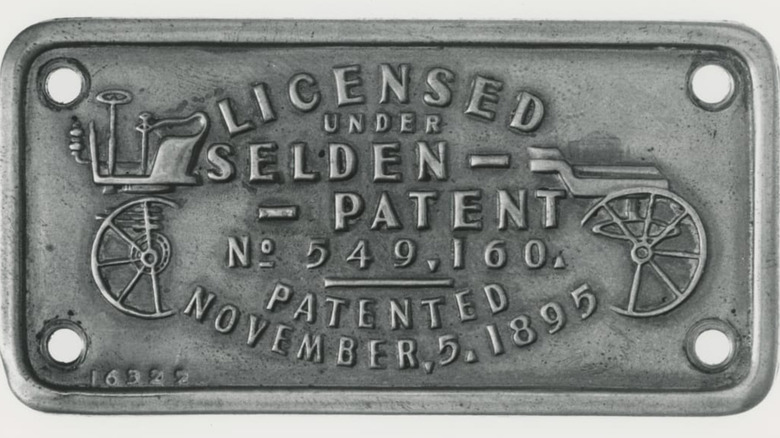
At this stage, most folks know that Henry Ford didn't literally invent the car. But it was Ford's efforts that kept that title from going to George Selden. In fact, if it weren't for Ford fighting against a Selden patent, every early automobile made and/or sold in the country would probably remain under Selden's monopoly.
George Selden was a patent attorney from Rochester, New York, and he had submitted a patent for the automobile back in 1879 — some seven years before Carl Benz patented his Motorwagen in Germany, creating what counts as the first car from one of the world's best-known automakers. Of course, one major difference was that Benz had built an actual running vehicle. Selden, on the other hand, tried his hand at building an engine, but he never actually built a car to put it in. When he filed the drawing needed for his patent application, that was all he had: a drawing of a car and his engine.
Selden, however, was playing the long game. In what seems to have been an impressive act of foresight, he used his knowledge of patent law to delay the review process until a number of major manufacturers had established themselves and cars seemed like they would be here to stay. Sometimes called the world's first patent troll, Selden knew that even if his patent were approved, he would maintain the rights only for a certain number of years. Since his concept was to sue other automakers for infringement, he wanted to wait for them to sell their cars and become profitable first, and he didn't want the clock starting on his rights before then. Roughly 16 years had passed between when he first submitted his patent and 1895, when it was granted. And in the end, George Selden had indeed patented the automobile.
How Ford fought back against Selden
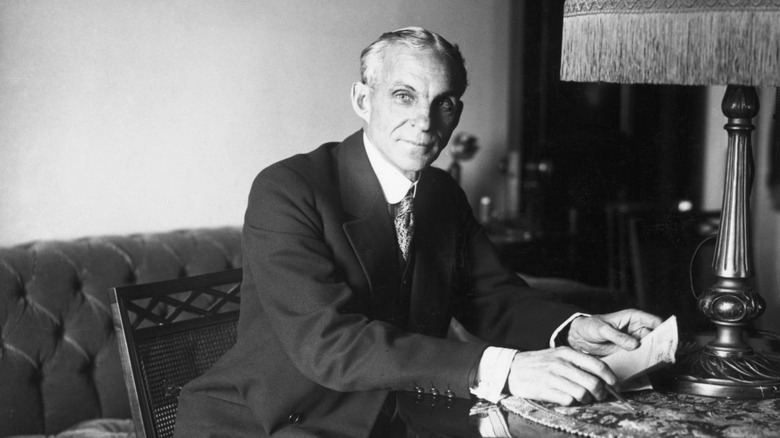
Selden's plan actually worked, too, at least for a while. In 1899, an entrepreneur named William Whitney was researching patents as he considered buying up an automaker or two himself. Needless to say, he found George Selden. The way things worked out was that Whitney and his associates formed a holding company for the car brands he was collecting, called the Electric Vehicle Company, and the EVC ended up owning –- and enforcing –- the Selden patent.
Among the first to be sued by the EVC was the Winton Motor Carriage Co., which was owned by another early auto pioneer, Alexander Winton. A fierce and expensive legal battle followed, with Winton getting the worst of it, and he eventually agreed to settle. A further outcome was that the EVC, Winton, and other automakers came together as the Association of Licensed Automobile Manufacturers to handle the patent business. Ford was not among them, though.
When the time did come for Winton and ALAM to take on Ford, the stage was set for yet another important battle between the two men. Remember, Henry Ford had already outraced Alexander Winton in a landmark 1901 victory that still echoes today — when IMSA Mustangs are wearing a livery inspired by that first fast Ford. Moving from the track to the courtroom, it took eight years of legal maneuvering, but the verdict went Ford's way in 1911: The Selden patent was held to be valid, but only specifically for Brayton two-stroke compression engines that Selden's design originally used. As long as Ford and other automakers stayed away from that kind of mill, they were good to go. Besides, the original Selden patent expired just two years later, anyway.
Did George Selden ever actually build cars?
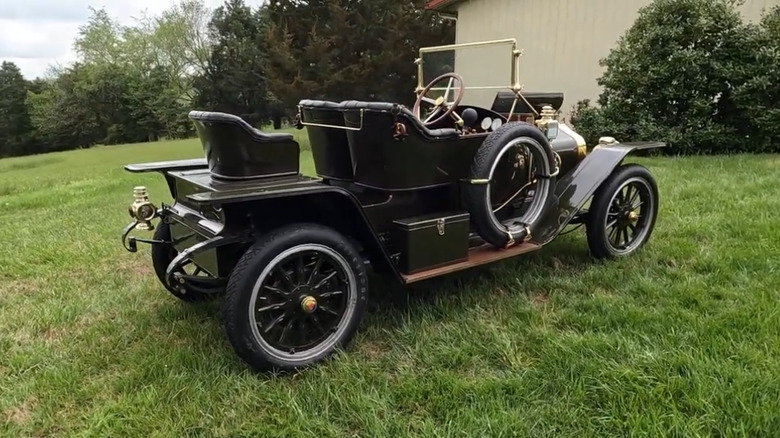
Nor did Selden simply go back to practicing law. Instead, he went all-in on automaking. Selden built two running cars meant to serve as proof-points to support his patent case, but he also founded the Selden Motor Company in 1906. The latter would produce its first car the year after. All told, Selden's car company manufactured more than 7,400 vehicles, backed by a full lineup of body styles, before ending ceasing to produce cars in 1914. What's ironic is that, despite the Selden patent for a two-stroke compression engine, his production vehicles all featured four-stroke units running on the standard Otto cycle.
They were some pretty massive motors as well. For example, the 1911 Selden 40R Varsity Roadster carried a 40-horsepower, 356-cubic-inch four-cylinder that translates into more than 5.8 liters of displacement — it would qualify as one of the largest 4-cylinder engines ever made. The Seldens were high-end rides, too. That very first model was reportedly priced between $2,000 and $2,500, which is the equivalent of $71,000 and $89,000 today. They've gotten even more expensive since, however. Seldens aren't seen too often at auction, but one particularly fine 40R Varsity Roadster crossed the block twice at Sotheby's this century. One of only six left in existence, with a single fixed rumble seat and a provenance that goes back to Selden himself, the car sold for $220,000 in 2007, and it went under the hammer again at $159,500 in 2019.