

IMSA Ford Mustangs Will Compete With Livery In Tribute To Henry Ford's First Race Car
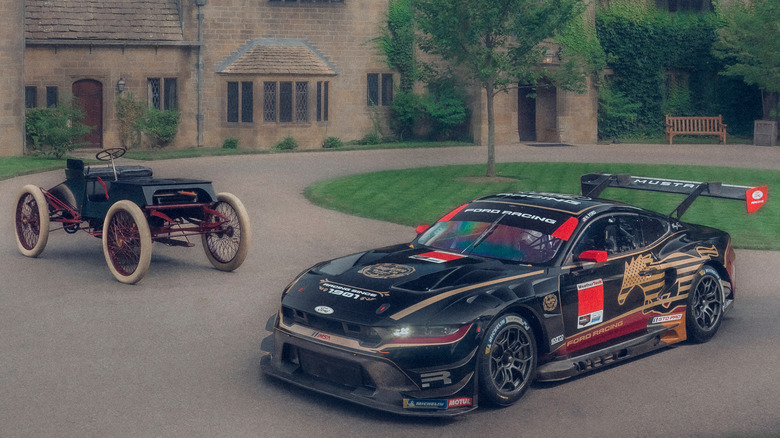
You can count the number of automakers on one hand that were around and racing over 125 years ago. To celebrate reaching the century-and-a-quarter mark in motorsport, Ford Racing revealed that its factory Mustang GT3s will compete with a unique tribute livery at the International Motor Sports Association's (IMSA's) Petite Le Mans in Atlanta this weekend. The black, red and gold paint scheme matches the colors of Henry Ford's 1901 "Sweepstakes" race car, his first racing machine.
Although it predates the founding of the Ford Motor Company by two years, the manufacturer says its racing involvement began with the "Sweepstakes." With body designs changing so much, there was plenty of room to be creative with the tribute livery. The "Sweepstakes" Mustang GT3 features a fully illuminated "Glow Pony," a Mustang logo decal on the rear fender carried over from the typical livery. The pony will be filled with a black-and-gold American flag. The hood sports the original Ford Motor Company logo, a slightly anachronistic element. Scott Bartlett, Ford's manager of on-road racing and product marketing, said:
"Everything we do in racing is a gamble. But without Henry Ford taking a risk on October 10, 1901, we wouldn't be able to watch the Ford Mustang GT3 wearing the colors of Sweepstakes at Petit Le Mans on October 3, 2026. To this day, we live by his example. You have to push the limits and sometimes put it all on the line to create the future. That is what we do at Ford Racing."
The Ford Motor Company was arguably born at a racetrack
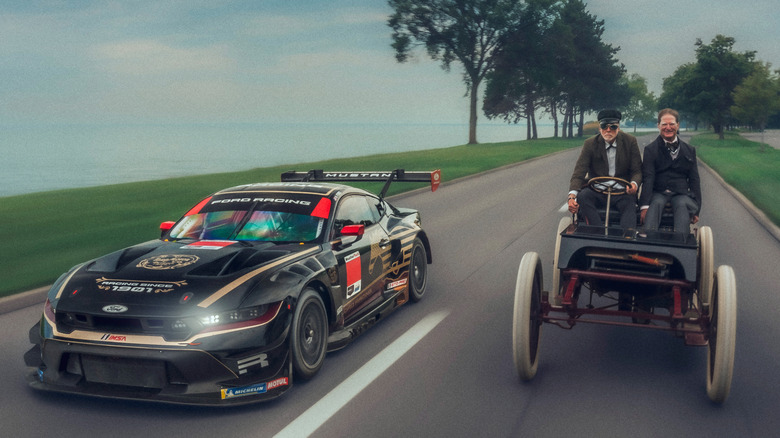
The original "Sweepstakes" race car featured a black body draped over a red chassis. According to the Henry Ford Museum, the open-cockpit two-seater was fitted with an opposed twin-cylinder engine. The motor reached 900 rpm and produced 26 horsepower. The 2,430-pound machine had a top speed of 72 miles per hour. That doesn't sound quick, but the "Sweepstakes" was fast enough in 1901 to defeat car magnate Alexander Winton in Grosse Pointe, Michigan. Ford fell behind by 300 yards but eventually passed his rival on the straightaway at the Grosse Pointe Race Track. Then, race in hand, he retired from the sport.
The victory would prove pivotal to automotive history, as the highly publicized triumph attracted the investment needed to establish the Ford Motor Company, Henry Ford's second attempt at starting a car manufacturer. From its '60s Le Mans program and the Cosworth DFV to its current collaboration with Red Bull Racing in F1 and its upcoming Le Mans Hypercar effort, Ford's presence in racing has remained an important part of the company's brand. Winning, on the other hand, has been more of an on-off relationship for Ford.