

F1 Race In Malaysia Salvaged By Software Update Made In Under An Hour
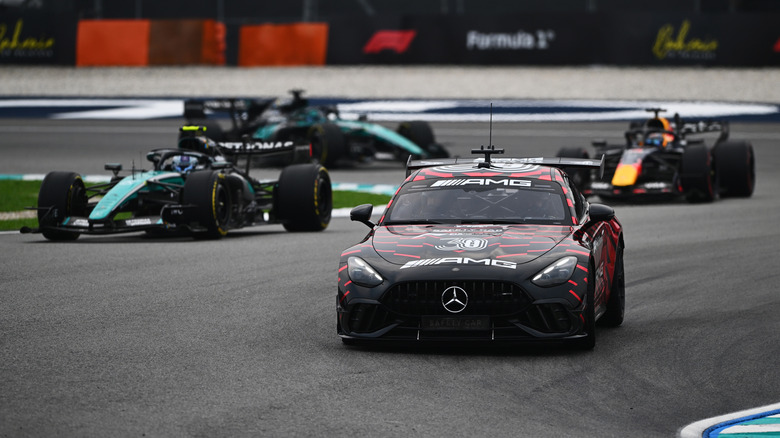
From an ongoing war to torrential rain showers, no one could be sure the Bahrain Grand Prix in Malaysia would actually be run until officials fired up the starting lights on Sunday. The final hurdle to clear was an ECU glitch that caused several cars to lose power during the formation lap. The FIA had to hastily develop a software update over a 40-minute red flag period to avoid any further failures. While the relocated race produced thrilling on-track action, the early stoppage worsened the already tattered reputation of Formula 1's new power units.
With the wet conditions, the 56-lap race was set to start with a rolling start behind the safety car. However, most of the field couldn't even stay in line to take the green flag. It began with polesitter Max Verstappen unable to accelerate out of Turn 11 on the formation lap. The four-time world champion got his Red Bull car back up and running, but the same issue struck Lewis Hamilton's Ferrari at the same point. Then, Charles Leclerc's Ferrari was the next victim on the start-finish straight.
According to the FIA, a perfect storm of factors caused the temporary power unit failures. The governing body stated, "An unprecedented combination of low engine speed, low-grip conditions, wet-weather energy management settings and the Sepang Circuit's section configuration led to an unintended loss of power for a number of cars." This explained why failures provoked more failures through the field. Drivers slowed to a crawl, unsure whether they were allowed to pass the code-stricken cars. The safety car was about to lap a third of the field when the red flag was thrown.
The FIA ripped the guardrails off to avoid further issues
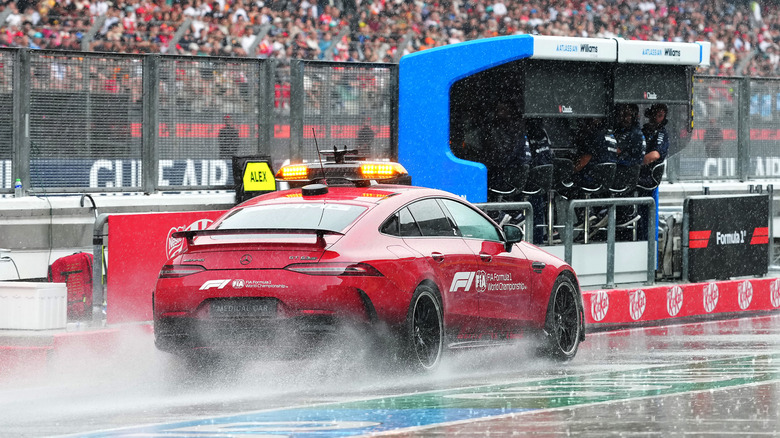
An ongoing topic of discussion this season in F1 is the software-defined power output. Teams aimed to manage their battery levels for their hybrid V6 engines over a lap, but created situations where a driver could floor the throttle, and the car wouldn't accelerate — attempting to preserve energy. Malaysia was the worst-case scenario because these cars have never run in the rain up until this point. The issue also didn't emerge on the reconnaissance laps to the grid.
Nikolas Tombazis, the FIA's single-seater director, explained to Autosport that the cars entered a minisector where teams limited their power output, then got stuck in a loop where the limit wasn't lifted. Ultimately, the teams were trying not to exceed a per-lap energy use maximum set by the FIA. The governing body's solution was simply ripping the guardrails off, stating:
"The FIA Technical Department removed the energy limit constraint in the affected sectors through an updated software release distributed to all competitors during the race delay caused by heavy rain enabling teams to make the necessary changes to the power unit before the start of the race."
Cars shouldn't be bricking themselves
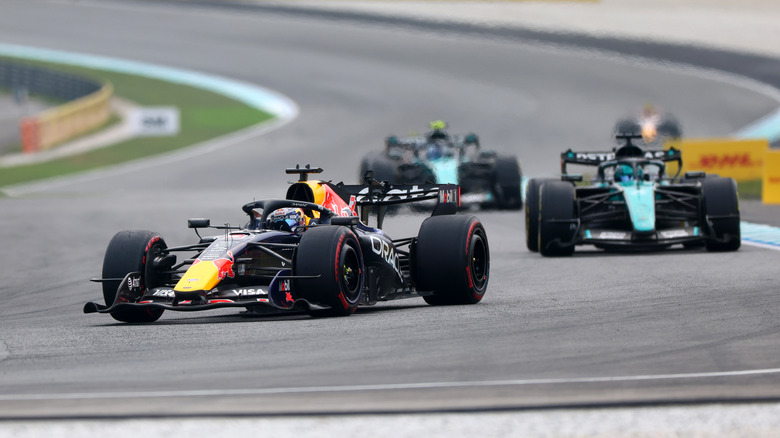
Once the conditions were deemed safe enough to race, it became a question of whether to run on slicks or intermediate tires. Mercedes opted for inters and took advantage of a poor Verstappen start to put Kimi Antonelli and George Russell in front. The tide turned as conditions dried with the Red Bull driver thriving on slicks. Verstappen carved his way to the lead and never looked back. Antonelli finished second. Russell suffered a heartbreaking power unit failure behind the safety car on lap 49, likely the nail in the coffin for the title campaign.
It certainly wasn't plain sailing for Super Max at the start! 🤩🦁
However, the slow getaway did little to stop Verstappen's hunt for victory at Sepang 🔼#F1 #BahrainGP pic.twitter.com/NcDEnQTWY4
— Formula 1 (@F1) October 5, 2026
The current hybrid V6 engines have been half-baked since their inception, restrained by the desire to cut costs and keep using old components. The rocky introduction of the new regulations has also highlighted how F1 is stuck in the past in other ways. In an age of software-defined vehicles where automakers can push updates to road cars over the air, it seems ridiculous that F1 teams aren't allowed to send any data to cars on track.
The two-way telemetry ban was imposed in 2003 at the height of a technological arms race, when F1 decision-makers feared competitors would no longer be driving "alone and unaided." Except drivers can't be expected to manage their power unit like the crew of Apollo 13 every single time they're out on track, while also managing a wheel-to-wheel race. Mechanical failures have always been and should remain part of the sport, but cars shouldn't be bricking themselves.