

Federal EV Tax Breaks Vanished, But Taxpayer Dollars Still Aid Charging Infrastructure
When President Donald Trump signed the One Big Beautiful Bill Act into law on July 4, 2025, it sparked quite a few debates. As far as the auto industry is concerned, Trump's Big Beautiful Bill is turning out to be something of a mixed bag. Although it brought along tax breaks on auto loans, the bill also marked the end of the $7,500 federal EV tax credit, which is no longer available for vehicles acquired after September 30, 2025. Many states, though, offer their own incentives and rebates in 2026.
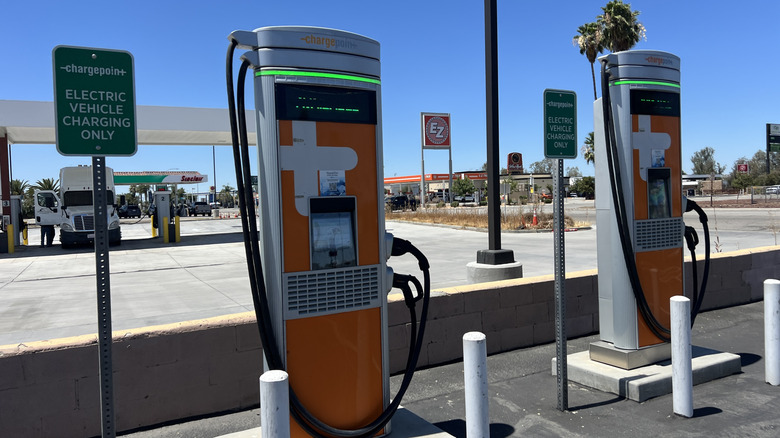
While it's been a year since the EV tax credits vanished, there's still a federal initiative called the National Electric Vehicle Infrastructure (NEVI) Formula Program to help states build more charging stations. The NEVI program was established in 2021 as part of the bipartisan Infrastructure Investment and Jobs Act (IIJA), signed by President Joe Biden, and set aside $5 billion to be allocated from FY2022 through FY2026. But the program came under scrutiny as soon as Trump took office last year.
Without getting too much into the weeds, the NEVI program, run by the U.S. Department of Transportation's Federal Highway Administration (FHWA), provides states with funding for up to 80% of eligible project costs, including the acquisition, installation, operation, and maintenance of EV chargers. But one of the first things the Trump administration did back in February 2025 when it went after EV projects was suspend the NEVI program.
What happened to NEVI
The Trump administration had to walk back the NEVI suspension after U.S. District Judge Tana Lin issued a preliminary injunction in June 2025, temporarily blocking the funding freeze for 14 of the states that sued.
New guidance was issued by the Department of Transportation (DOT) in August 2025, with Secretary of Transportation Sean Duffy saying, "Our revised NEVI guidance slashes red tape and makes it easier for states to efficiently build out this infrastructure. While I don't agree with subsidizing green energy, we will respect Congress' will and make sure this program uses federal resources efficiently."
When Duffy and the FHWA launched their review, 84% of NEVI formula funds remained unobligated. Announcing the new guidance, Duffy said that "the Biden-Buttigieg administration failed to deliver EV chargers despite their promises," also arguing the initiative's previous requirements were difficult to implement. The new NEVI guidelines eliminate requirements for states to address consumer protections, extreme weather concerns, emergency evacuation plans, and terrain considerations. The revised version also allows states the freedom to decide how far apart each charging station should be, as opposed to the original guidelines, which required one every 50 miles along the designated FHWA alternative fuel corridors.
In January 2026, Lin issued a final ruling declaring that the administration unlawfully withheld funds from states, and permanently barring the DOT from doing so. When the administration defended its actions by saying it was a temporary pause, the judge pointed out that the IIJA never contemplated a pause, temporary or otherwise. The Trump administration is now looking to cancel $2.7 billion in unobligated NEVI funds in its FY2027 budget request, and states like Florida think flying cars are a better investment than EV chargers.