

3 Alternatives To The Hyundai Tucson That Actually Have More Horsepower
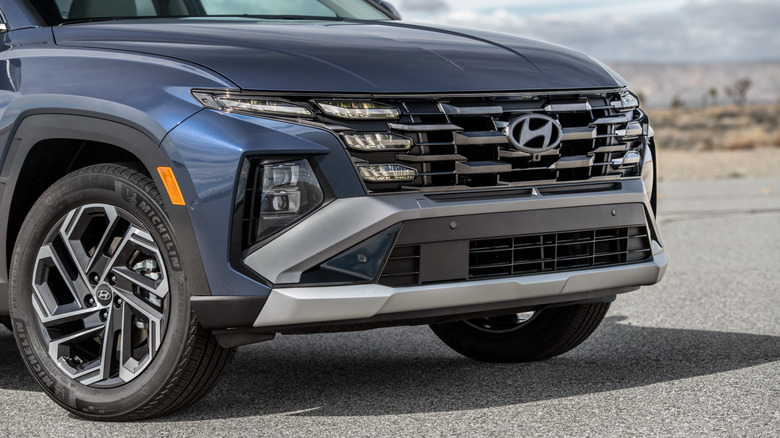
Hyundai Tucson buyers have a very appealing spread of options in 2026, as the popular compact SUV is currently available as a gas-only option, traditional hybrid, and plug-in hybrid. The gas-only Tucson sports a naturally aspirated 2.5-liter inline-four, with 187 horsepower on tap and 178 pound-feet of torque, which is directed toward either the front or all-four wheels through a standard 8-speed automatic transmission.
As for the hybridized options, both make use of a turbocharged 1.6-liter engine, plus a single electric motor. Here, the 8-speed automatic is swapped out for a 6-speed unit, and once again, both front- and all-wheel drive options are available. The traditional hybrid makes 231 hp, while the plug-in boasts a meaningful 268 hp. Both churn out an identical 258 lb-ft of torque.
That's plenty powerful for a value-focused SUV, but for those with a heavier right foot, there are more potent options out there. And, to keep it relevant, these more powerful alternatives are priced to compete directly with the Hyundai — so no X5 Ms or Range Rover Sports.
Alternatives include models such as the Honda CR-V and the Kia Sportage. Others include the Volkswagen Tiguan, Mazda CX-50, and new generation of the Toyota RAV4 — all three of which offer higher horsepower outputs than the Tucson. So, while the Tucson is certainly one of the best new SUVs for sale right now, these alternatives might be better suited to those who prefer something with a little more power.
More powerful alternatives to the gas-powered Tucson
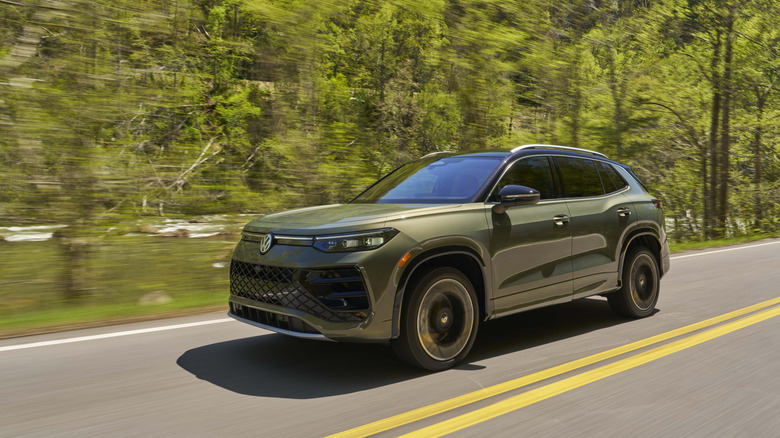
Starting off with the gas-only Tucson, 187 hp really isn't much to work with in 2026, so it's easy to find a good number of alternatives that pack a more meaningful punch. The first of which is the freshly redesigned Volkswagen Tiguan, which offers a duo of gas engines, compared to the Tucson's single engine.
For most trims, the Tiguan comes equipped with a turbocharged 2.0-liter inline-four, which produces 201 hp, alongside 221 lb-ft of torque; a healthy increase in comparison to the Tucson. It's also priced from $32,280, including destination fees, so certainly cross-shoppable with the Tucson, which, with destination fee included, kicks off at $31,300. Buyers seeking even more bite from the new Tiguan may be tempted by the SEL R-Line Turbo, which boasts a 268-hp turbo 2.0-liter inline-four engine – coincidentally exactly what the Tucson Plug-In Hybrid produces.
Stepping away from Volkswagen, the Mazda CX-50 makes for a great Tucson alternative at $31,495 with its mandatory destination charge. In some guises, it delivers a decent touch more oomph than the Hyundai. It is worth noting, however, that the base inline-four engine in both the CX-50 and CX-5 delivers the same 187 hp as the Tucson. However, Mazda offers a turbocharged upgrade for the CX-50, also an inline-four, which delivers a much more meaningful 256 hp. That power goes through a conventional 6-speed automatic and powers all four wheels.
Hybrid SUVs which pack more power than Hyundai's electrified Tucsons
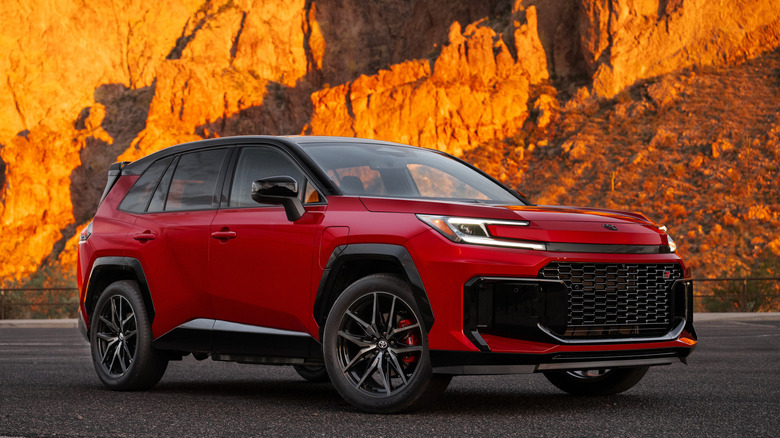
As stated above, the Tucson is available with two hybrid powertrains: a traditional setup with 231 hp and a plug-in version with 268 hp. The search for a more powerful alternative leads to Toyota with the recently revamped RAV4.
Now, not all RAV4s are created equal. The standard front-wheel drive RAV4 Hybrid packs 226 horsepower — 5 shy of the Tucson — while the all-wheel drive model brings 236 hp to the party. The RAV4 is motivated by a naturally aspirated 2.5-liter inline-four, and while the front-wheel drive models sport a pair of electric motors, the all-wheel drive-equipped cars boast 3. For reference, the cheapest 236-hp RAV4 comes in at $34,895 with destination fees factored in, as does the $33,495 LE grade with the all-wheel drive system at an optional cost of $1,400.
Jumping up to the plug-in hybrid grade of both models requires a significantly larger financial commitment from buyers. Hyundai charges $42,275 with fees for the base SEL grade, while Toyota's plug-in RAV4 is $43,095 with fees. What that additional $820 buys is really quite impressive, as the RAV4 kicks out a seriously potent 324 hp – miles north of the Tucson's 268 hp. Toyota also sells the RAV4 Plug-In Hybrid as a dynamic GR Sport model, although buyers will barely net any change from $50,000.