

19,000-Mile 1995 Maxda RX-7 Twin Turbo For Sale May Be Peak '90s Japanese Sports Car
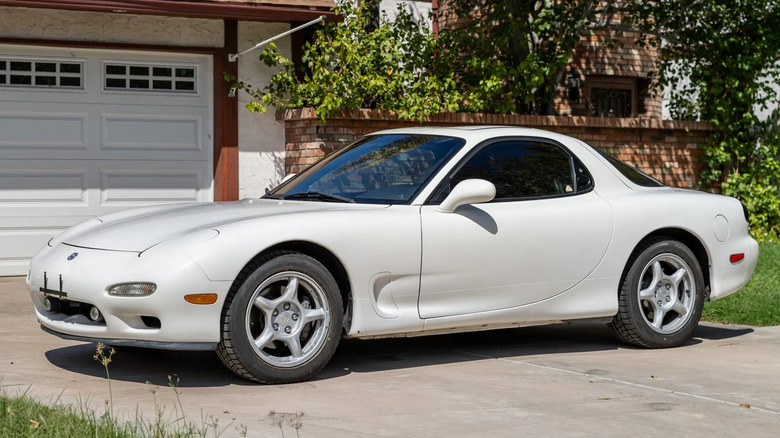
Like every Japanese carmaker, Mazda now makes mostly crossovers, while sports car enthusiasts still have the MX-5 Miata – and the next generation will be even lighter and offer a manual transmission. However, back in 1978 — more than a decade prior to the arrival of the Miata — Mazda also made a sports car called the RX-7. Today, on Bring A Trailer, there's a third-generation RX-7 listed with just 19,000 miles. As we type this, its bid already sits at just $25,000. However, there's no way on earth that'll be the price when the auction ends.
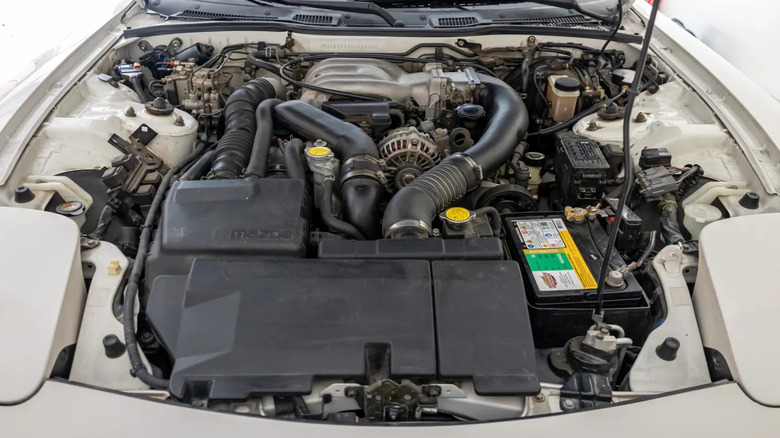
This particular car is finished in white with a black leather interior and has had the same Phoenix, Arizona owner since 2003. Yes — a low-mileage RX-7 that's lived the past two decades in a state where it's unlikely to see salted roads. Not only that, but this one is pretty much bone stock, with a five-speed stick-shift transmission and a limited-slip differential. It was ordered with Mazda's Popular Equipment Group, and that meant it got a power sunroof, leather seats, nifty pop-up headlights (RX-7s had these way before the first-gen Miata), fog lights, plus cruise control, air conditioning, and it seems to still ride on its original five-spoke wheels. From the listing, the interior looks pretty clean given the car's age, and the twin-turbocharged Wankel rotary looks untouched, which should be good for a whopping 255 hp from a tiny 1.3-liter displacement.
What made the RX-7 so unique
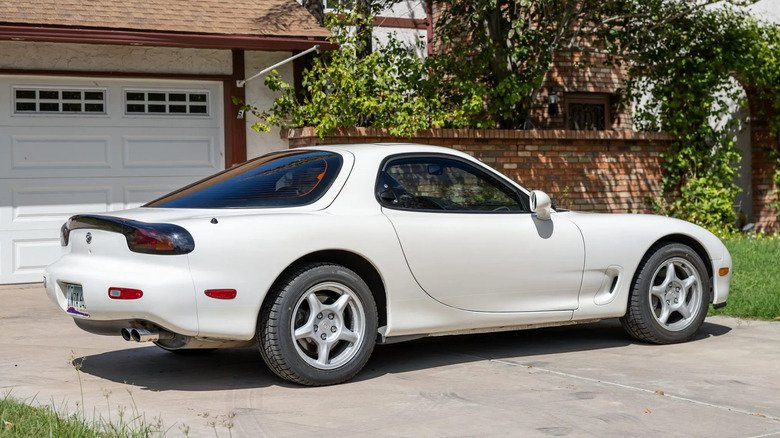
Mazda sold the third-generation FD RX-7 in Japan from 1991 and into the early 2000s, producing many limited versions along the way, such as the Spirit R and Type RZ. But in the U.S., the FD was only offered from 1993 to 1995, and while roughly 70,000 were sold globally, only about 14,000 came to our shores.
As for why the RX-7 is so special, one secret is low weight. Mazda wanted the RX-7 to lose some 200 pounds versus the second-generation car, keeping weight to about 2,800 pounds. Which, in turn, led to a 0-60 mph time of about five seconds. Then there's the rotary engine. You may already know the history of Mazda's most famous rotary-powered car. A rotary is the type of engine where a triangular rotor spins past inlet ports that deliver fuel and air, and the force of the rotation causes combustion. For every cycle — rather than every other cycle of a four-stroke piston engine — the rotary delivers power, which is how a tiny 1.3-liter engine can make 255 horsepower. A rotary has fewer moving parts, and the rotor spins at just a third of the engine speed, which is what Mazda claims makes it incredibly durable. However, there are pros and cons of a rotary engine.
The powerplant under the hood of this stock FD, called the 13B-REW, has sequential turbocharging. The first turbo begins spooling just off idle, at around 1,800 rpm, while the second turbo hits later, at about 4,000 rpm, enabling more power up to the gloriously screaming 8,000-rpm redline. The seller of this car also notes that the body is clean, with no dents or scratches, and that a Mazda mechanic who's serviced the car says it runs like new. It's been garage-kept and only driven occasionally since 2003.
The RX-7 remains an icon worth owning
The answer to our own question is simple: 19,000 miles. That's very low for a three-decade-old, seemingly stock, FD RX-7. It's also useful to know that as of 2020, Classic Mazda began supplying at least some parts for second- and third-generation RX-7s. That's a big deal; having an O.G. Japanese sports car might seem neat, but not as a lawn ornament.
Speaking of which, even though it has low miles, this car might still be daunting to maintain, and rotaries have a reputation for burning through oil and gasoline at a prodigious rate. One common solution to lower maintenance costs on FD rotaries is to switch to a single turbocharger rather than sticking with the complexity of the twin-stage turbocharging still featured on this car. Regardless, FD RX-7s are exceedingly popular among tuners, inflating in price far more than peers like the 1990s-era Nissan 300ZX Turbo or the Mitsubishi 3000 GT VR4. Hagerty says a 1990s RX-7 in good condition is worth about $57,000, and its values will only continue to climb.
But keep that in context. The final year of RX-7s in the U.S. sold for an astonishing $38,000, which is $83,385 in 2026 money. This car's window sticker, however, shows it sold for $40,679 in 1995. If you can buy it for ten grand more than that, you might still consider it a bargain.