

Do The Top Summer Tires Reviewed By Consumer Reports Outgrip The Cheapest Ones?
You know what doesn't roll off the tongue? Well, no, not tires. With a big enough tongue that would work fine. But we're talking about the National Highway Transportation Agency (NHTSA) Uniform Tire Quality Grading (UTQG) standard. That's the wonky way the feds evaluate wear, traction and temperature.
For our purposes, since we're talking about grip, and how Consumer Reports has scored that metric among 14 ultra-high-performance summer tires, you need to know that NHTSA's UTQG scale for traction ranges from AA to A, B, and down to C. The feds say these scores reflect "the tire's ability to stop on wet pavement as measured under controlled conditions on specified government test surfaces of asphalt and concrete." NHTSA doesn't actually test tires, however; tire manufacturers conduct their own testing and self-report their ratings to the feds.
Still, it's telling that only one out of 14 tires on Consumer Reports' recent evaluation didn't nab an AA UTQG score for traction, the $149 Firestone Firehawk Indy 500 — which still has an A rating. Maybe what's more revealing is that from the cheapest $147 Sumitomo HTR Z5 to the most expensive $241.99 Michelin Pilot Sport 4s, Consumer Reports gave 13 of 14 tires either its top score or second-best rating for dry braking, wet braking and handling. One tire, the $181 Nitto NT555 G2, only managed an average rating tally for wet braking and handling. The rest of the scores are nearly identical.
So it's apparently wise to buy one the cheapest tires (like that Firestone) that still gets the same traction-related scores from Consumer Reports as that 62%-more-expensive Michelin. Is there any question about this? Perhaps.
Tire Rack has slightly more nuanced scoring.
Tire Rack sells tires. So it's in the business of having you buy rubber from it. But it also tests tires, like Consumer Reports, and conducts surveys, just like the publisher. And it slots models like the ones Consumer Reports tested into a category it calls Max Performance Summer tires.
For the top two tires in Consumer Reports' test, the Michelin Pilot Sport 4s and the $200 Continental Extreme Contact Sport 02, Tire Rack flips the script and narrowly gives the win to the Conti, not the Michelin. Its scores for the Continental (out of 10) are 8.9 for wet traction and 9.4 for dry traction versus 8.8 for wet and 9.5 for dry for the Michelin. These are nearly identical. However, the Michelin scores a hair lower in Tire Rack's comfort rating (8.9 for the Continental versus 8.7 for the Michelin).
If all this sounds like slicing the rubber with an X-Acto, you might be right. Although, one reason grip is so important in evaluating summer tires is that you want it to be predictable at the limit.
Still, if you don't get regular track time, going with a best bang-for-your-buck tire might be good enough. For instance, one near-winner for both Tire Rack and Consumer Reports is the $149 Vredestein Ultrac Pro. It just slightly trails the Michelin and Continental in Tire Rack's ratings for wet traction (8.8) and dry traction (9.0). Consumer Reports ranks the Vredestein eighth out of 14 high-performance summer tires but Tire Rack gives it a strong sixth place out of 31 tires in this category. While Consumer Reports dings it with an average score for ride comfort, according to Tire Rack it's slightly more comfortable (8.8) than the Michelin.
Don't overlook tire noise
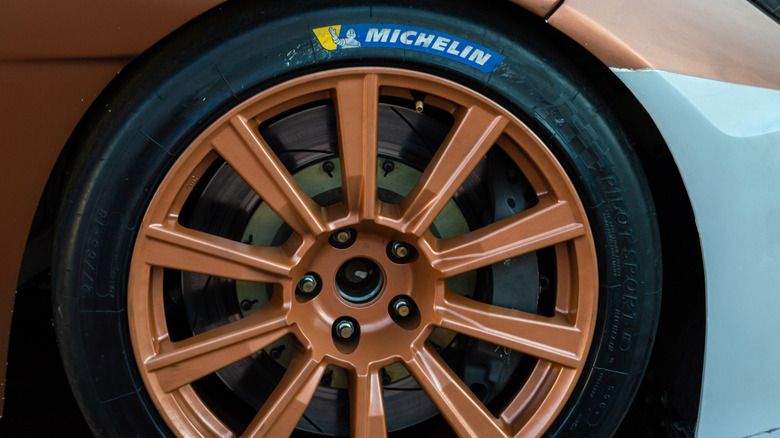
So far your math brain should be telling your performance-wanting brain that springing for a fancy-pants brand isn't worth it. A set of four of those Vredestein Ultrac Pros will run you $596. Four of those pretty Continentals costs $800. The Michelins cost nearly $1,000. So why do Consumer Reports and Tire Rack give those more expensive tires the advantage over their cheaper rivals? Noise is one factor. Both the Michelin and Continental earned nearly top ratings from Consumer Reports. Prioritize noise alone, however, using Consumer Reports' shopping tool and you'll find that another tire, the $161.20 Kumho Ecsta Sport S PS72 actually ranks as quietest.
That tire's not in Tire Rack's grouping, but again the Vredestein does very well, getting an 8.7 versus the 8.9 for the Continental. And the Vredestein does fine at Consumer Reports, too, matching the Michelin and Continental.
So is this all subjective? Sort of. The big lever on the scales at Consumer Reports is its owner satisfaction ranking, based on reports from 5 million readers. By that measure the Michelin ranks highest — but the Vredestein actually comes second. Tire Rack both tests tires and weights its scores from tire owners, too; on its surveys you'll see a Miles Reported number on the left of any chart (along with Best in Category and Price) , which lets you factor how much weight you're giving survey data versus the seller's in-house testing to arrive at your own magic math.
Bottom line, your odds are good going with a cheaper option. But P.S., 'tis the season to start thinking about the best winter tires according to Consumer Reports.