

Chevy's New V8: Why Cars Will Have Engine Oil Dipsticks But Trucks Won't
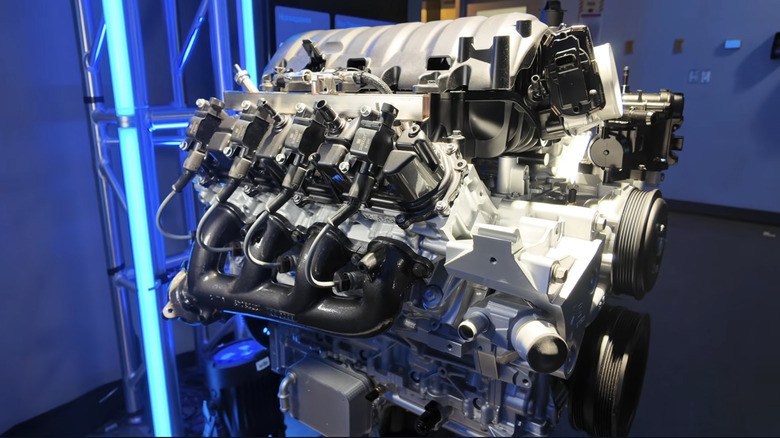
Among the oldest engines still in production today is the small-block Chevy (SBC) V8, and you may have heard that GM recently took the covers off the latest entrants into the sixth-gen family — the 5.7-liter L76 and 6.6-liter L78. While the headline figures of more power and capability are all exciting news, the fact that these engines no longer feature the good 'ol dipstick might come as a bit of a letdown to ardent GM fans.
Although GM is not the first company to drop dipsticks, many enthusiasts consider it an unnecessary complication to engine maintenance. However, that's not exactly the sentiment that Ian Stahl, Assistant Chief Engineer of Small Block Engines at GM, has towards the idea. Speaking to YouTube's The Fast Lane Truck, Stahl was quoted as saying, "I've never been a fan of them." He likens the whole oil dipstick shebang to how many people didn't like seatbelts back in the old days. "Now, nobody thinks twice about [seatbelts]... so everything takes time to get accustomed to," according to Stahl.
Perhaps his rationale of not many owners checking oil or knowing how to check it correctly may hold water, but apart from that, the engine's packaging and other design considerations also played their part in the decision to ditch the traditional setup. Instead, what you find is a battery of sensors that rely on a number of parameters, including driving time, temperature, and miles driven, to check the oil pressure, oil level, and oil life.
While the video's comment section didn't spare Stahl or his remarks, it's worth noting that these sixth-gen small blocks do bring along several noteworthy upgrades over the outgoing 5.3 and 6.2.
More about GM's new 5.7-liter L76 and 6.6-liter L78 V8s
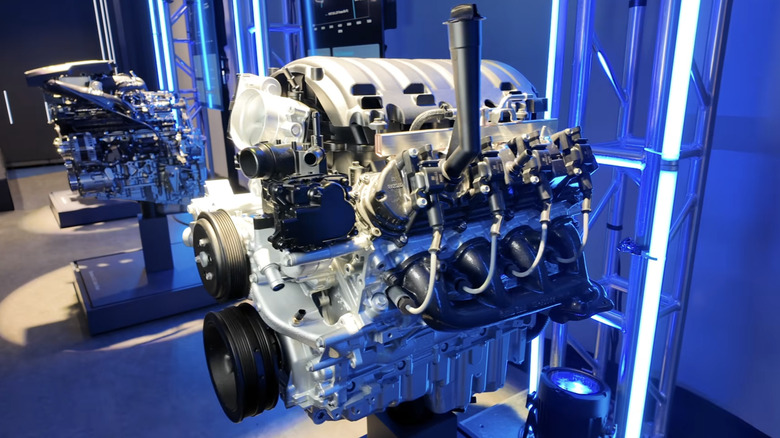
Before we get into the specifics, it's important to understand that these new 5.7 and 6.6 V8s aren't the first of the sixth-gen engines to arrive. That honor goes to the 2027 Corvette's 6.7-liter LS6 motor. What's interesting, however, is that, according to GM Authority, unlike the latest sixth-gen small blocks, the LS6 does feature an oil dipstick. Remember, these 5.7s and 6.6s are for the latest crop of GM light-duty trucks. When comparing the 6.7 LS6 to the 6.6 L78, engineers told Car and Driver that the LS6, in addition to its slightly larger displacement, had hardware changes that wouldn't have made sense for the trucks. Also, the LS6 is dry-sumped, so make of that what you will.
Dipstick controversy aside, the 5.7-liter L76 V8 puts out 402 horsepower and 428 pound-feet of torque, which is significantly more than the 5.3's 355 horses and 383 torques. As for the 6.6-liter L78, the V8 belts out 481 horsepower and 501 pound-feet of torque, numbers that make the outgoing 6.2's 420 hp and 460 lb-ft look a lot less impressive. Increasing the stroke length by 6 mm helped the engines make more power and torque, as did the use of larger throttle bodies, new intake manifolds, and increased compression ratios. The combination of port and direct fuel injection is another sixth-gen highlight, as well as the introduction of a new lubrication system.
While GM chose the unconventional route for its latest truck V8s, that's not the case with the 3.0-liter straight-6 Duramax diesel and 2.7-liter TurboMax inline-four. These engines continue with the traditional oil dipstick. And if it makes you feel any better, the Ram 1500's twin-turbo 3.0-liter inline-6 is also dipstick-free.