

This Rare Engine Is What Henry Ford Tried Before Developing The Legendary Flathead V8
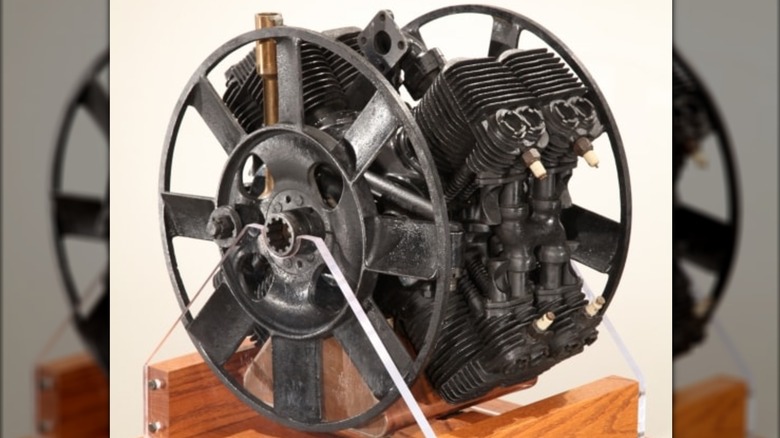
Pop into the Henry Ford Museum of American Innovation in Dearborn, Michigan and you'll see plenty of interesting cars, but you may not be expecting to stumble upon one of the rarest Ford engines in existence on display. Most people won't know there's such a thing as an X-shaped engine in the car world, but the X-8 was actually conceived by Henry Ford and his engineering team in the early 1920s. And yes — that means an eight-cylinder engine in an X configuration.
The museum piece allows visitors to pore over the unusual construction of this rare engine. It's notably compact, just 17 inches tall and wide. Against a length of 30 inches for the famous flathead V8 that launched in 1932, the X-8 is also shorter at just 14 inches long. Four individual pairs of cylinders make up the bulk of the X-8 engine, with eight spark plugs protruding, though the cooling fans on either side will likely catch your eye first. Driven by the crankshaft, they are necessary as this is an air-cooled engine. Hence the fin-like cylinder blocks, which maximize the surface area available for cooling. This X-8 displaced 108 cubic inches — about 1.77 liters — but no power or torque figures are quoted.
This X-8 unit was part of an ill-fated project, followed on by the highly successful flathead V8, but it was no one-off prototype. Evidence shows that Henry Ford planned to replace the Model T and its complex planetary transmission with a new car with a compact new — and powerful — engine as its foundation. The X-8 project included extensive development of the engine itself, along with vehicles to test it in, a bespoke transmission and even the possibility of adding a supercharger to the unit.
How does an X-8 engine even work?
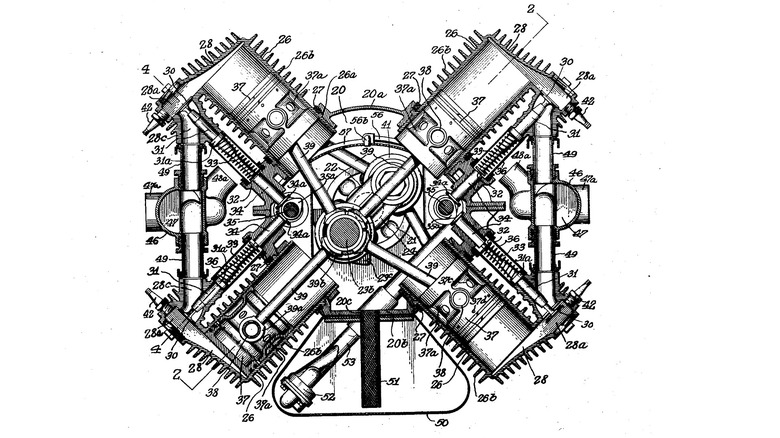
Henry Ford's X-8 has been described as two V4s mounted end to end, and that helps visualize this rare engine, but it's not strictly correct. In fact, looking at the original patent drawings, while it can be seen that there are two sets of four cylinders sharing a crankshaft, each of those sets is a cross. I.e. the X-8 is more like two X-4s joined together. Once you realize it has only two crank throws — when a V8 needs four — you begin to appreciate how the X-8 is so compact.
More cleverness is found in the X-8's manifold design. On each side of the engine, serving four cylinders, there is a single manifold construction incorporating channels for inlet and exhaust tracts, leading to the backs of the inlet and exhaust valves.
Ford's patent also describes the X-8 as having "what may be termed an explosive balance," due in part to the chosen firing order. This alludes to the overlapping power strokes from the engine, smoothing out its operation. That combines with the described mechanical balance of the eight-cylinder layout to satisfy one of the primary objectives of the engine. Ford said this arrangement allows for smaller bores. The patent also describes one example of the engine as producing up to 30 horsepower.
The original design incorporates air cooling, doing away with the need to allow for water channels through the engine, and the patent makes mention of combining at least one cooling fan with the flywheel on the end of the crankshaft. Intriguingly, the patent covers an extension of the concept to create X-shaped engines of different sizes, by lengthening the crankshaft and adding another crank for each series of extra four cylinders.
So why did Ford give up on the X-8 and develop the flathead V8?
Henry Ford's engineers describe him as a man that liked to try new ideas. According to Eugene Farkas' personal account of his career provided by the Benson Ford Research Center, Ford came to him with an idea for a new eight-cylinder engine: "You're going to laugh at me when I tell you this. I'm going to have the cylinders in a cross, and I'll have the connecting rods' ends open forming one crankpin."
Another engineer, Allen Horton, did the initial design work on this air-cooled engine under Ford's instruction, including the creation of a prototype car to test the engine in. After several years in development, it still had issues including oil getting into the cylinders. Farkas took over and changed it to a water-cooled design, but one of the major problems never addressed was exposing of the lower spark plugs to the elements.
Farkas gives us interesting insight: "It had so many new things in it. Each one of the items that we tried out needed years of research in order to make a successful whole out of it." But the X-8 was running out of time as its development stretched into 1926. A replacement for the Model T was needed and the Model A, which featured a new four-cylinder engine, was developed as merely an intermediary car. Years later, the flathead V8 project would begin in earnest. Its conventional layout made it easier to bring to production, and the novel casting of the cylinders and crankcase together as a single iron block cut manufacturing costs. It officially debuted in 1932 and lived until the early 1950s, becoming an icon of hot rod history in the process.