

Compared To Its Competitors, The 2013 Shelby GT500 Was HP King. Then Came The Hellcat
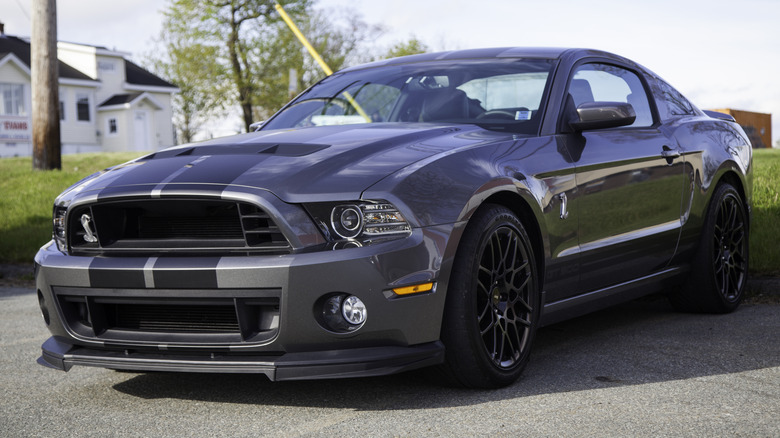
When the 2013 Shelby GT500 hit the streets, there wasn't much competition in the muscle-car realm. Sure, there was the 2012 Chevy Camaro ZL1, but its 580 horsepower was quite a bit less than the 662 ponies Ford's Special Vehicle Team (SVT) managed to squeeze out of the GT500's eight-pack. And the best the Dodge Challenger could muster at the time was 470 hp from its 6.4-liter V8. Clearly, the GT500 was the horsepower king of muscle cars in the early 2010s. But that changed when the Hellcat came along just a few years later.
The 2015 Dodge Challenger SRT Hellcat overtook the mighty GT500 and left the ZL1 to rethink its life choices by introducing a 707-horse 6.2-liter supercharged V8. It's not like the GT500 or its Trinity V8 were underengineered; Ford's SVT division gave the 5.8-liter supercharged V8 vastly superior cooling (versus the previous 5.4), and the 2.3-liter supercharger ran a much higher 14 pounds-per-square-inch max boost, with the car even featuring a single-piece carbon-fiber driveshaft. While the Hellcat's horsepower seems like a decent chunk more than the GT500, the 631 pound-feet of torque from Ford's V8 is awfully close to the Mopar's 650 lb-ft.
By the time Ford managed to catch up with the 760-hp 2020 Shelby GT500, Dodge had already crossed the 800-horsepower mark with the Challenger Demon. And GM settled for 650 hp with the sixth-gen Camaro ZL1. So as far as muscle cars were concerned, from the mid-2010s to when these V8-powered Challengers bowed out at the end of 2023, it was essentially the Hellcat era.
The Hellcat V8's history and comeback
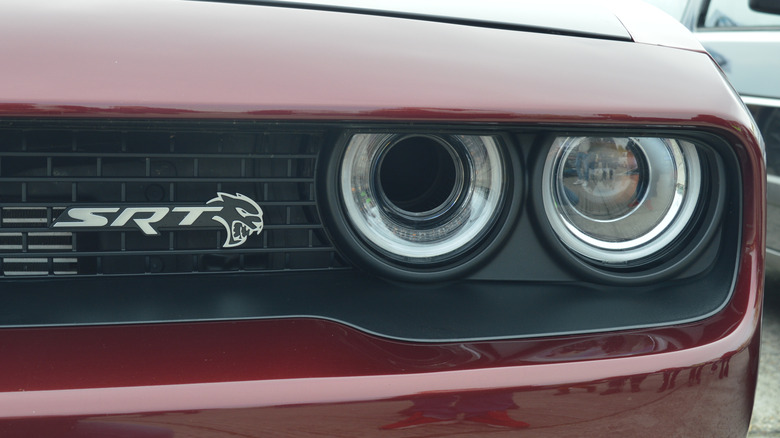
Dodge had planned for a 600-horsepower Challenger before rumors spread of the spicier GT500. Reports of the 662-hp Shelby helped Fiat Chrysler's director of advanced power train development, Chris Cowland, persuade his bosses to approve a bump to 675, but Cowland had even bigger plans. He gave his team a target of over 700 horsepower.
The 6.4-liter V8 was chosen as the basis for this new Goliath of an engine. However, the SRT lineup's trusty V8 soldier was de-stroked to 6.2 liters, and a supercharger displacing nearly 2.4 liters was added. That blower alone consumed 80 horsepower.
While the 6.4 and 6.2 were designed to share the same assembly line, more than 90% of the 6.2's components (by value) were new. Mopar gave it top-shelf parts, including forged-aluminum pistons, a forged-steel crankshaft, and powder-forged connecting rods with beefed-up bushings and carbon-coated pins to compensate for the additional stresses the engine had to endure. The project was so secret that, according to InsideHook, not everyone at Dodge was privy to the engine's SAE-verified horsepower numbers.
After the Hellcat's debut in 2015, the industry was shaken, and the engine's relative affordability meant it quickly became popular. Since then, several iterations of the Hellcat engine have powered everything from Challenger Demons and Charger Redeyes to Durango SRTs and even the wild Ram TRX. And while the Hellcat V8 seems likely to return in the 2028 Charger, you don't have to wait until then for one: Ram has brought back the Hellcat-powered 1500 TRX SRT for 2027.