

6,900-Mile 1969 Plymouth Barracuda Is A Green-On-Green Torque Monster With A Factory 440
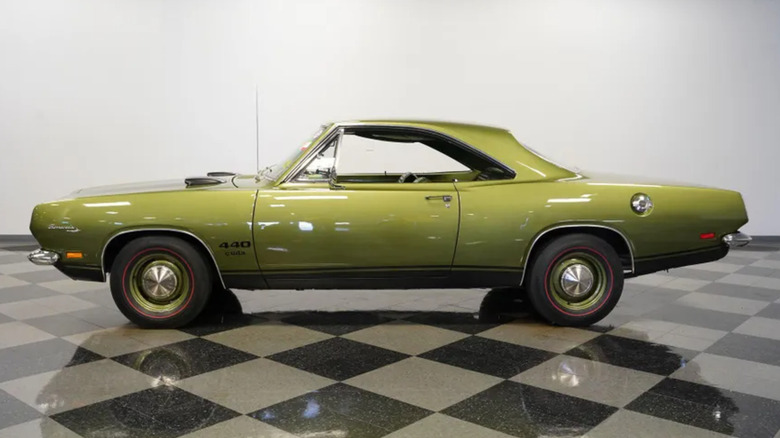
There were a lot of pretty hot muscle cars around in 1969, but only one could burn, burn, burn, burn it to the wick: Barracuda. We're talking about the 1969 Plymouth Barracuda M-Code, to be exact, and if it isn't one of the scariest cars you've seen out on the road, that's likely because they're so rare. There are just 19 cars in the A-Body M-Code registry, and the seller says this is one of them.
As for what makes it so terrifying, imagine a 1960s-engineered compact car with more claimed torque than a 2026 Dodge Charger Sixpack R/T 4-door — but without annoyances such as power disc brakes, power steering, or any regard for weight balance. Thanks to its 440-cubic-inch Super Commando V8, the Barracuda M-Code not only came with 375 horsepower and 480 pound-feet of torque, but it also carried 57% of its weight over its front wheels. When you also consider those wheels were only 5.5 inches wide, the result was such a mismatch between the car's straight-line power and its handling that one contemporary review — hosted by Curbside Classic – called the M-Code downright "disturbing."
Also perhaps scary is the price of this machine: You'd have to shake loose some $129,995 to drive home with this low-mileage high performer. It's listed in the Streetside Classics online classifieds, where it's waiting for someone brave enough to get behind the wheel. There should be plenty of life left in this particular Barracuda as well. The seller says it has only 6,906 miles on the clock — a number that Hemmings says is "believed original." For some context, Hagerty reports that a typical 1969 Barracuda, in good condition and in an average spec, is valued at about $31,238.
The history behind the M-Code
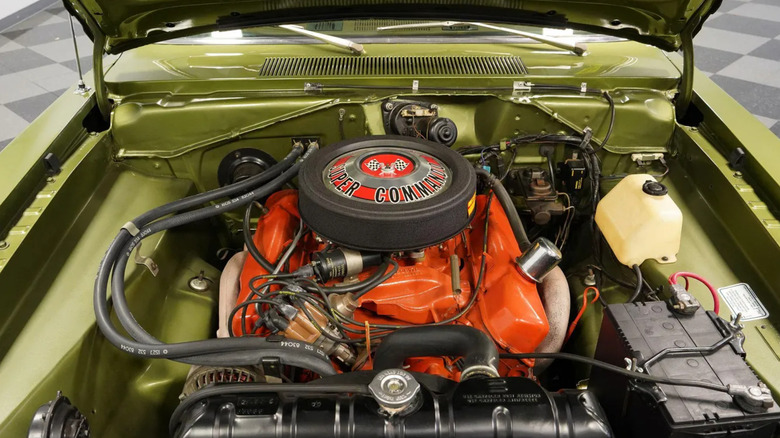
What do you get for your six figures' worth of Barracuda? Well, the important piece is under the hood. The car's motor provided both fear-inducing performance and gave the car its M-Code nickname.
The Barracuda itself was born from the bones of the Plymouth Valiant in 1964, adding a classic to our list of cars named for ocean creatures. Knowing Ford was preparing to sportify its Falcon into the Mustang, Plymouth followed the same playbook but at a faster speed to get to the market first — by just over two weeks. The Barracuda naturally launched with an available V8, in this case, a then-new 273-cubic-inch mill, but as the demand for muscle cars grew, so did its engines. First, for 1965, Plymouth reshaped the camshaft lobes, upped compression to 10.5:1, and added a four-barrel carb to transform the Barracuda's small block into the Commando V8. The motor leveraged the same displacement to raise its horsepower rating from 180 to 235, and those horses were complemented by 280 pound-feet of torque.
The second-generation Barracuda debuted in 1967 and got a 383-cubic-inch V8 good for 280 horsepower. By 1969, the final year before Plymouth upsized the car to the E-Body platform, enthusiasts could choose from four V8 motors -– including the 440-cubic-inch Super Commando V8 that was actually too big for the Barracuda's engine bay. Engineers were only able to cram it in by removing the hardware for the power steering and power disc brakes, leading to its less-than-stellar handling. To close the circle here, Plymouth's VINs during the period, at least for its top performers, had a character space reserved to indicate which engine was being used. And in the Barracudas motivated by the Super Commando V8, that letter was M.