

Scientists Discover T. Rex Blood Was As Hot As Human Blood, Suggesting They Were Fast-Running Predators
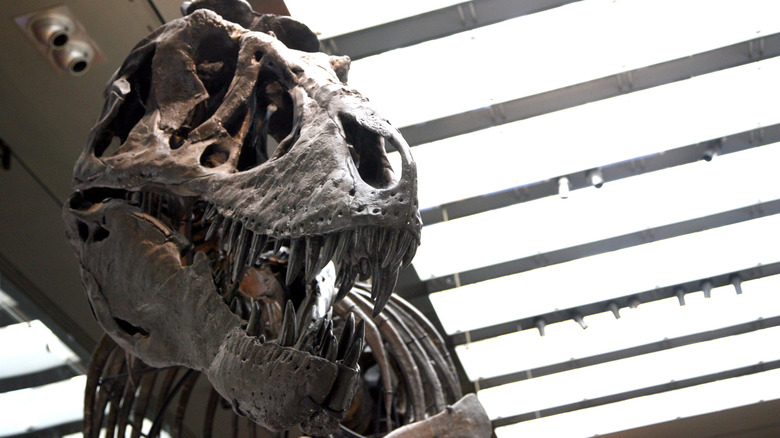
Using a novel technique, a team of scientists at UCLA have managed to take the body temperature of a Tyrannosaurus rex. Despite being extinct for over 65 million years, the T. rex could be studied because the team discovered a power beyond time, beyond death: dentistry. Examining the isotopes in the molecules of the enamel, the researchers have now announced that the world's most famous dinosaur had an internal temperature of 97 degrees Fahrenheit, give or take a few degrees. That's roughly the same as you or I, or your best elephant friend. This is proof that T. rex was indeed warm-blooded, as long suspected, as opposed to most other reptiles. That in turn suggests that T. rex was an active and fast-running predator or scavenger, rather than a sit-and-wait ambush predator like a crocodile. Speed definitely makes them worthy of our little blog.
The breakthrough comes courtesy of a technique developed at UCLA about ten years ago, which looks at the molecules preserved in fossils. Carbon and oxygen are very common ingredients, but they do come in different flavors, or "isotopes," based on how many neutrons they have. It turns out that the heavier isotopes bond with each other into molecules at different rates than their lighter cousins, based on temperature. So running an analysis of the isotopes within a fossil can reverse-engineer what the body temperature must have been. Since enamel changes the least over time, its best to do this technique with a tooth sample.
Still, there's an issue: There are only so many dinosaur teeth that have been found, so shaving some of them off for analysis risks degrading the few that we have. For the last decade, the technique simply required too much mass from a tooth for anyone to allow the UCLA team to touch their fossils. What changed was the technique itself, which became more refined. Now able to get good results with very little mass, the team convinced the nearby Natural History Museum in Los Angeles to let them scrape off a few precious samples. Thomas the T. rex and one of his buddies became the first dinosaurs ever to have their temperature taken.
It's good to be so hot
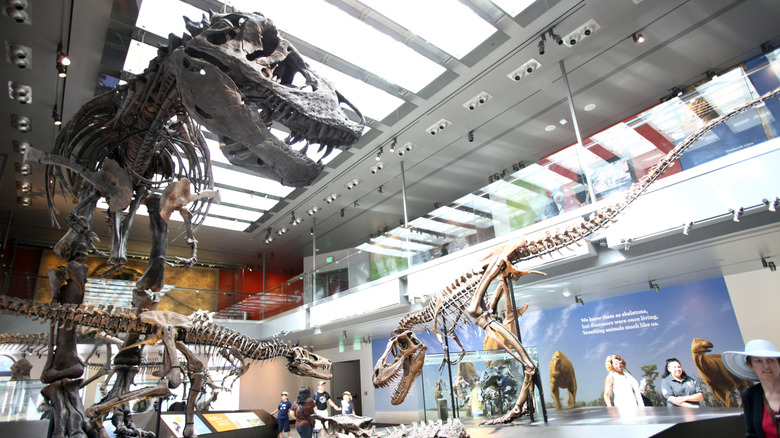
The official conclusion of this study, published in Science Advances, is fairly straightforward: Tyrannosaurus rex had a body temperature of 97.3 degrees Fahrenheit, plus or minus 4.5 degrees. The questions that stem from this get more interesting. How did it maintain this temperature? With a mammal-like metabolism, or by insulating better than other reptiles? How did T. rex actually behave? Far from a slow, lumbering beast, an animal with this temperature, like an elephant, is capable of sustained activity and movement over time. A crocodile, by contrast, is only capable of short, swift bursts; anything more is beyond its cold little heart. (If you're wondering, the scientists did measure some ancient crocodile teeth, too, indicating a body temperature of a mere 88 degrees Fahrenheit.)
This isn't the only recent bit of T. rex news. The first known set of adult T. rex tracks was just discovered in North Dakota, giving us an idea of how fast it walked — about 3.5 to 4.5 mph, the same pace as a human. Each footprint was about 3 feet long, giving it a walking stride of about 13 feet. That's about as long as a Mini Cooper. And a recent study from the College of the Atlantic in Maine discovered T. rex may have ran on its tiptoes, like modern birds, and smaller T. rexes could cover 100 meters in 8.77 seconds, beating Usain Bolt.
The blood study also says something about where T. rex could live. Cold-blooded reptiles need warm environments with lots of sun to keep themselves warm. A warm-blooded creature could climb to higher elevations or go farther north, where it's cooler. That would finally confirm why a T. rex was found all the way up in Alaska, despite no other fossils from cold-blooded animals. Keep in mind that Cretaceous period, when T. rex was alive, was just about the warmest the Earth ever got, averaging around 10-25 degrees Fahrenheit hotter. That puts the T. rex's possible habitat range pretty wide.
What this doesn't answer is the question of whether the star of Jurassic (should be Cretaceous) Park was a predator, a scavenger, or both. The classic image is of a big huge lizard chasing down another big huge lizard and eating it, but there's evidence that it could have just saved the energy and scared away smaller predators from their kills. Warm blood doesn't mean T. rex couldn't be ice cold. Science hasn't confirmed this one way or the other yet. Maybe ask a dentist.