

9 Ultra Quick Motorcycles That Can Eat A Ford Mustang Dark Horse SC For Breakfast
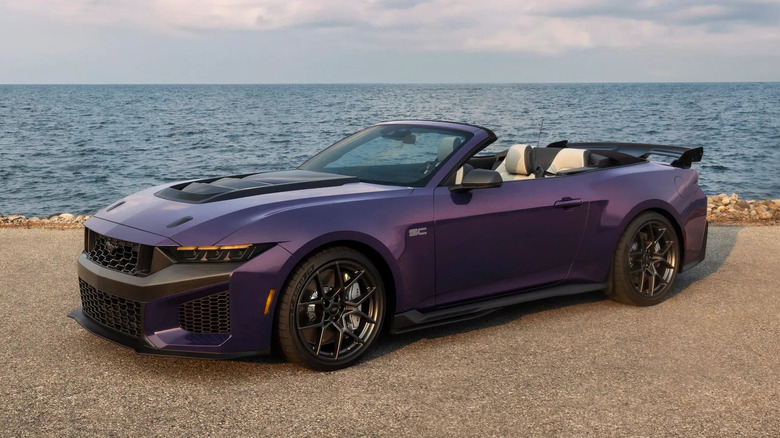
The 2027 Ford Mustang Dark Horse SC convertible is shaping up to be a serious piece of machinery, with the sizzle largely built around its supercharged 5.2-liter V8, making 795 horsepower and 660 lb-ft of torque. Third-party testing hasn't happened yet, but MotorTrend estimates it will hit 60 mph in 3.0 seconds, which gives us a useful starting point.
We're also going to presume that this doesn't put the Dark Horse SC on pace for a sub-10-second quarter-mile that'll make good on what we owe Dom Toretto. For reference, a 2015 Nissan GT-R likewise did 0 to 60 in 3 seconds flat and still needed 11.2 seconds to cover the quarter-mile. We'll have a firmer answer once the SC gets instrumented testing, but we're pretty confident that it's not going to find 1.2 seconds on the backstretch.
In the meantime, let's compare it to some bikes. We'll run through some of the quickest street-legal motorcycles with an emphasis on 0 to 60 and a little quarter-mile analysis for good measure. That includes obvious monsters like the supercharged Kawasaki Ninja H2, but also the hulking Triumph Rocket 3 R and a 20-year-old Suzuki GSX-R1000. All have published acceleration figures that put the Mustang's estimated performance squarely in their sights.
2018 Kawasaki Ninja H2 SX SE
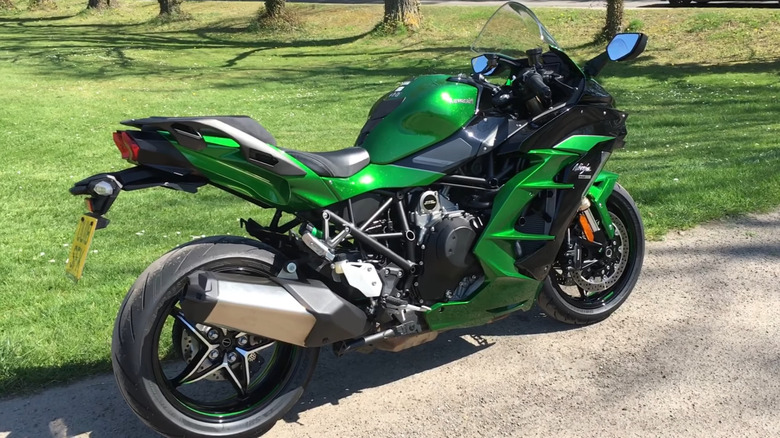
The Kawasaki Ninja H2 SX was among Kawasaki's fastest motorcycles ranked by top speed when it debuted in 2018, and also had enough juice to just barely clear our 3.0-second 0-to-60 bar we're using for the Ford. With the SE getting to 60 in 2.98 seconds, it isn't living on the bleeding edge of speed by modern standards, but we're also talking about a nearly decade-old bike that can be found for sale pretty readily below $20,000. It's essentially a dead heat to 60 with what we're expecting from the Dark Horse SC, with the Kawasaki widening the gap should the race continue beyond that.
It's a fun comparison not just because of the age and cost gap, but because the H2 SX SE also isn't supposed to be a single-minded speed machine. It's essentially a sport tourer that just happens to be a little extra fast, mostly thanks to its supercharged 998cc inline-four-cylinder engine. So while Dark Horse owners can take comfort in amenities like air conditioning, cupholders, and a second pair of wheels, the Kawasaki isn't roughing it by bike standards. The SE gives you heated grips and cruise control, plus other touring niceties like actual storage. It turns out that riding comfortably and getting up to cruising speed with alarming haste are not mutually exclusive.
2010 BMW S 1000 RR
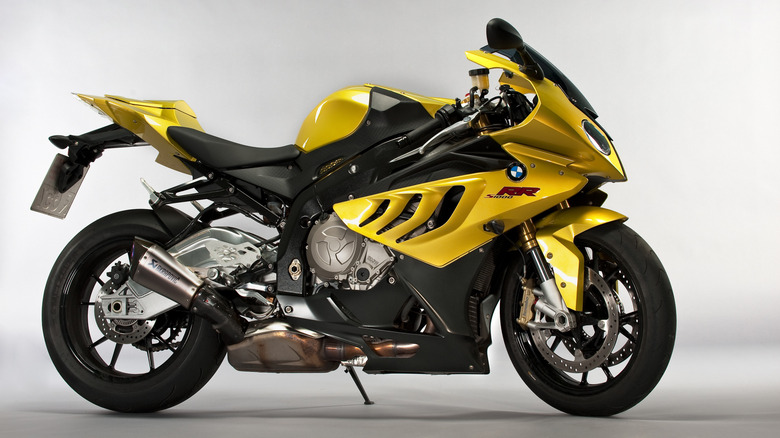
While BMW Motorrad has since debuted the 205-horsepower M 1000 R and RR superbikes, the 2010 BMW S 1000 RR was no slouch back in the day either. It wasn't insane off the line, getting to 60 in a respectable but not unthinkable 2.9 seconds, but it is among the very fastest on this list when it comes to the quarter mile, going the distance in 9.57 seconds. That's considerably nastier than the 2.9-second launch alone might suggest, and firmly on the other side of the 10-second line we don't expect the Dark Horse SC to cross.
For some context on what BMW had unleashed, the S 1000 RR arrived with a 193-horsepower 999cc inline-four in a bike weighing around 450 pounds. BMW also offered performance ABS and traction control, which helps explain how something with that much power and that little mass could put up serious drag times rather than just chuck its rider into the grandstands. More than a decade and a half later, its acceleration has only begun to seem ordinary, and it remains a wonderfully credible way to keep up with your buddy's new Dark Horse.
2014 Ducati 1199 Panigale
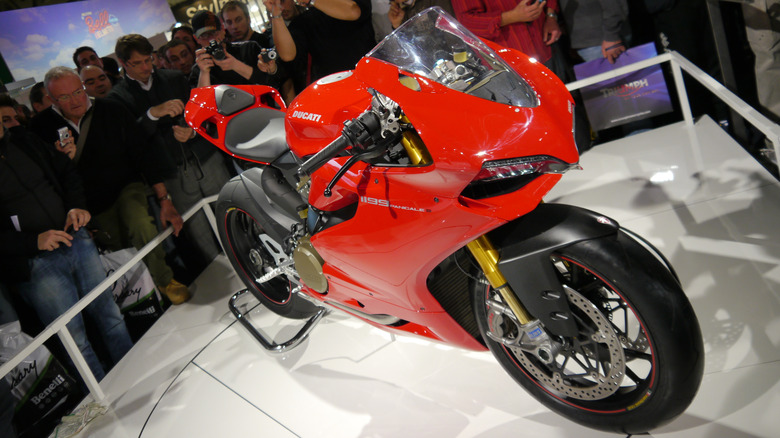
The 2014 Ducati 1199 Panigale clears our Mustang benchmark with just a little more breathing room, zooming to 60 in 2.8 seconds, followed by a 9.91-second quarter-mile at 145.5 mph. That latter figure is especially useful here, because it puts the Ducati on the other side of the 10-second line we're cautiously assuming the Dark Horse SC won't cross. It gets there with beefy-for-a-motorbike 174.4 horsepower and 88 lb-ft of torque – numbers that really drive home how 795 horsepower doesn't go quite as far when you're hauling space for four and all manner of creature comforts along for the ride.
Obviously, the Ducati is moving a lot less stuff. It weighs just a hair over 400 pounds, which gets us to one of the recurring reasons motorcycles make these comparisons so unfair, not to say unfun. A Mustang has to bring seats, glass, doors, airbags, carpeting, climate control, and enough structure to keep all of that behaving like a car. The Panigale mostly has to bring you, an engine, two wheels, and the sort of acceleration that makes your internal organs reconsider their assigned seating. That isn't a knock on the Ford. It's just why comparing a very fast car to a very fast motorcycle can feel a little like drag racing a truck that happens to be towing an RV.
2020 Triumph Rocket 3 R
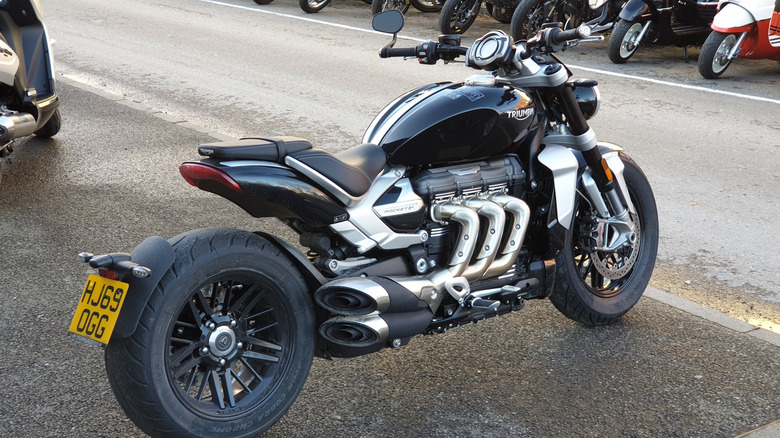
The 2020 Triumph Rocket 3 R can run a 2.73-second 0 to 60, which wasn't the product of some moto journalist with a lack of mechanical sympathy that borders on sociopathy, but rather was pulled off by Triumph itself, setting a company record at the time. It also managed a 10.562-second quarter-mile at 126.41 mph, and that number came from a stock bike being repeatedly dialed in at the strip rather than some barely recognizable drag-racing special.
What makes that performance especially entertaining is the size of the thing doing it. The Rocket 3 R uses a 2,458cc three-cylinder engine with 165 horsepower and 163 lb-ft of torque, which is an absurdly large motorcycle engine attached to a machine that weighs north of 600 pounds. That isn't quite Honda Gold Wing territory or anything, but it isn't light, either. The Rocket ultimately makes a nice midpoint between a superbike and a car: huge by motorcycle standards, brutally quick by almost any other standard, except maybe bullets and badminton shuttlecocks. (Badminton shuttlecocks move really, really fast.)
2015 Kawasaki Ninja H2
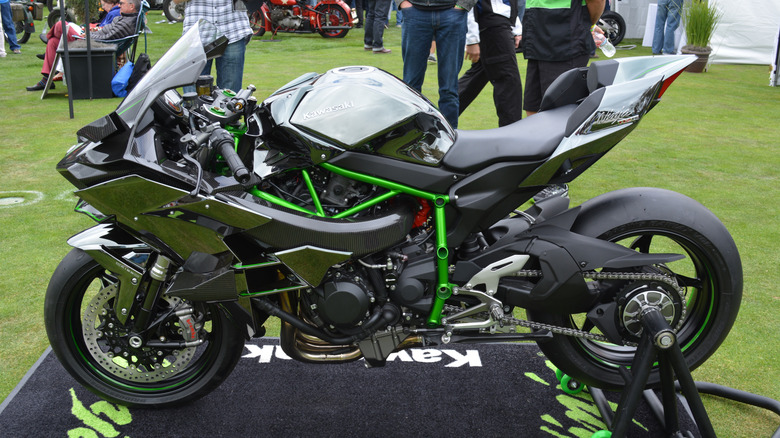
By 2015, Kawasaki had decided its halo bike needed something most production motorcycles of the day still didn't have: a supercharger. The street-legal Ninja H2 wrapped that blower around a 998cc inline-four and put out 189.8 horsepower and 91.2 lb-ft of torque. It could also hit 60 mph in 2.6 seconds and run the quarter-mile in 9.62 seconds at 152.01 mph, putting it comfortably on the wrong side of the line for anyone hoping the Dark Horse SC will catch up after 60.
The H2's real party trick is what happens once it is already moving. In runway testing, it was the quickest motorcycle in its group to 60 mph and continued pulling hard enough to reach 180 mph in roughly 16 seconds. It also did it in fairly heroic fashion. With the electronics-heavy bike offering plenty of options for dialing in performance, Cycle World Road Test Editor Don Canet opted for shutting all of that noise off completely before putting up the fastest time of the day. Has he been telling that story for the last ten years? We would be.
2012 Kawasaki Ninja ZX-14R
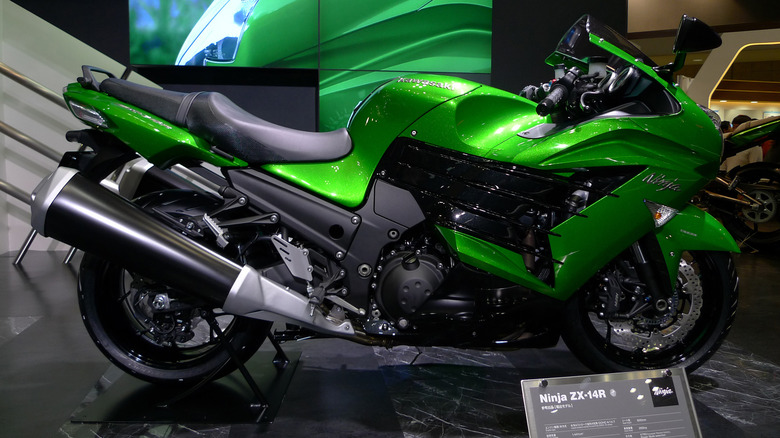
The 2012 Kawasaki Ninja ZX-14R is where our little comparison stops being close. It hit 60 mph in 2.6 seconds and ran the quarter-mile in 9.47 seconds at 152.83 mph, which was the quickest production-bike elapsed time Cycle World had ever recorded when it got its hands on it in 2011. That's four-tenths quicker to 60 than MotorTrend expects from the Dark Horse SC, and, more importantly for our breakfast metaphor, comfortably into the nine-second quarter-mile club. The Ford may eventually surprise us when somebody gets timing equipment on one, but this is the first bike here where "almost certainly quicker" starts turning into "good luck with that."
Kawasaki didn't stumble into those numbers, either. For 2012, the ZX-14 became the ZX-14R and picked up a substantially reworked engine, growing from 1,352cc to 1,441cc, while the chassis and supporting hardware were updated along with it. It has a dyno-measured 192 horsepower and 113 lb-ft of torque, so this wasn't some delicate little race bike eking out an advantage through pure elegance. The ZX-14R was Kawasaki's enormous open-class hammer, and in a straight line it hit hard enough that even a nearly 800-horsepower Mustang starts looking outclassed.
2008 Suzuki Hayabusa
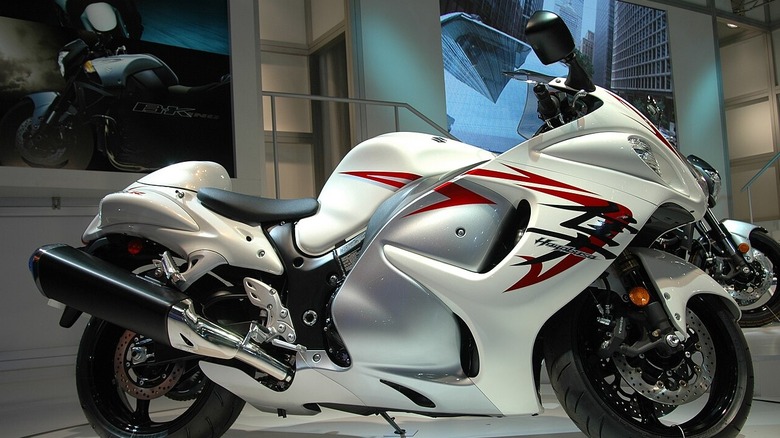
It isn't always easy to describe speed with words, but "Hayabusa" is one of those names that makes human language seem almost adequate. It just sounds fast. And if you're wondering how fast the Suzuki Hayabusa can go, meet the second-generation bike that hits 60 mph in 2.58 seconds and can run the quarter-mile in 9.90 seconds at 147.94 mph.
That second generation arrived after Suzuki had left the original Hayabusa fundamentally alone for about nine years, and the 2008 redesign increased displacement from 1,299cc to 1,340cc while substantially reworking the engine underneath the familiar bodywork. Suzuki had also spent years developing the replacement, rather than simply turning up the volume on an already famous nameplate. Suzuki had tinkered with the bodywork, ever refining the bike's aero. Meanwhile, in modern-day Dearborn, the Dark Horse was also obsessing in the wind tunnel, only they were trying to figure out how to design a soft top that doesn't become a drag parachute at speed. To give both companies their due, the Suzuki does indeed go really, really fast and the Mustang, as far as we know, doesn't go spontaneously topless when the wind blows the wrong way.
2009 Yamaha VMAX
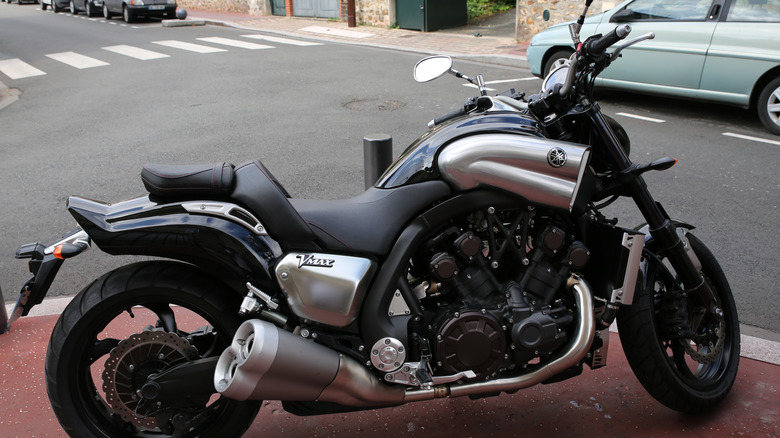
You may have read that a brand-new Yamaha VMAX is on the way, but it turns out that's because AI slop YouTube channels are telling AI slop Google about AI slop motorcycles that don't exist. What a time to be alive. Anyway, back in 2009, when neither the Mustang Dark Horse nor prevalent AI slop was a thing, there was the Yamaha VMAX. This is not a delicate superbike trying to disappear beneath its rider. It is a big, dramatic musclebike built around a 1,679cc V4, which makes it about as close to a kindred spirit to the Mustang as you can get from something on two wheels that was engineered in Japan.
It gets to 60 mph in 2.5 seconds before running the quarter-mile in 10.11 seconds at 137 mph. That makes it half a second quicker to 60 than the number we're using for the Dark Horse SC, while still fitting the same broad philosophy of solving the acceleration problem with an indecent amount of engine. The 2009 bike was also a genuinely big moment for the nameplate. It represented the first complete VMAX redesign in 24 years, replacing the basic formula Yamaha had been selling since 1985 with a new engine and aluminum frame. And at roughly 683 pounds, nobody gets to explain away that 2.5-second launch by pointing at some featherweight track toy. It is a big motorcycle using a big engine to make big power that generates big speed. Somewhere beneath all the differences in wheels, bodywork, and cupholder count, the VMAX and Dark Horse SC may actually understand each other.
2006 Suzuki GSX-R1000
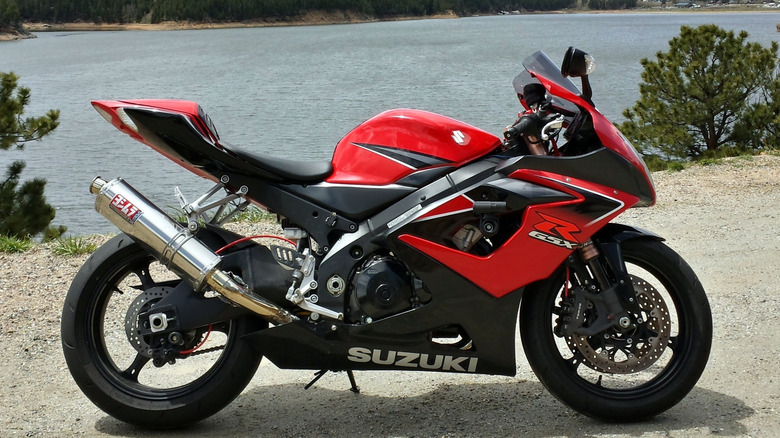
Yup. A decades-old Gixxer is still faster than the most advanced modern superbikes on the track, and it looks plenty capable of embarrassing the new Dark Horse, too. The 2006 Suzuki GSX-R1000 is the quickest bike here by the specific 0-to-60 figure we're using, with an instrumented 2.35-second sprint to 60 mph. That doesn't mean this 20-year-old Suzuki is categorically faster than the supercharged H2 we just covered, but it's pretty clear that if those two teamed up against the Dark Horse, they'd quickly be racing each other.
The K5/K6 generation was not some random statistical outlier attached to an otherwise ordinary bike. The GSX-R1000 was substantially redesigned for 2005, while the 2006 K6 carried that same basic generation forward. The K5/K6 remains one of the most highly regarded versions of the model. That makes it a pretty satisfying place to end: the Mustang Dark Horse SC is an enormously impressive modern performance car, but motorcycles have been doing deeply unreasonable things measurable only by a stopwatch and a quick thumb for a very long time.