

Why Only One US Highway Uses The Metric System
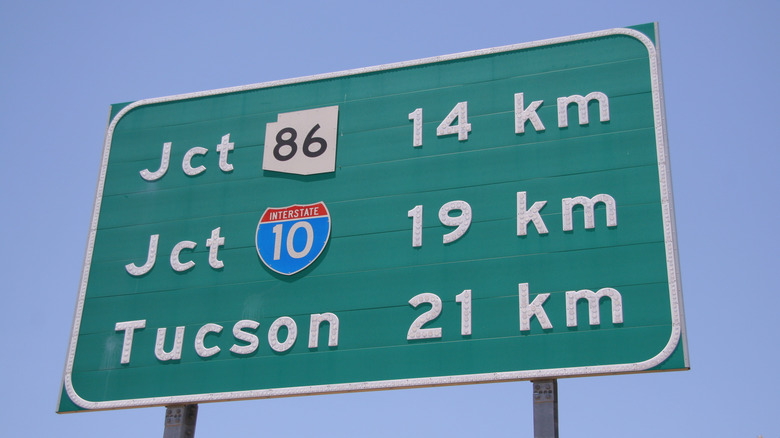
While most of the globe adopted the metric system at least 50 years ago, the United States remains one of the few holdouts refusing to join the international standard. However, the country isn't completely devoid of government metric usage. Interstate 19 uses metric signage, and it's the only U.S. highway that does so. The 63-mile route stretches from Nogales on the Mexican border to Tucson, entirely within Arizona. I-19's metric signs are a vestige of a federal flirtation with joining the final wave of major countries to convert to the metric system.
Believe it or not, Congress passed the Metric Conversion Act of 1975 with overwhelming bipartisan support. In the House, 300 representatives voted for the bill against 63, more than a supermajority. One caveat made the Act popular with legislators: conversion to metric was completely voluntary. The only concrete achievement of the Metric Conversion Act was establishing the United States Metric Board, an agency tasked with acclimating the American public to the metric system.
The metric signage along I-19 was the U.S. Metric Board's largest experiment. According to the New York Times, the Interstate was selected because it was "a relatively isolated" highway near the border with Mexico, a metric-using country. I-19 also doesn't intersect with many highways along its route. The agency hoped this project and others like it would, over time, foster a population that wanted to convert to metric. Over 40 years later, and we're still waiting.
The U.S. could've converted to metric, if we were patient
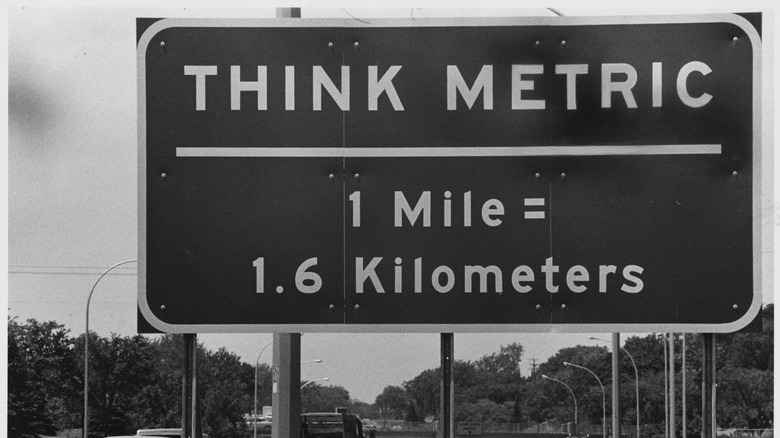
Arizonans were not vehemently against the sign swap to metric. Tom Willett, the head of the Federal Highway Administration's Phoenix office, told the New York Times, "Most of the reaction I've seen is negative." To be clear, all of the distances were changed from miles to kilometers. However, the speed limits were displayed in both miles per hour and kilometers per hour. Decision-makers didn't want people guessing how fast they were going. Surprisingly, the disgruntled drivers complained about the program's cost. The new metric signs cost $628,000. This would be a valid criticism, but I-19 was slated for new signs anyway. The signs with customary units would've cost $600,000. It seems like people were embarrassed to admit that they just don't like change.
President Ronald Reagan shuttered the U.S. Metric Board in 1982, but the metric signage has remained along I-19. Over the decades, Arizonans have changed their opinions on the experiment. According to the Arizona Department of Transportation, the agency planned to replace the metric signage with customary units, but opposition from businesses and local communities derailed the plan. The U.S. Metric Board might have had a winning strategy. Who knows where the country would be if Reagan hadn't closed the agency.