

Connecting Car Batteries Backwards Can Have Shockingly Bad Results
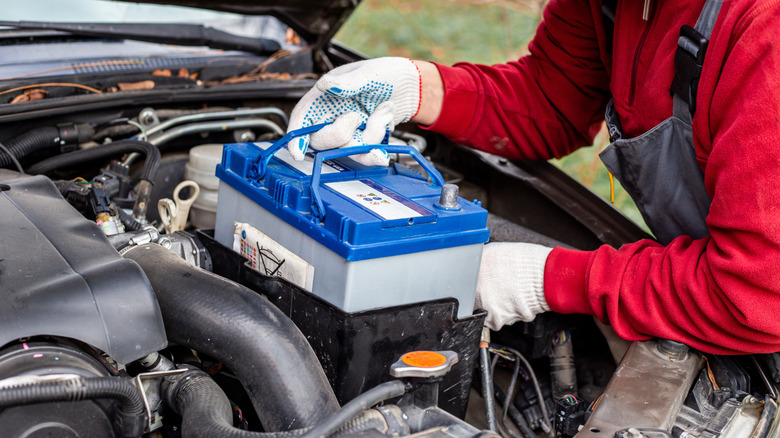
Your car's battery is its lifeblood, enabling starting and operation of its electronics — the fan that blows hot air, the radio, not to mention the headlights. Even EVs require 12-volt batteries to operate. (Although when you jump-start an EV what's actually going on is a little different than jumping a gas car.)
Unfortunately, it's entirely possible to connect a car's 12-volt battery backwards, where you've attached the negative terminal to the positive lead and vice versa. This can also happen when jump-starting a car backwards — for example, attaching the red (positive) cable from the car with the good battery to the negative terminal of the car you're jumping, and the negative lead to the positive side. All of these scenarios induce what's called reverse polarity. That's bad. You could fry several items at once — and the jumper cables themselves could even catch fire. Oh, also, the battery could explode.
Ideally, however, several layers of protection built into the car's components will protect instruments and electronics from damage. Then again, this brief reversal of polarity could also cook several components. There are built-in safeguards, such as the car's fusible links. Think of these as the fail-safes in your car's wiring, designed to pop just like a fuse, before harmful voltage can fry more expensive bits. They're also designed with non-flammable insulation, ideally to prevent something like a reverse polarity incident from causing a fire. Often a modern car will have a few, such as one near the battery.
What to do after you did the bad thing

Not to add insult to injury, but did you happen to check if you actually needed a new battery, or just a jump start? That's worth knowing, at least for future reference. However, now that the damage is done, what next? First, get those keys out of the ignition (or, if your car has a push-button ignition, be sure it's turned off). You want to try to limit any further damage caused by that reverse polarity.
Then, whether you were jumping the car or cross-connecting the leads from the car to the battery, remove the cable connected to the battery's negative pole to break the circuit that's causing damage to your car's electrical system. Next, remove the lead connected to the positive pole of the battery.
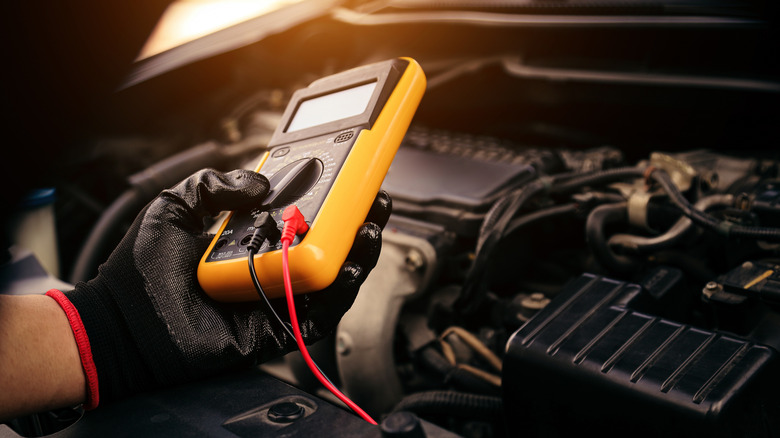
Now, have a look around under the hood. If you see (or smell) burnt wires, that's bad. Possibly, depending on the level of torching, you'll need a professional mechanic to advise you on the next steps. Let's hope you don't find a big melted mess. Good! But you still must inspect your fuses. There are typically boxes both under the hood and in the passenger compartment. (Check your owner's manual if you're unsure of the locations.) You can go through these one by one and inspect them visually. Often there's a built-in fuse puller in the fuse box. And be sure to replace blown fuses with ones of the same amperage. If you're handy with a tester, you can get through this task a bit more quickly.
Hopefully the fuses saved you from major damage
Remember, though, there's still that fusible link. A lot of the time a car has one of these built right into the battery terminal, designed to pop if there's a voltage spike directly from the battery, regardless of the cause. In some cars they're built more like actual fuses, and in others, fusible links are more like loops of wire.
The tough part is that not every car's manual is going to identify this fuse as the fusible link, and it may call it something like the main fuse or multi-fuse. But no matter what, you're going to have to replace any of these that have popped. That's not hard; it just means reviewing every fuse in the manual or wiring diagram and, almost certainly, one or several of these are fusible links.
There are unfortunately more possible downsides. You could have fried the powertrain control module and/or the alternator. If the latter is harmed, it won't properly charge your battery.
But, fingers crossed, if the fusible link or links and fuses did their job, that hopefully prevented damage from reaching these expensive components. In turn, if you then properly connect a fresh battery — because, remember, you very likely could have damaged the prior replacement one — your car should run just fine. Just remember to never jump start a modern car without checking these things first.