

The Korean-Market Hyundai Grandeur Looks Awesome But Sucks To Drive
I grew up thumbing through as many car magazines as I could get my grubby little hands on, whether they were the domestic buff books or totally foreign ones that didn't even use the Latin alphabet. I didn't care that I couldn't read them; my car-obsessed mind simply wanted to look at all the cars that I wouldn't otherwise see driving around my hometown in Los Angeles, so I've had a lot of practice lusting after foreign-market cars. Unfortunately, like many things one lusts after in life, reality is often much less exciting than fantasy, and there's usually a strong reason why companies choose not to bring certain models to the U.S. market.
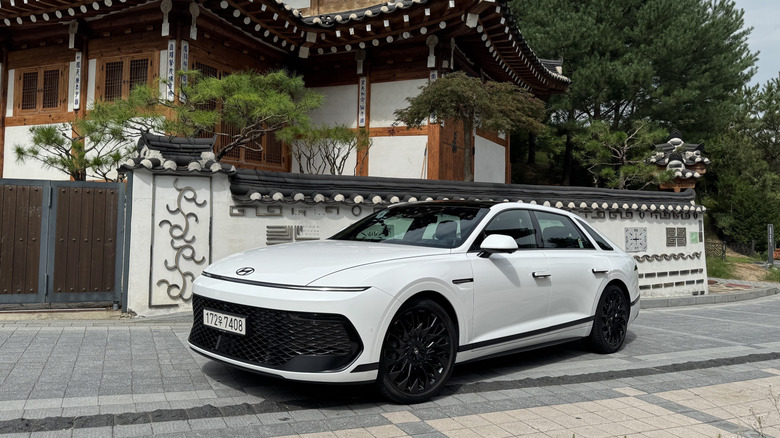
Which brings me to the case of the wonderful Hyundai Grandeur. We first knew of it in the U.S. as the one-generation-only Hyundai XG350 in the early 2000s, and then the Hyundai Azera that lasted two generations before being discontinued in our market. But the Grandeur was first introduced in 1986, and it has soldiered on in other markets since our Azera's discontinuation, topping Korean car sales lists for a while. I had the chance to drive the newly facelifted Grandeur when Hyundai flew me to its home country a couple weeks ago, and while my time with the car was limited, it was enough to know we aren't missing anything of substance by not getting the Grandeur in the U.S. — at least not with the powertrain I sampled.
 Logan K. Carter/ Jalopnik
Full disclosure: Hyundai flew me and a small group of journalists to Korea to cover its annual Investor Day Meeting, as well as to learn about and experience its new Pleos Connect infotainment ecosystem. It put me up in a swanky hotel and kept me fed for a few days, and I also got a brief chance to drive the Korean-market Grandeur.
I only drove the naturally aspirated four-cylinder and it was Not Good
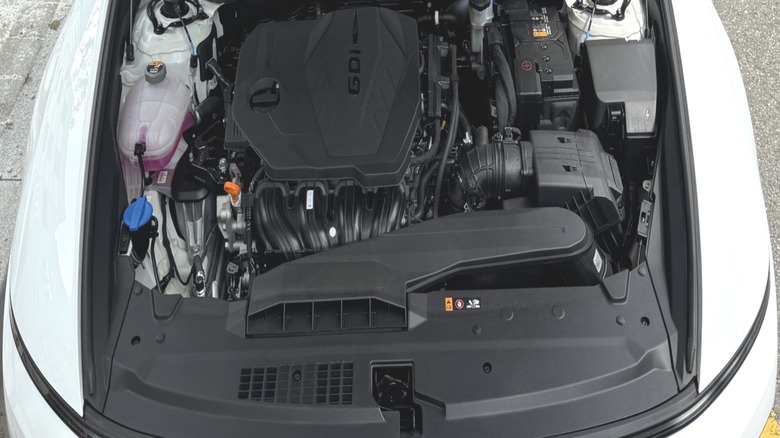
In South Korea the Grandeur is offered with four powertrains: the base naturally aspirated 2.5-liter inline-4 that produces 195 horsepower and 183 pound-feet of torque, a naturally aspirated 3.5-liter V6 with 295 hp and 265 lb-ft, a hybrid using a 1.6-liter turbo four with a total of 235 hp and 195 lb-ft, and an LPG-fueled 3.5-liter V6 that produces about 236 horsepower and 231 lb-ft of torque. Unfortunately I only got time behind the small-diameter steering wheel of two Grandeurs that were both saddled with the base four-cylinder, and let me tell you, it's not great. I'm sure the other drivetrains make this a more compelling car, but I was only compelled to be disappointed.
The Grandeur is a big, comfy, luxury-adjacent sedan that stays in its lane — thanks to lane-keep assist, yes, but also thanks to a lack of sporty aspirations. This car prioritizes comfort over all else, which I appreciated. I had to sift through the touchscreen to find and activate Sport mode, and when I did, it really only held gears longer and made the transmission shiftpoints slightly more aggressive. And there's only so much that little four-cylinder could offer.
 Logan K. Carter/ Jalopnik
At one point I had two other adults in the car with me and I needed to merge onto a highway with a slight incline – nothing crazy, a pretty standard maneuver one would expect a midsize sedan to handle in stride. I had to give it full throttle, which filled the cabin with a high-pitched, thrashy engine noise, and I still wasn't able to get up to the speed of traffic by the time the merge lane ended. Most of the roads in Seoul have low speed limits and are littered with speed cameras as well as average-speed cameras, so it wasn't like there was a need for gobs of power in many scenarios, but the standard engine still felt woefully underpowered to my American sensibilities.
Hyundai says the V6 will complete the 0-to-62 mph sprint in 7.5 seconds, which is nearly two whole seconds quicker than the base engine's 9.3-second claim. The hybrid also dunks on the four-cylinder with a 0-to-62 time of 8 seconds, so I hope anyone who buys a new Grandeur opts for one of the more powerful drivetrains. Beyond the wheezy engine, the Grandeur's handling was nothing to write home about, with lots of body roll, light and numb steering, and low limits of adhesion, as I discovered on a looped freeway onramp. It was a comfy ride, at least!
The Pleos Connect infotainment was pretty slick, but took some familiarization
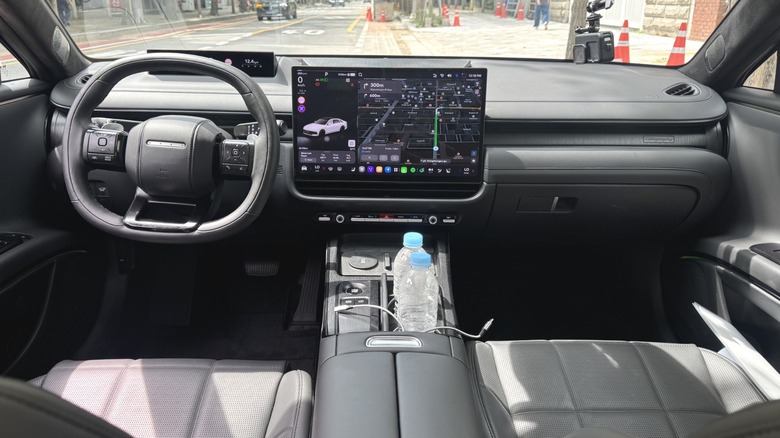
A big reason for my trip to Korea was to experience Hyundai's new Pleos Connect infotainment system, which we've seen in cars like the Grandeur, new Elantra and Ioniq 3. I've done a separate full review of the new infotainment ecosystem, but it's a big part of the Grandeur's driving experience, so you're going to listen to me talk about it again here. The new UX consists of a large 17-inch central touchscreen, a slim driver's display, and a large colorful head-up display. As promised, Hyundai kept a row of real physical controls as well.
Initially I had some trouble familiarizing myself with the new infotainment interface while driving on Korean roads for the first time in my life, but I got a better feel for it after spending more time in the car. The center display is very Tesla-like, with the left-most portion of the screen dedicated to vehicle functions like speed, gear selection, fuel, a numerical tachometer, trip info, and road sign info. The other two-thirds of the screen can be dedicated to either one other function or further split to allow two additional app windows. I thoroughly appreciated the redundancy of having navigation directions on the HUD, driver's display, and center screen, so no matter where my gaze landed I could easily see my next move. Hyundai's signature blind-spot camera feed has moved from the driver's display in current models to the center screen in cars with Pleos, and you can swipe the camera feed to any corner of the screen depending on your preference, which I liked because I could check my right mirror and cross-reference with a quick look at the camera feed in the same field of vision.
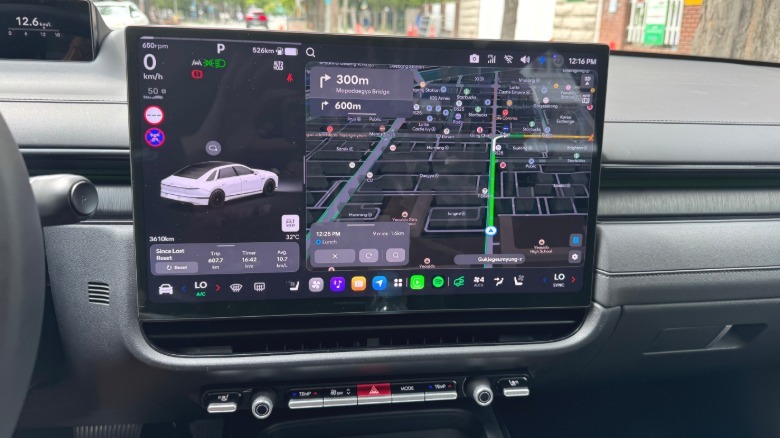 Logan K. Carter/ Jalopnik
I didn't have enough time to play with all the layouts and features, but from my experience the system felt intuitive enough after familiarizing myself with it, with crisp graphics and seamless, glitchless operation. Wireless Apple CarPlay also worked without flaw, and the option to toggle the system between light mode and dark mode is nice.
Stylish and comfortable interior appointments
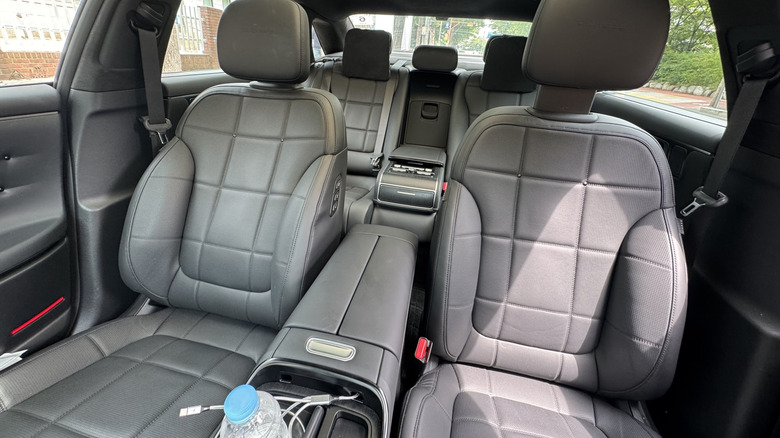
To me the Grandeur's interior looks great, with distinctive upholstery on the seats and the door panels, and a slick-looking dashboard with hidden climate control vents on the sides. Unfortunately those hidden vents can only be aimed and readjusted through the touchscreen, which is one of the most annoying choices an automaker can make in my opinion. Luckily fan speed, temperature, and climate modes can be easily adjusted without much brain power by using the row of physical toggle switches under the screen, which felt sturdy and nice to use. The interior materials look great, and everything above the arm rests feels great too, but everything below them is made of hard plastics. It's not a dealbreaker by any means, but it's evidence of the Grandeur not quite getting that luxury car designation.
The layout of the Pleos infotainment system necessitates a squat steering wheel that the driver looks over to see the driver's display, which some people may dislike, but as a card-carrying tall person, I had no issue with it. The wheel may look small and strangely shaped, but I didn't find myself wishing for a more traditional setup, even though I only had a short time with the car to get used to it. Shorter drivers may feel differently depending on their preferred driving position, but taller folks should have no issue.
 Logan K. Carter/ Jalopnik
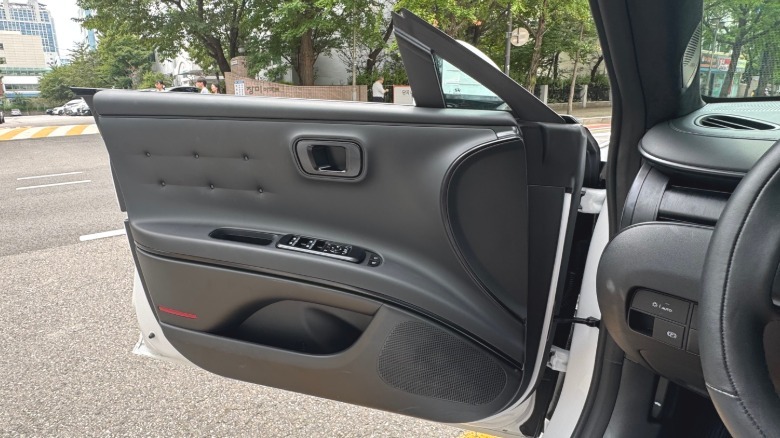
The front cabin felt massive, even to my 6-foot-8-inch tall, leggy frame. I didn't even need to scoot the driver's seat all the way rearward in order to achieve a comfortable driving position, which is a remarkable feat. The wide grid-stitched front seats were comfy and cushy without being totally devoid of side bolstering or support, and the door panels offer a fresh take on a classic button design reminiscent of Cadillac Broughams of yore. I only slid into the rear seats to take some photos, but I was met with ample legroom, and limited head room despite the Grandeur's distinctively lengthened roofline and D-pillar.
Despite ultra-modern looks and tech, the Grandeur is a big, comfortably numb sedan
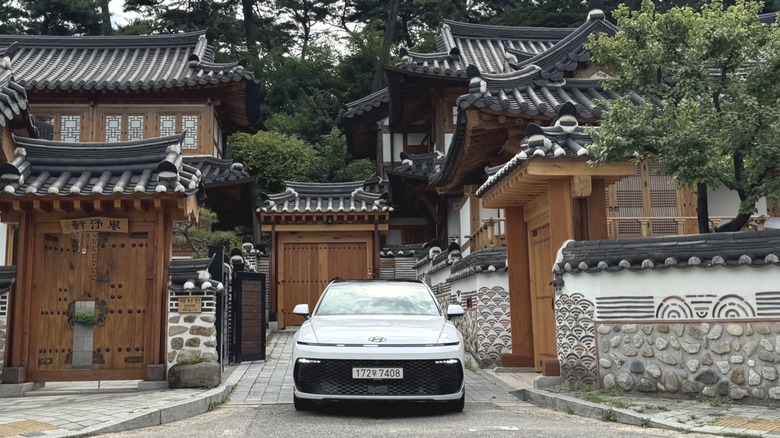
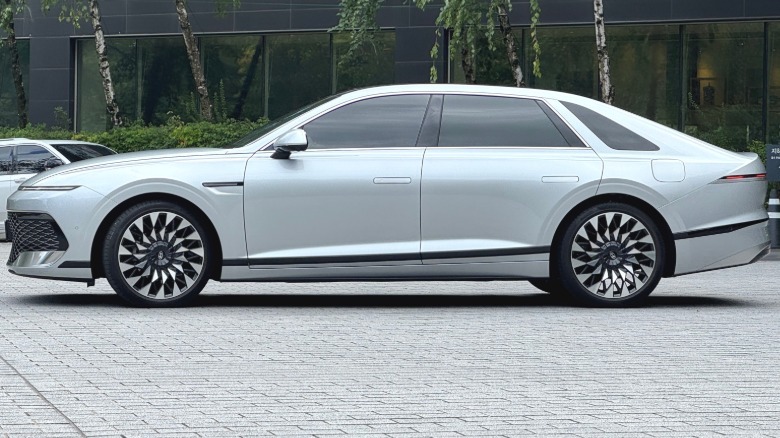
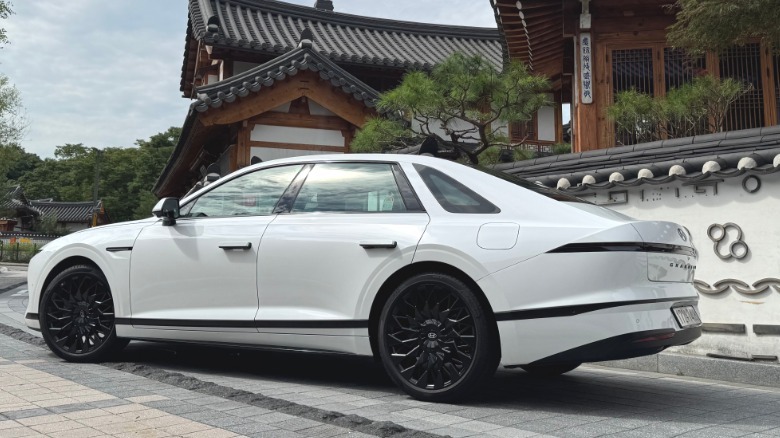
Looks are subjective, but I'd be remiss if I didn't discuss the Grandeur's striking exterior styling. The ultra-modern looks are achieved by remarkably thin lighting elements front and rear; the pre-facelift Grandeur had the slimmest taillights of any production car and they got even slimmer on the facelifted Grandeur that I drove. Beyond its lights, the seventh-generation Grandeur retains a signature styling cue of Hyundai's first-generation Grandeur of the late-1980s: the extra side window behind the frameless rear door, which necessitates the presence of a D-pillar. In my opinion, it creates a slightly awkward roofline, but I like that this feature distinguishes the Grandeur from most other sedans on the road.
Honestly, the Grandeur's driving experience felt more closely related to an old American luxury barge than a modern midsize sedan. From the pleated door panels to the square-stitched seat design to the floaty driving experience, it was a charmingly nostalgic package. It's just too bad the underpowered engine was also reminiscent of old gutless luxobarges.
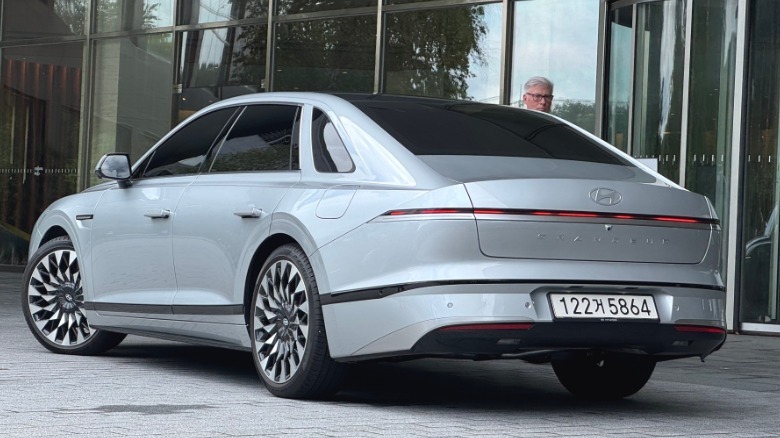 Logan K. Carter/ Jalopnik
The throwback driving experience of my base-engine test cars was juxtaposed with the ultra-modern design and Pleos Connect system, which helps make the Grandeur a charmingly spacious and comfortably numb near-luxury sedan. We're not missing out on much by not having the four-cylinder Grandeur in the U.S., but the absence of the V6-powered car might be a different story for carbuyers looking for affordable luxury and modern tech. For now, those buyers will have to stick with something like the Toyota Crown, or perhaps a used Genesis G80.