

Caltrans Announces 'Games Route Network' Improvement Project To Turn Existing Lanes Into Permit-Only Lanes For Olympic Athletes, Staff, Organizers
Time sure flies when the news cycle is filled with new and fresh hells every day, doesn't it? At this rate it seems like the 2028 Olympic Games will be here before we know it, and it's taking place in sunny Los Angeles, California. Aside from its arid weather, Los Angeles is famous for many other reasons, including its car-centric nature and notoriously congested roads, neither of which bode especially well for a global influx of athletes, coaches, and spectators. To address those concerns, the California Department of Transportation, or Caltrans, announced a slew of improvements to the Games Route Network or GRN, including a camera-enforced, permit-only nearly 360-mile roadway network for Olympic and Paralympic athletes, coaches, and other staff organizers.
Two years ago, LA announced a plan for a car-free 2028 Olympics, but it's not looking like that's going to be the case; instead, Caltrans will implement the GRN to ensure VIPs are able to get where they need to go. The improvements will include new pavement striping, traffic roadside signs, traffic signal upgrades, electrical infrastructure upgrades, smart cameras, CCTV systems, and ATM gantries.
Roadway improvements will span between the valley and San Diego County
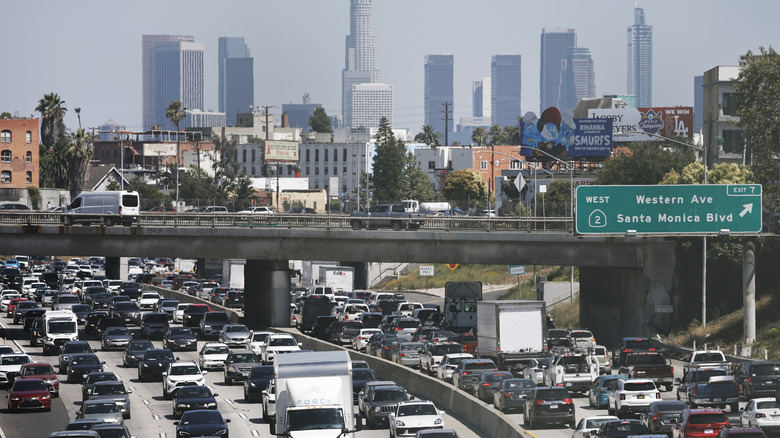
LA's infamous sprawl means the games will be spread between the Sepulveda basin north of Los Angeles down to San Diego county, and affect most of the freeways and highways in all regions. In LA County, improvements are planned for state routes 1, 2, 37, 91, and 164, as well as the 5, 10, 101, 105, 110, 134, 210, and 405 freeways. In Orange County, work is planned for state routes 55, 57, 73, and 91 as well as the 5 and 405 freeways, while work in San Diego County is limited to the 5 freeway in various locations that aren't yet available.
UCLA transportation researcher Juan Matute told KTLA5 News, "They're not making extra lanes. They are taking existing lanes and restricting public use of those lanes. There will be some on-street lanes, like Sunset Boulevard by UCLA where the [Olympic] Village is, and many lanes on freeways — often converted HOV lanes that will be fitted with cameras that are designed to have automatically [determine] which vehicles have those permits."
These lanes will be painted blue and marked with "LA28" labels on signs, and the fine for violating the restrictions could be up to $300, with enforcement planned to involve new smart cameras, wireless communication systems, and CCTV. For now, the only timeline Caltrans offers for these roadway improvements is 2027, but check its website for more details.