

Ford Fathom Will Be More Than Just An F-150 Lightning Do-Over
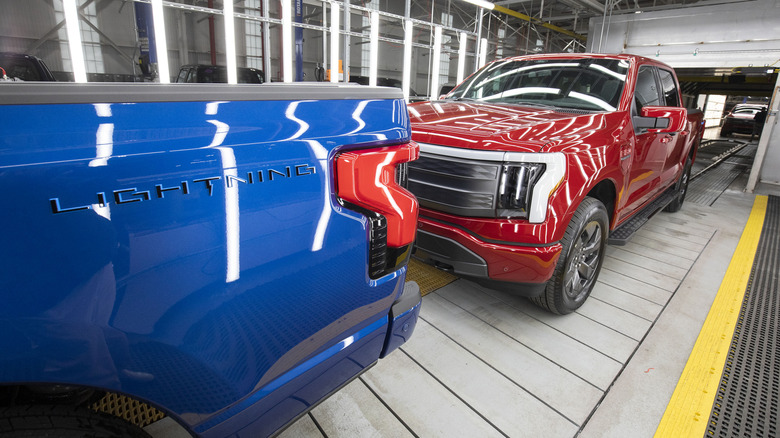
They're both electric trucks made by Ford in the U.S., but that's one of the few things the new Ford Fathom and retired Ford F-150 Lightning have in common. The Fathom is not a direct replacement for the F-150 Lightning, and it isn't even designed for the same buyer, as Ford has fundamentally changed its approach to making a utilitarian EV.
This much should be clear from one of the few definite morsels of information Ford has thus far announced ahead of the Fathom's full launch in 2027: The MSRP will start from $28,350 and buyers should expect a destination charge on top of at least $1,800. In case you've forgotten the jumpy-stock-market-like pricing of the F-150 Lightning, it was introduced in 2021 with a suggested price before destination charges of just under $40,000, rocketing to $60,000 nearly two years later. And that's before we mention price-gouging by some dealers.
Aside from the sticker price on the windshield, and although we don't know any other key data about the truck, the Fathom is shaping up to be fundamentally different from the F-150 Lightning. Where the latter is based on the proven F-150 body-on-frame construction and designed to be as tough and useful as a gas-powered F-150, the Fathom — by Ford's own reckoning — sounds suspiciously like a regular car with a load bed out back. And it's designed from the ground up as an EV.
Saying that, Ford hasn't deigned to tell us the Fathom's EPA range, battery capacity, towing capability or power output. But hey, it has BlueCruise and Apple CarPlay; what more do you want?
The Ford F-150 Lightning didn't spark an EV revolution, but it wasn't a complete failure
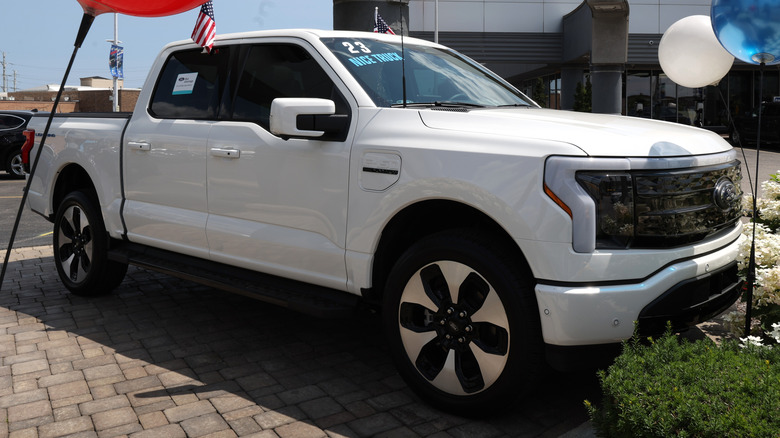
Initial demand for the F-150 Lightning was strong, leading Ford to bullishly plan for production of 150,000 vehicles a year, and for a significant investment to help move the company toward a future with a lot more EVs in it. But the F-150 Lightning cost a small fortune to develop, and its core remit resulted in it being expensive to produce, too. How could it not be, given the hardware required to deliver 580 horsepower, 10,000 pounds of towing and yet up to 320 miles of EPA range? We shudder to think how much the Lightning's 131-kilowatt-hour battery pack cost on its own.
Keen buyers may have been willing to pay a premium to be among the first with an all-electric F-150, but sustained demand never materialized, so Ford's EV division — Ford Model e — struggled to make a case for its own existence. Across the world, confidence in EV pricing and residual values plummeted thanks in part to Tesla's price reductions in 2023 and 2024, while significant regulatory changes — including the Trump adminstration killing EV tax credits — effectively derailed the F-150 Lightning project, making large EVs undesirable to buy and cost-ineffective to make. Unsurprisingly, demand for the F-150 Lightning waned and Ford changed tack, tossing the product roadmap in the wastepaper basket and embarking on a new plan involving smaller, more affordable EVs.
Despite all that, the F-150 Lighting brand is probably too strong to die, and it promises to be rejuvenated as a range-extended EV instead, using a gas generator on board and delivering more than 700 miles without stopping. The economics of making such a thing fully electric just doesn't add up.
Making the Ford Fathom a defining moment in EV adoption
It's a little curious that Ford has led the pre-launch hype surrounding its new Fathom with little other than its price. Sure, it has also told us that it will have more interior space than a Toyota RAV4 for up to five people, will use cheap-to-make and durable lithium iron phosphate (LFP) batteries, have a frunk and bidirectional charging, but that list could describe nearly any new EV. Ford has told us a lot more about what underpins the Fathom — namely its new Universal EV Platform. The construction of this is vastly different from that of the F-150 and its ilk, as it utilizes large aluminum "unicastings" to replace what would traditionally be stamped or welded steel components.
Ford has spent $2 billion gutting and rebuilding its Louisville Assembly Plant to accommodate a new way of manufacturing, in which three sub-assemblies — the front of the vehicle is one; the rear is the second; and the central section incorporates the structural battery and cabin — are simultaneously manufactured and come together later in the plant. Meanwhile, helping to keep control of costs is Ford's own battery factory in Michigan. The new production setup using both these facilities will have the capability to spit out different vehicles as required, though the Fathom is the guinea pig for the concept.
And given Ford's comment about the Fathom's aerodynamics, saying they'll help it achieve 15% longer range than traditional upright vehicles of this type, perhaps the Fathom will be as cute as a guinea pig, too. With a promise that first customers will get their Fathoms in 2027, we won't have too long to wait. Just don't expect it to be an F-150 Lightning with a new name.