

Car Vs. Airplane Engines: Why They're Built Differently
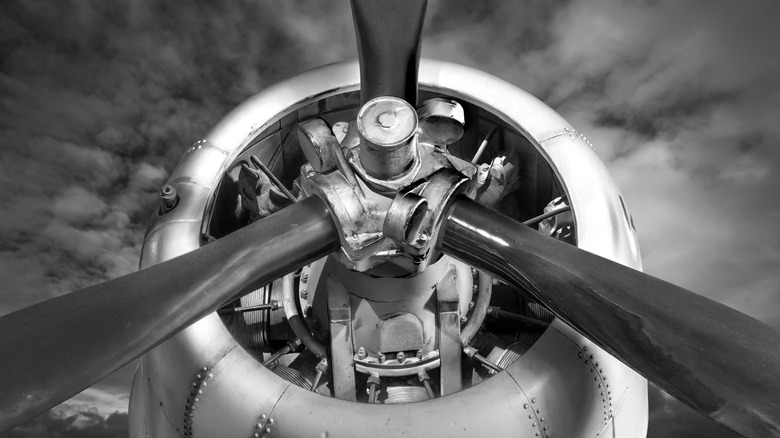
That lump under your car's hood? Yep, that's an engine. Duh, right? That thing spinning the propeller on a Piper J-3 Cub? Also an engine. That said, they're about as similar as a catapult and a suspension bridge. It makes sense, too. Your Toyota Camry hardly operates in the same conditions as an airplane. Even small, light, single-engine piston airplanes have to contend with the challenges of flight and the dangerous, often deadly consequences of in-flight failure.
It's no surprise, then, that piston airplane engines and car engines differ so wildly in construction. Sure, both internal combustion applications run on fuel, involve a combustion cycle with strokes, and produce emissions. However, unlike cars, airplanes use much more of their engines' overall available power output to take off and reach cruising altitudes than cars do to get up to speed.
So what else makes them different in design? Well, beyond the dissimilar power demands, piston airplane engines incorporate redundancies you won't find in your typical passenger car, like two spark plugs per cylinder and dual magnetos. Oh, and you better believe the extra demands mean different maintenance rituals. Frankly, you'd almost certainly cry if you had to tear down your Honda CR-V's engine as often as a piston airplane engine needs an overhaul. Well, that or take the bus.
Power, lightness, lift

So, back to the engine in your car. Suck, squeeze, bang, and blow. Not an adult title, but rather how your internal combustion engine consumes air and fuel, prompts a controlled explosion with spark, and sends exhaust packing as part of a four-stroke cycle. It's the same sort of thing you'd find in a piston aircraft engine, albeit with a whole lotta vital differences. Not just to make things difficult, mind you. Airplane engines have to be different for the sake of safety, function, and reliability under flight-specific conditions.
For starters, your typical passenger car engine uses an inline or V-configuration engine operating at well below its maximum power output to drive at city and highway speeds. An airplane engine uses much more of its available power to take off and climb, often between 70% and 100% compared to a car's much more leisurely effort. Also, while your daily driver's engine is likely a liquid-cooled, small-cylinder application, a small airplane will often use a slow-running, air-cooled setup with large cylinders to achieve the necessary torque requirements.
Piston airplane engines also make use of electrical redundancies you won't find on your typical grocery getter or weekend runabout. Most current production ICE vehicles have one spark plug per cylinder (part of the 'bang' in our four-stroke cycle). There are exceptions, of course, like modern Hemi V8 engines and their 16 spark plugs. Why? In airplane engines, this is a necessary redundancy. Two magnetos can fire a dual plug setup for every cylinder. An air-cooled engine means less cooling-system weight, while electrical system redundancy means less reliance on the airplane's electrical system while in flight.
Different stakes, different maintenance
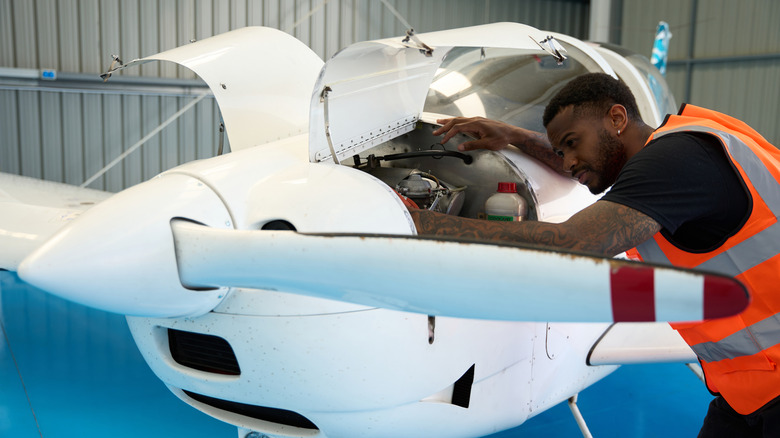
We can hear you already. 'But wait! DIYers get away with automotive engine swaps in airplanes all the time!' Well, you're not wrong. As it turns out, not even planes are safe from an LS engine swap. An LS-swapped bird sounds pretty awesome, but it admittedly might not be everyone's cup of tea. Still, the standard, purpose-built piston engine airplane application is a tried and true way to fly. Your LS engine in your C5 Corvette could last a long, long time without a total rebuild. Then again, it's not the typical mill you'll find under the cowling of an airplane that can't simply pull over onto the shoulder.
As such, a piston engine in an airplane has different maintenance requirements than that of the cars we drive every day. Depending on the manufacturer's recommendations, a small aircraft engine may allow for a 2,000-hour time between overhaul (TBO). Accounting for a combination of stop-and-go driving and highway cruising, that 2,000 hours behind the wheel of your car could equate to between 60,000 and 70,000 miles. Yikes. Hardly the odometer reading you'd want before tearing into your car's engine. It's important stuff, really. Failures can be costly in the air, and tragically, small plane crashes happen more often than you might think.