

The First Jail Sentence For Speeding Came In 1904 (For A Speed You Could Reach On Foot)
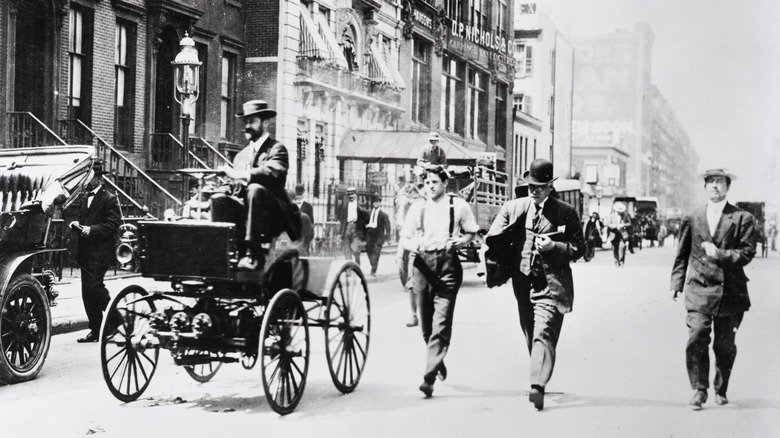
It doesn't matter how safe of a driver you think you are — you've probably let your speed drift above the posted limit at least once in your life. It happens, and speeding tickets and citations happen, too. After all, heaps of American drivers think speeding is okay as long as they're not alone in the practice. Push the envelope too much, though, and you might find yourself in handcuffs. It's the sort of thing that might make you ponder when a speeding ticket becomes a reckless driving charge. Today's jail-bound super speeders come from a long line of careless drivers, and it's been a long time since the first American motorist ended up in a Rhode Island jail cell for driving too spiritedly.
As of August 2026, it's been 122 years since a motorist in an early automobile received the country's first formal jail sentence for speeding on public roads. As you might imagine, the cars of the early 1900s were hardly fast. They were so sluggish that the driver who went to jail for their then-reckless pace was traveling at a meager speed of 15 miles per hour. So slow, in fact, that a pursuing police officer could have (theoretically) caught the motorist on foot with sufficient hustle.
How a driver went to jail for the first speeding crime 122 years ago
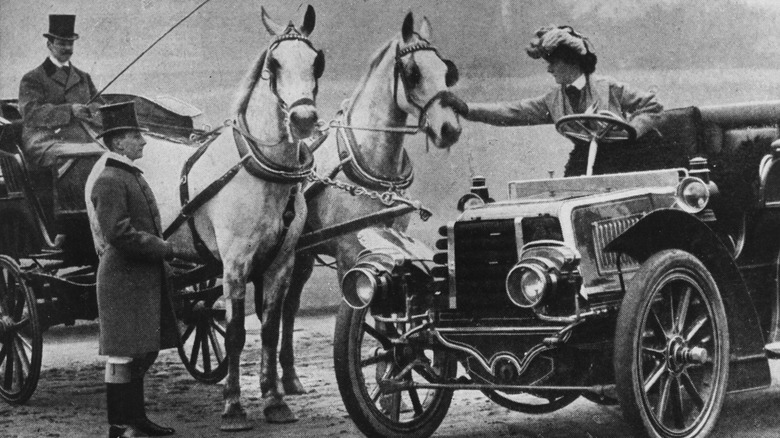
In August 1904, a Rhode Island judge passed down a jail sentence for a crime a motorist committed behind the wheel of an early automobile. The judge, one Darius Baker, sentenced the driver to five days behind bars for speeding at 15 mph, of all things. If that wasn't hilarious enough, the average physically-active adult can hit around 15 to 20 miles per hour in a dead sprint.
The finer details of this arrest — including the offender's identity and just what kind of car they were driving — are a bit thin. But it's possible to make some inferences for the latter. At the time of the driver's jail sentence, the most popular and best-selling car in America was the Oldsmobile Runabout (with its characteristic curved dashboard). The 95-cubic-inch single cylinder engine was peppy enough to coax the Oldsmobile to 20 miles per hour. Slow as it sounds, it was apparently swift enough to land a driver in handcuffs during that time.
It might be the first formal jail sentence for speeding, but it's certainly not the first time a driver got in trouble for it. On January 28, 1896, Walter Arnold attracted the attention of police in Kent, England, for breaking the speed limit aboard a new-fangled motorcar. Mind you, the Rhode Island speed freak's 15 miles per hour is blisteringly quick compared to Arnold's pace. Arnold went careening past a bobby at an eye-watering 8 miles per hour aboard a motorized vehicle. The speed limit in Kent was 2 mph at the time. So, naturally, the police officer chased the miscreant on a bicycle and ultimately wrote him a citation, doling out justice for his crime.
Automobile traffic laws were still a brand new thing
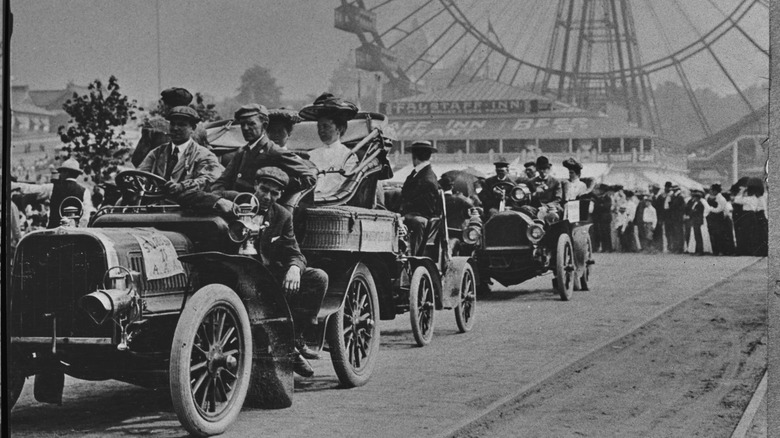
Judge Baker clearly wanted to make an example of the Rhode Island speeder, given that traffic laws were still being newly developed in 1904. Granted, the fuzz had been busting travelers for speeding horse-drawn carriages for centuries before Baker sent the driver to jail. In 1901, Connecticut became the first state to pass speed limit laws. Those regulations established 12-mph limits in cities and 15-mph limits on rural roads. It wasn't until 1903 that New York introduced the nation's first comprehensive highway code.
Today, 122 years after the first lead-footed motorist found themselves behind bars, drivers are still going to jail for speeding. Some states refuse to take it easy when it comes to breaking that posted speed limit. Take Oklahoma, for example; the Sooner State is so hell-bent on managing speeders that it posts no tolerance speed limit signs around the state's highways. And in Florida, speed freaks can go straight to jail for any speed above 100 miles per hour or 50 miles per hour over the posted speed limit.