

5 Weird And Wild Child Car Seats From Back When We Were Figuring Out How Safety Worked
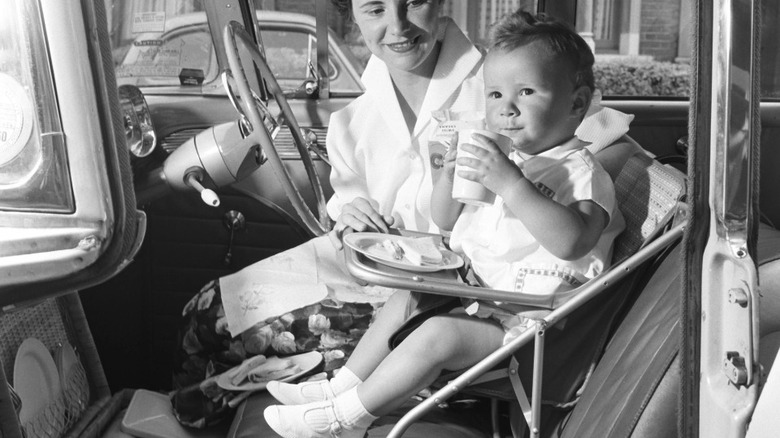
If you're old enough, you probably remember riding in the cargo area of a station wagon or the bed of a pickup as a child. No seatbelts, no airbags, nothing to hold on to, except for the dog, who also rode back there. We've always been confused to see other Gen Xers bragging about this on social media. Why is it such a flex that our parents evidently didn't care whether we lived or died? It should come as no surprise, then, that this "let nature take its course" approach to child safety would be reflected in early child car seats.
In 1971, the U.S. federal government launched regulations for car seats, deciding, correctly, that many of our parents couldn't be trusted to make wise decisions regarding their children's safety. More regulations and state legislation would follow. Automakers themselves would show some initiative in the 1990s with a standardized locking system for car seats. Nowadays, depending on which guidelines or state laws apply to you, you may be keeping your kid in a booster seat until they're 12. But before those regulations, it was the wild west when it came to child safety.
One very early child car seat around the turn of the 20th century was mounted on an unbelievably dangerous part of the car. Separately, there were seats that did not anchor to the car at all, one the child could stand in, and one sketchy bassinet. There was even a baby hammock in the mix.
Using the baby as a human shield
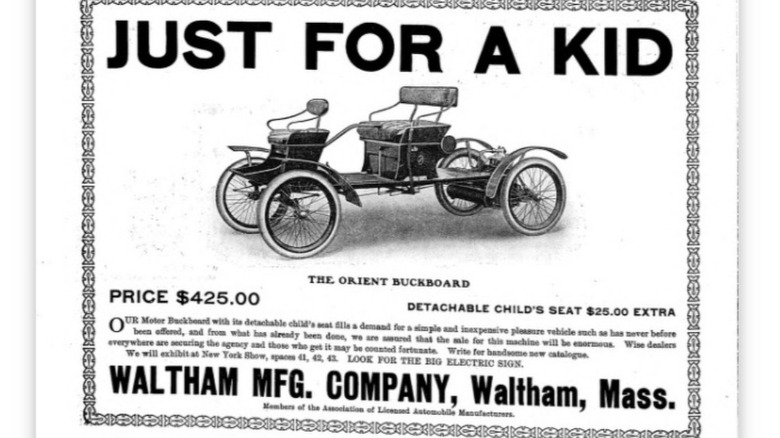
The motorized "buckboard" was a common type of automobile around the turn of the 20th century. It was basically a flat platform on wheels with a small engine on the back, a bench seat in the middle, and a steering tiller in front. The bench seat was big enough for Mom and Dad, but what if they wanted to take Junior with them? In 1904, the Waltham Manufacturing Company thought it had a solution.
The January issue of Motor Age carried an ad that year for the Orient Motor Buckboard with a detachable child's seat that cost $25 extra. Where was the seat attached? Right to the front of the vehicle. By "front," we don't mean next to the bench seat. No, it was attached to the very front, in front of the steering tiller, right between the front wheels. Who needs a bumper when you have a child? That's much different than today, when experts specify not only that the child seat should go in the back seat, but which part of the back seat.
Since there was no windshield on the Orient Buckboard to speak of, we're wondering if the idea here was to use the baby to keep the bugs off of Mom and Dad. But seriously, we can't imagine how anyone thought this would be a good idea. Whatever the case, it makes us feel a little better about being tossed into the bed of Dad's pickup truck.
Why settle for a seat when you can have a baby hammock?
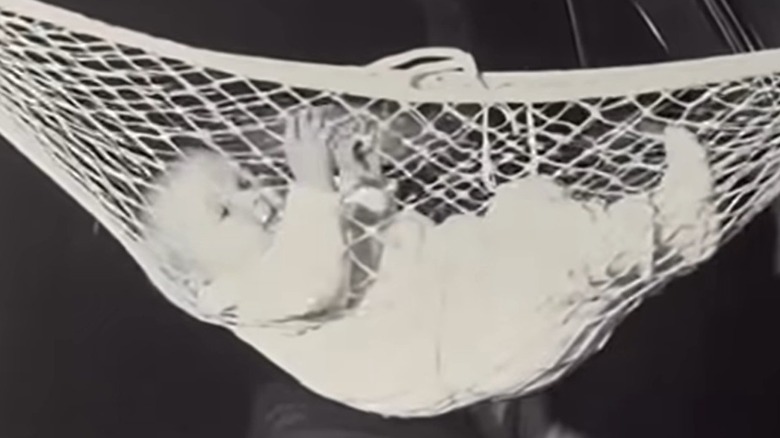
Everyone likes to lie in a hammock, don't they? We're guessing babies would tell us that they enjoy it, too, if they could talk. So, why not string a tiny hammock above your back seat so that baby can swing away? Because you have common sense, that's why. There seems to have been a shortage of common sense, though, when it came to child safety in the Wild West days of car seats.
Enter the "Lull-A-Baby" car hammock, which retailed for only $6.95. Believe it or not, the company pitched safety as one of its selling points. "Keep Baby SAFE with a 'Lull-A-Baby' Car Hammock," the headline on one ad read. It touted the hammock as the "safest, most comfortable car bed ever made." That sounds absurd, but there was also a time when tobacco companies would advertise their cigarettes as "healthier" than other cigarettes, claiming that doctors preferred their brands.
Well, there was at least one doctor who seemed to see through this nonsense. Dr. Michael Henderson was interviewed by the Australian Broadcasting Company in 1970 for a report on child car seats. When asked about the hammock, he said, "I don't like it at all," then went on to demonstrate how it could smack the baby's head against the car ceiling. This contraption obviously wouldn't fly in today's age of tightening regulations around child seats.
Mother-friendly, doctor approved
If you think holding a smartphone is distracting while driving, try holding a crying baby while merging onto a busy freeway. Actually, don't try that. Please don't. Anyway, mothers needed a place in their automobiles to put their babies, especially if they were driving. That was really the point of all these pre-safety era car seats. Safety was almost a secondary concern.
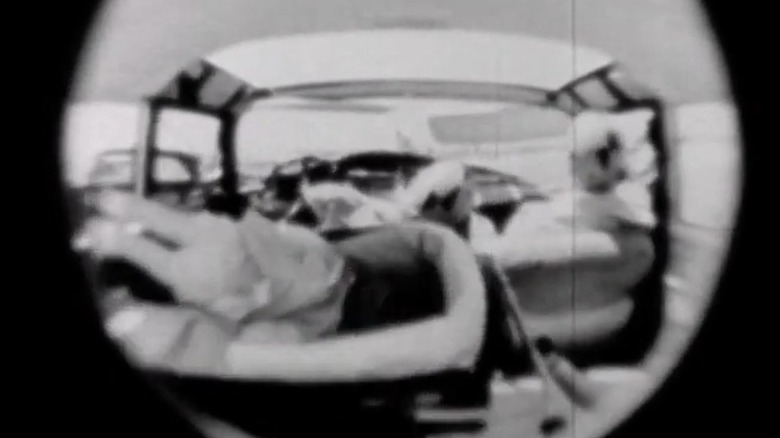
That's why Gordon Motor Crib marketed their bassinet as "More comfort for Baby — more pleasure for mother." What really strikes us is the unintentionally hilarious copy in the ad for the bassinet. "'The safest way' the doctors say," it brags. Who are these incompetent doctors, and are they the same doctors who said the hammock was the safest way? Another selling point is that it "takes up no useful space." Heaven forbid that we should waste any useful space on something as unimportant as a baby. Otherwise, where would we put the dog? The ad also says it's "recommended by baby specialists." How does one become a "baby specialist?" Is there a certification you can get? When these people went to college, did they major in babies?
To be fair, this bassinet does seem to be the least deadly of all the examples we list here (even though the image above shows it nearly ejecting a test doll during a 30 mph impact). Dr. Henderson, quoted earlier, cited bassinets as a safer alternative to the hammock, as long as the bassinet is anchored to the seat and the baby is restrained.
Who needs anchors?
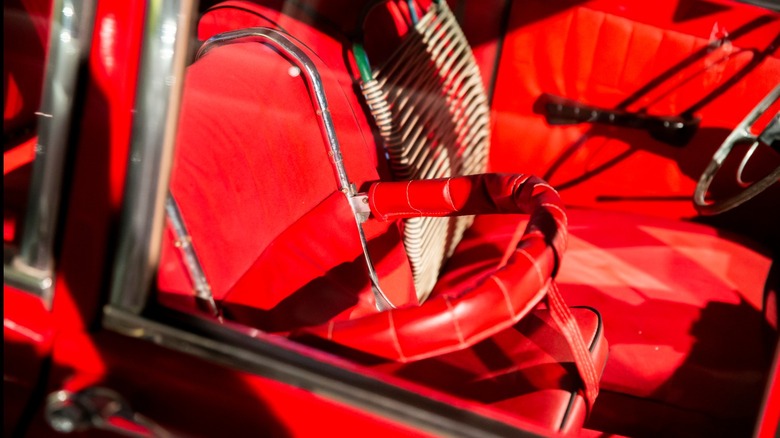
One common type of car seat that emerged in the 1930s could be hung on a regular car seat by means of a couple of hooks that fit over the top. The seat was designed to hold the baby at a height where it could see out the windows. One version that the Bunny Bear Company put out actually had a toy steering wheel attached to it so the little one could pretend to drive. Safety aside, we're not sure we agree with this approach. We have enough trouble with the spouse trying to backseat drive. We don't need the baby chiming in, asking why we didn't take a shorter route.
The real problem with this seat is that it was not anchored to the car at all. But hey, at least the baby could see over the dash.
Once again, the ad copy is comedy gold. An ad for the Bunny Bear seat talked at length about how the seat was "safe" because the baby wouldn't get splinters from the toy steering wheel. We're no safety experts, but when your car is hurtling down the interstate at 75 miles per hour, we don't think "splinters" should be your main concern.
Who wants to sit all the time, anyway?
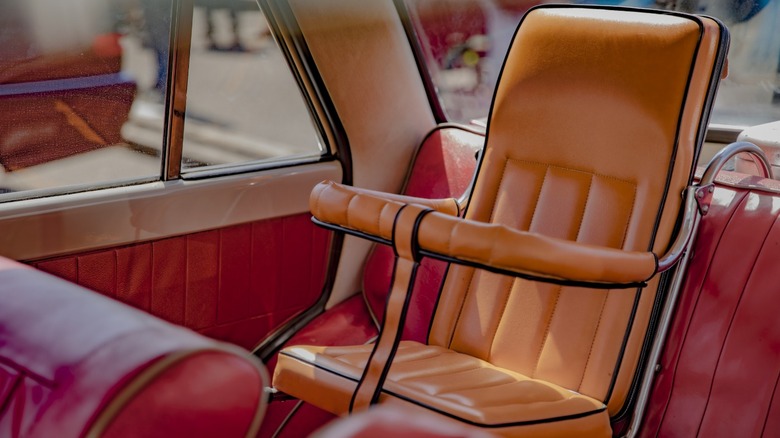
Most people don't like to sit for too long because it gets uncomfortable. Do you know who really doesn't like to sit for very long? Toddlers. So, Montgomery Ward thought it would be a good idea to come out with the "Tiny World Deluxe Sit-N-Stand Car Seat" in the mid-1960s. After all, as any parent knows, you should indulge a toddler's every impulse, especially in a moving vehicle.
The Sit-N-Stand had a similar design to the Bunny Bear seat, except it looked a little sturdier, as it was made for the child to be able to stand in it. It also had extra cushion for added comfort on bumpy rides. Dr. Henderson in the ABC report cited earlier showed how you could sort of anchor a similar product to the seat with a seat belt, which would have made it safer as long as the child was seated and restrained. And there was a restraining strap for the child, but it would have been useless if the child was permitted to stand up.
We can breathe a sigh of relief that the world has come to its senses regarding child car seats. Do you belong to the generation that rode in the back of their parents' station wagons? What other incredibly dangerous things were you allowed to do? Let us know in the comments.